
The book “Slow Productivity The Lost Art of Accomplishment Without Burnout” by Cal Newport.

An excerpt is available on the author’s website:
“When I first encountered the story of John McPhee’s long days looking up at the leaves in his backyard — a scene from a time long past, when those who made a living with their minds were actually given the time and space needed to craft impressive things.
“Wouldn’t it be nice to have a job like that where you didn’t have to worry about being productive?”
In the summer of 1966, toward the end of his second year as a staff writer for The New Yorker, John McPhee found himself on his back on a picnic table under an ash tree in his backyard near Princeton, New Jersey. “I lay down on it for nearly two weeks, staring up into branches and leaves, fighting fear and panic,” he recalls in his 2017 book, Draft No. 4.
It couldn’t have existed, however, without McPhee’s willingness to put everything else on hold, and just lie on his back, gazing upward toward the sky, thinking hard about how to create something wonderful.
Productivity:
perhaps knowledge workers’ problem is not with productivity in a general sense, but instead with a specific faulty definition of this term that has taken hold in recent decades.
People were overwhelmed, but the sources of this increasing exhaustion weren’t obvious.
…
Or maybe what we’re really seeing is the inevitable collapse of “last-stage capitalism.”
| SLOW PRODUCTIVITY A philosophy for organizing knowledge work efforts in a sustainable and meaningful manner, based on the following three principles: Do fewer things. Work at a natural pace. Obsess over quality. |
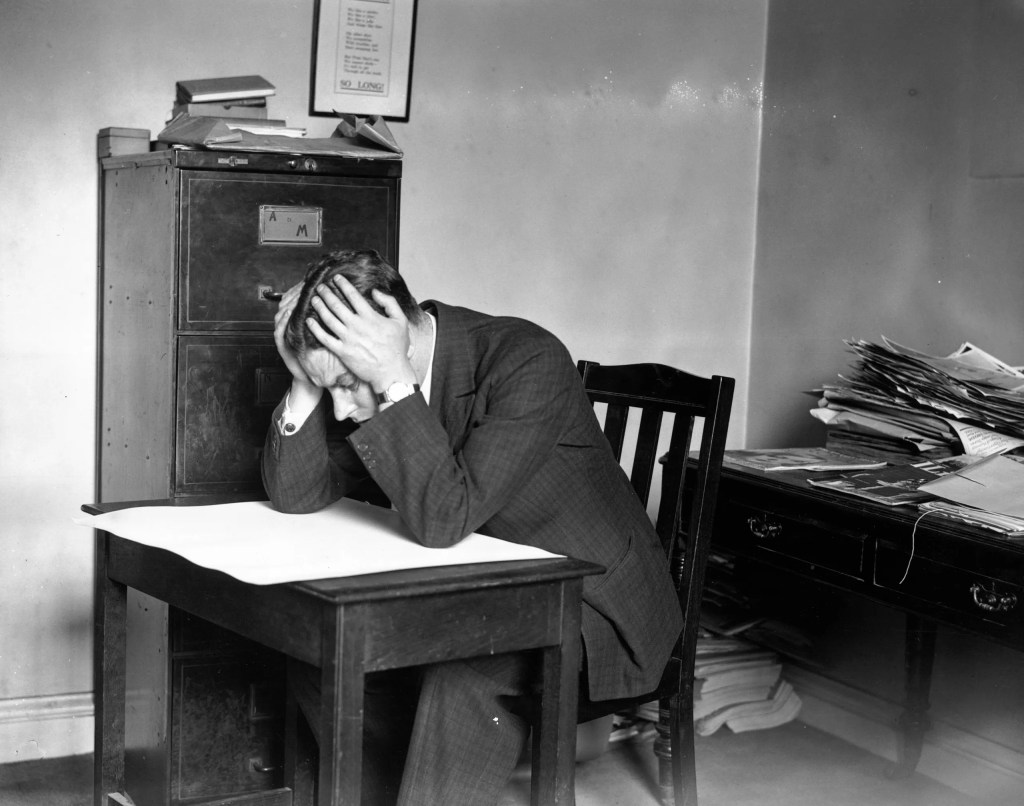
This philosophy rejects busyness, seeing overload as an obstacle to producing results that matter, not a badge of pride. It also posits that professional efforts should unfold at a more varied and humane pace, with hard periods counterbalanced by relaxation at many different timescales, and that a focus on impressive quality, not performative activity, should underpin everything. The philosophy’s core principles include, providing both theoretical justification for why they’re right and concrete advice on how to take action on them in your specific professional life, regardless of whether you run your own company or work under the close supervision of a boss.
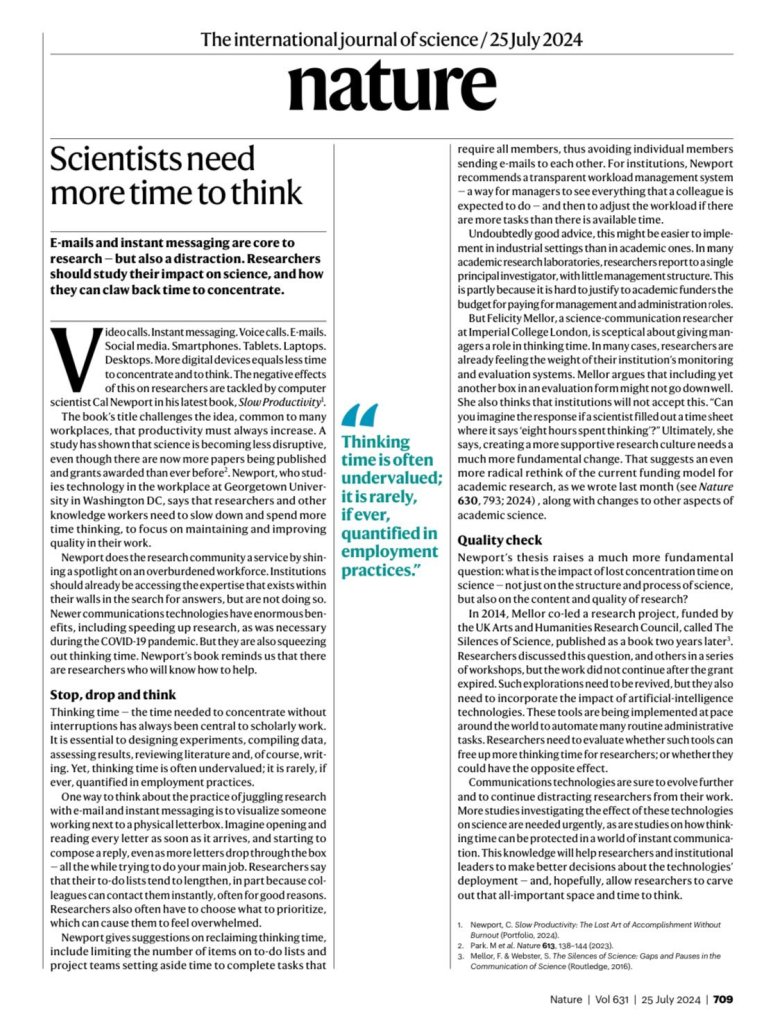
The book inspired the Nature review “Scientists need more time to think” , which got a lot of attention in science communities.
Thinking time — the time needed to concentrate without interruptions has always been central to scholarly work. It is essential to designing experiments, compiling data, assessing results, reviewing literature and, of course, writing.
Thinking time is often undervalued;
it is rarely, if ever, quantified in employment practices.
Newport’s thesis raises a much more fundamental question: what is the impact of lost concentration time on science — not just on the structure and process of science, but also on the content and quality of research?
Slow Productivity was discussed in 2022 by Cal Newport in the New Yorker
The “Core Idea: Slow Productivity” video by the author on “burnout”
 Surtil :
One response to “the lost art of accomplishment without burnout”
[…] The full title is “Slow productivity worked for Marie Curie — here’s why you should adopt it, too“, and yes, it is referring to the book from Cal Newport, I already mentioned a while ago. […]
LikeLike