
“Civil society comes of age in economics: Tracking a century of research“
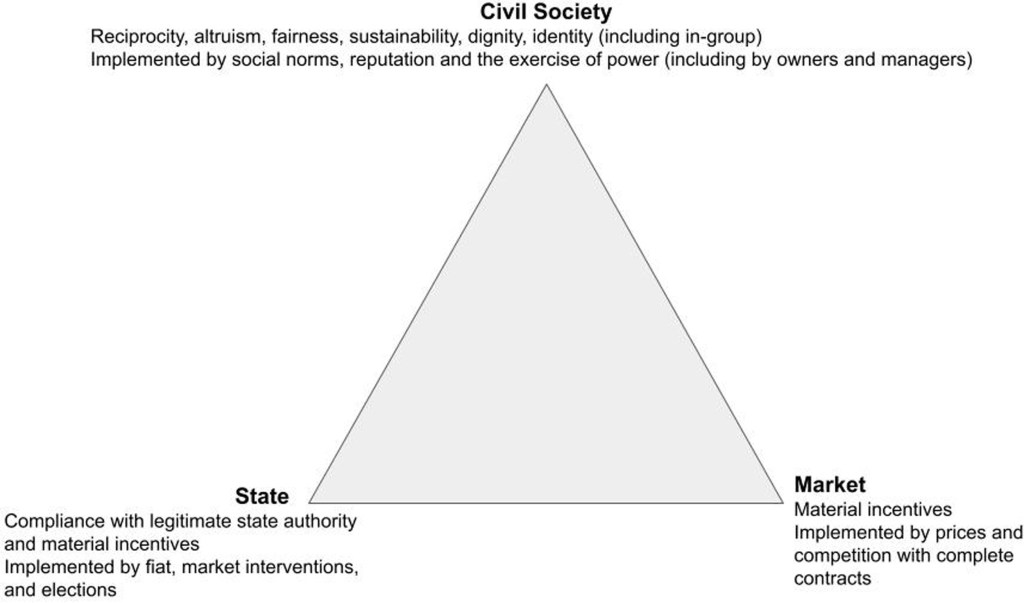
Using topic modeling on the corpus of papers published in seven leading economics journals since 1900, we study the evolving emphasis in research on themes relating to the state, markets, and civil society, the latter referring to families, firms as organizations, other private organizations, neighborhoods, and identity groups. We document a shift between 1900 and 1970 away from research on state-related topics towards the market, even as the economic importance of the state was growing. This was followed by a substantial movement away from market topics towards topics related to civil society. We associate the first shift with the mathematical formalization of the Marshallian paradigm. The subsequent increased attention to civil society coincided with novel research questions and empirical methods including experiments and the use of large datasets. Since the middle of the last century advances in game theory and the economics of asymmetric information also facilitated the extension of economists’ research agendas to encompass themes central to economic behavior in civil society, including other-regarding preferences and social norms as well as strategic interactions not covered by complete contracts.
Economic research has broadened beyond his dichotomy of the “anonymous atomism of the price system” and “state action” to encompass what we will call “civil society”.
The turn towards civil society themes in economics is consistent with two propositions.
The first is that much of what we think of as the economy consists of non-market interactions and exchanges under incomplete contracts within the firm, and in labor, credit, residential housing and other markets.
Second, in these and in other settings, ethical and other-regarding preferences along with self-interest are important in explaining behavior and in supporting mutually beneficial exchanges.
We see a significant movement in economic research between 1900 and 1970 away from state-related topics towards market topics, even as the economic importance of the state was growing. This shift was slowed, but not reversed, by the war economy of the early 1940s. The period since 1970 witnessed an equally large and uninterrupted shift towards civil society topics, primarily at the expense of market topics.
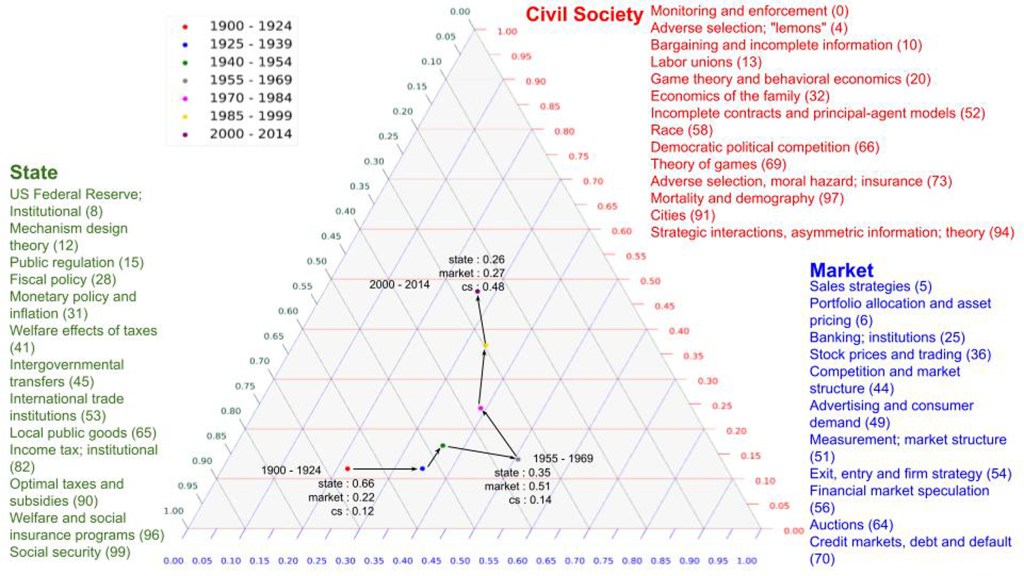
The evidence in suggests that the shift from state to market was associated with the increased use of mathematics, especially constrained optimization by (for the most part) non-strategic actors. This constituted a change in method – roughly the mathematization of Marshall – rather than any novelty in the kinds of economic behavior under study.
Changes in method, including models of limited information and strategic interaction, along with advances in quantitative methods was also a hallmark of the subsequent shift in research towards civil society themes.
The shift in focus has been facilitated by exploiting the mutual gains from exchange across the social science disciplines. Since the late 1960s this occurred both by the application of conventional economic tools to an expanded set of topics and also through the application of novel insights from other disciplines to the conventional subject matter of economics (on gift exchange, and on the exercise of power in the firm).
 Surtil :