
“Power and profit drive what we eat: here’s why the food system needs a revolution”
Decades of corporate control have shaped diets, harmed farmers and strained the planet — transforming the system will take collective action.
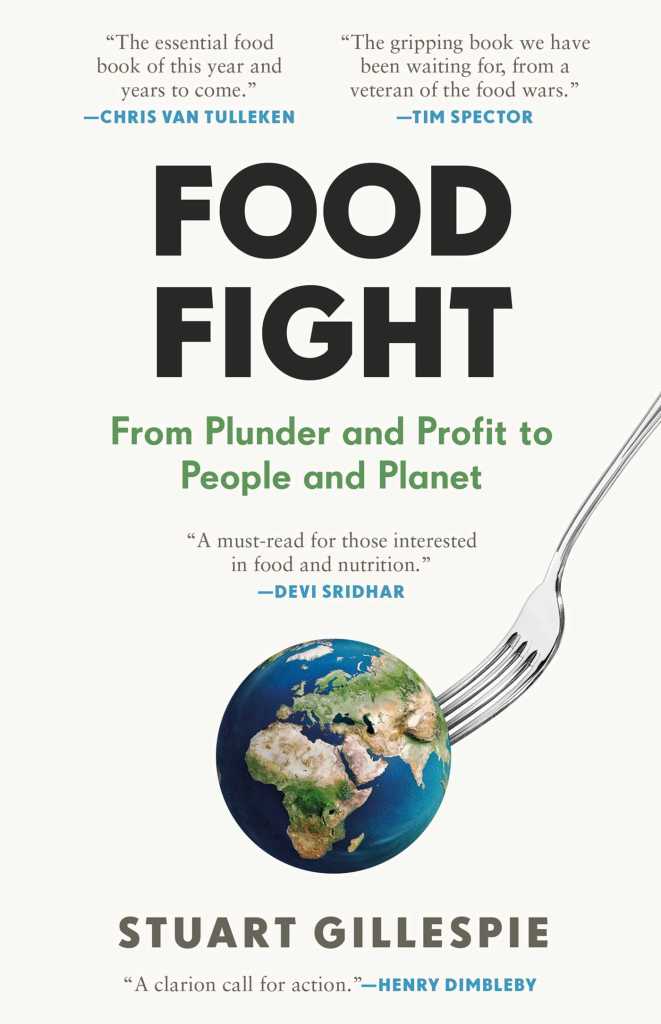
Food Fight: From Plunder and Profit to People and Planet Stuart Gillespie Canongate Books (2025)
Stuart Gillespie’s book Food Fight offers a sharp diagnosis: a global system once designed to stave off famine through cheap, calorie-dense foods now fuels obesity, disease, environmental harm and inequality. Drawing on four decades of experience in global nutrition and policy, Gillespie argues that tinkering won’t do. Fixing the system will take nothing less than a revolution.
The statistics that Gillespie presents in this eye-opening book are shocking: poor diet now accounts for one-quarter of all adult deaths worldwide (more than 12 million a year); malnutrition in all its forms affects one in three people; and ultra-processed foods (UPFs), which are highly profitable to corporations, are linked to as many as one in seven premature deaths in some countries. Moreover, food production generates roughly one-quarter of global greenhouse-gas emissions.
Gillespie attributes many of these issues to corporate greed, weak regulation by governments and complicit international organizations. The result is a system that prioritizes profit, with people and the planet paying the price.

Credit: Thom Lang/Getty
The book traces the shaping of modern food systems to colonialism. Agriculture during colonial times was extractive, and geared towards the production of profitable items, including sugar, tea, coffee and cocoa, rather than nourishing local populations. Gillespie argues that this logic of plunder persists in today’s corporate-dominated system, in which a handful of transnational firms — ‘Big Food’, ‘Big Sugar’ and ‘Big Choc’ — control nearly every stage of food production, distribution and consumption. Their pursuit of profit drives the manufacture of ultra-processed products that are designed to be addictive and have a long shelf life and strong appeal, while simultaneously shifting social and environmental costs to the public.
One of the most damning sections of Food Fight deals with the health impacts of this corporate control. Gillespie emphasizes that malnutrition is no longer just about hunger — it’s about the poor quality of diets. The number of people with obesity, diabetes, cardiovascular disease and diet-related cancers is soaring worldwide. At the same time, undernutrition and micronutrient deficiencies persist — the ‘double burden’ of malnutrition.
Food Fight tackles a crucial issue at an important moment, offering rich detail on how our food is produced, traded and consumed, and why the system must change. Yet its arguments are at times weakened by an anti-business rhetoric and the book fails to sufficiently acknowledge the key role of small producers in low- and middle-income countries in feeding the majority of the global population. The book is replete with references and scientific studies. Yet some of Gillespie’s assertions, especially about corporate motivations, are made without evidence. Nonetheless, readers will come away better informed about what is needed to build a system that serves both people and planet.
 Surtil :