
“From Soundwaves to Brainwaves: The Transformative Power of Music”
The human brain physically embodies rhythmic sound in a remarkable
symphony that has the power to heal.
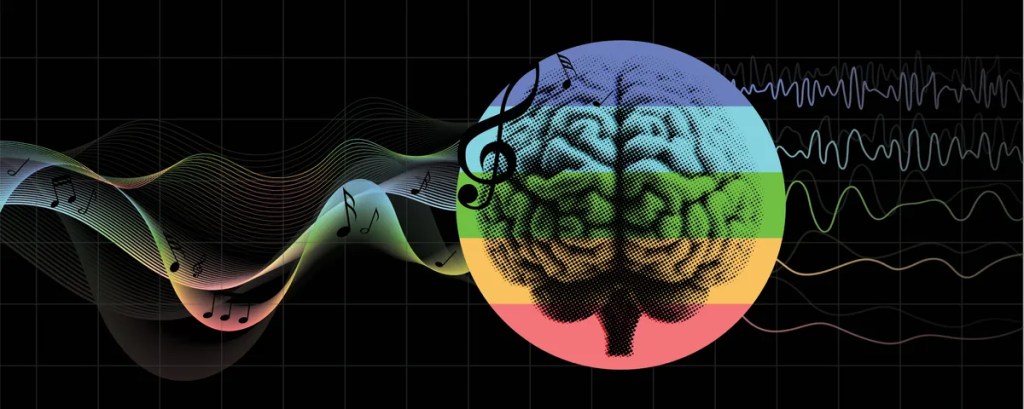
People resonate to music.
—Caroline Palmer, McGill University
They respond positively in ways that suggest that the rhythms of the brain and body, like neurons, breathing, or cardiac rhythms, are engaged when you listen to music.
“Human bodies are made up of these periodic oscillations, [and] we are wired to respond to patterns of sound that change over time,” sais Caroline Palmer, a cognitive neuroscientist at McGill University, who studies how the human brain and body respond to music. “People resonate to music. They respond positively in ways that suggest that the rhythms of the brain and body, like neurons, breathing, or cardiac rhythms, are engaged when you listen to music.”
The human brain has musical features integrated into its physiological patterns. The intrinsic rhythm of brainwaves, those natural oscillations that underlie consciousness, cognition, creativity, dreams, and everything in between, form the basis of musical perception and cognition. Researchers are increasingly interested in understanding how human brainwaves synchronize their frequency to musical rhythm.
Humans innately experience this when bopping to a beat. Palmer and her team aim to unravel the neuroscience behind this phenomenon using computational models of how the human brain perceives and coordinates auditory sequences.
There are nevertheless individual differences. “It may not be the same kind of synchrony for each person. In a large audience, you can see some people tapping their foot to perhaps the bass or drums and someone else might be bobbing their heads to the guitar rhythm,” Palmer said. “We’re not just passively predicting what’s going to come next. We’re actively resonating, moving in response to the music at certain rhythms that naturally entrain our bodies to the external sound.”
“Music is not just about listening,” says Leonardo Bonetti, a cognitive neuroscientist at Aarhus University’s Center for Music in the Brain and the University of Oxford’s Centre for Eudaimonia and Human Flourishing also acknowledges the therapeutic potential of music. “The brain reshapes its functional organization.” To see how this happens, Bonetti and his team developed advanced algorithms to help tease apart the activity of different brain networks from magnetoencephalography recordings.
They found that the human brain responds to rhythm by tuning into the frequency of the sound as well as reshaping brainwave activity across different interconnected regions. “Networks reshape themselves in terms of the spatial locations and also the prominence in terms of the specific frequency content,” Bonetti said. “The brain is very complex. There are multiple networks that are active at the same time [with] different strengths.” These can include an entirely new emergent network of activity that was not present before hearing the rhythmic sound, the rearrangement of previously present networks of activity, or minimally changing patterns of activity in time and space. Music cognition goes far beyond perceiving the auditory stimulus. The attunement involves dynamic shifts in brainwave frequency and regional activity. Bonetti noted the significance of the location of emerging activity, with a transition towards brain regions that control motor activity. “[The] beat was probably engaging more of these motor regions already at this particularly frequency,” he said. “Listening to the beat would help people to, in a way, be more ready to be active. It might be interpreted as a sort of readiness to action…but this is a bit of speculation.”
At the anatomical level, the brain on music can be likened to a jazz ensemble, with different brain regions riffing off the auditory input and one another in real time to create a rich and dynamic symphony of activity. The transformative power of music has been recognized across cultures and ages long before the British poet, William Congreve, coined the original version of the now famous idiom “music soothes the savage beast” in 1697. As modern neuroscience catches up to ancient understandings, new findings about how music affects the brain across all life stages and cultures continue to emerge.
 Surtil :