
“The immorality of too much money”
Study across 20 countries shows extreme wealth seen as more immoral in richer, equal societies — tied to moral purity beliefs. “Filthy rich” takes new meaning.
In Fast Company: ow.ly/zJBe50XsSWx
In PNAS Nexus: ow.ly/JyJ950XsSWy
In some societies, people find excessive wealth immoral, while others are structured so that having too much money is morally neutral or even praised.
Here, we show that moral judgments of excessive wealth are distinguishable from moral judgments of economic inequality and examine how people’s moral concerns and national inequality predict the immorality of excessive wealth around the globe.
Using demographically stratified samples from 20 nations, we find that across all countries, people do not find excessive wealth very immoral, with notable variability such that more equal and wealthy societies (e.g. Belgium, Switzerland) consider having too much money more wrong.
People’s equality and purity concerns reliably predicted their condemnation of excessive wealth, whereas loyalty, authority, and proportionality concerns were negatively associated with condemnation of excessive wealth across societies after controlling for the moralization of inequality, religiosity, political ideology, and demographic variables. We conducted a follow-up study in the United States, showing that moral purity is more broadly linked to the moralization of excess beyond wealth, even after controlling for different ways of wealth acquisition and spending. Collectively, these cross-cultural results demonstrate that some moral intuitions shape our moral judgment of excessive wealth above and beyond economic inequality.
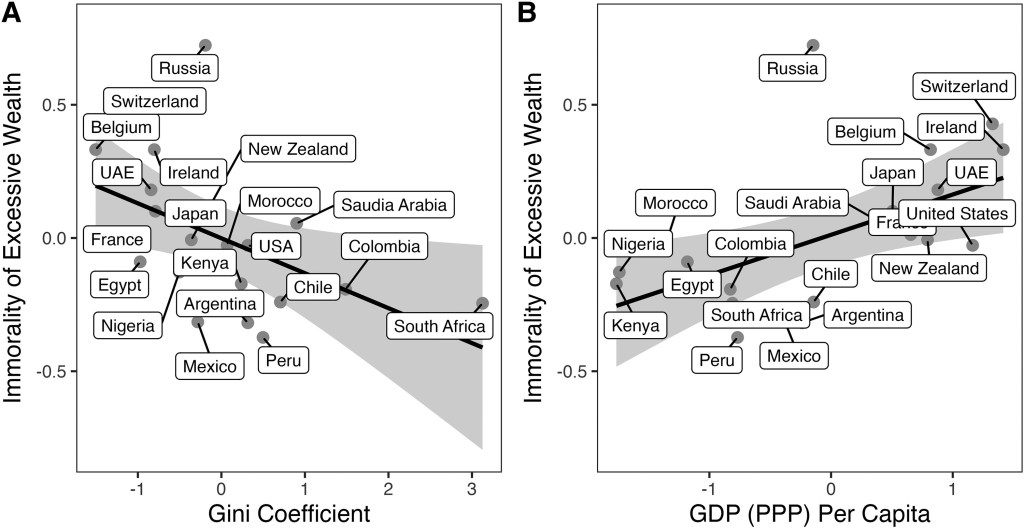
A) Gini coefficient and B) log GDP (PPP) per capita with the immorality of excessive wealth.
Note: (A) Gini coefficient was standardized where higher numbers represent more inequality and lower numbers represent more equal societies. (B) GDP was log-transformed and then standardized, where higher numbers represent more economic development and lower numbers represent a smaller economy.

- The ‘Extraordinary Committee’ of independent experts – appointed by President Ramaphosa – submits the G20’s first-ever report on global inequality today
- The Committee above all urges the creation of a new ‘International Panel on Inequality’ to inform policymaking internationally and by governments – inspired by the IPCC
- New analysis published in the report shows that between 2000 and 2024, the world’s top 1% captured 41% of all new wealth, while just 1% went to the bottom 50%, amid growing concerns about democratic capture associated with wealth concentration
A system that allows billionaires to exist alongside extreme poverty is immoral.
Alexandria Ocasio-Cortez, USCongresswoman
 Surtil :