
Collective behaviours are frequently observed to self‑organize to criticality. Existing proposals to explain these phenomena are fragmented across disciplines and only partially answer the question.
This primer compares the underlying, intrinsic, utilities that may explain the self‑organization of collective behaviours near criticality. We focus on information‑driven approaches (predictive information, empowerment and active inference), as well as an approach incorporating both information theory and thermodynamics (thermodynamic efficiency).
By interpreting the Ising model as a perception‑action loop, we compare how different intrinsic utilities shape collective behaviour and analyse the distinct characteristics that arise when each is optimized.
In particular, we highlight that thermodynamic efficiency—measuring the ratio of predictability gained by the system to its energy costs—reaches its maximum at the critical regime.
Finally, we propose the Principle of Superefficiency, suggesting that collective behaviours self‑organize to the critical regime where optimal efficiency is achieved with respect to the entropy reduction relative to the thermodynamic costs.
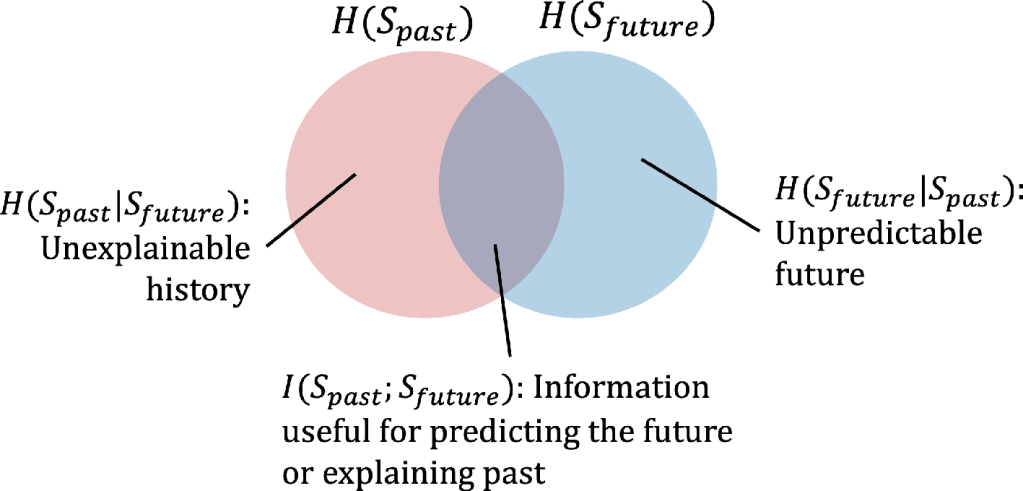
sensory states: it represents how useful the past is for predicting the future.
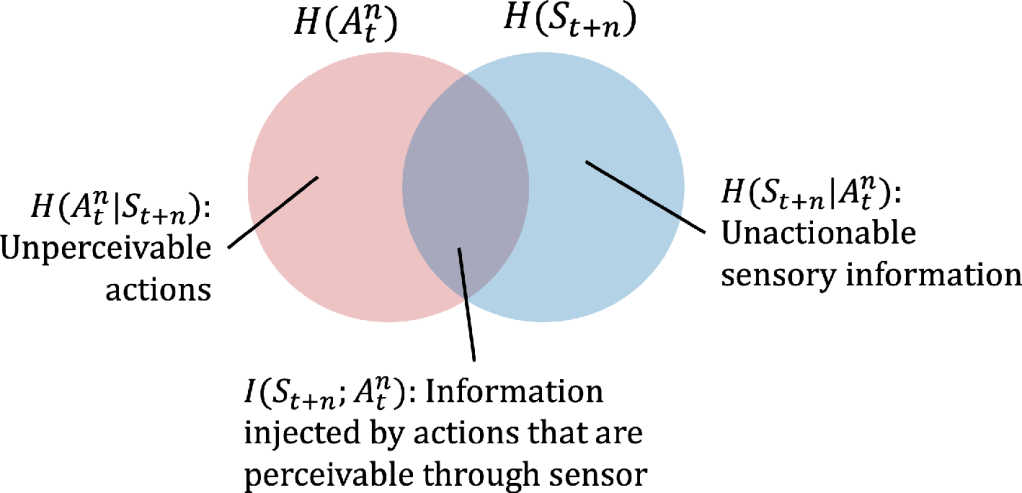
Empowerment is the maximum of this mutual information for a given action channel.
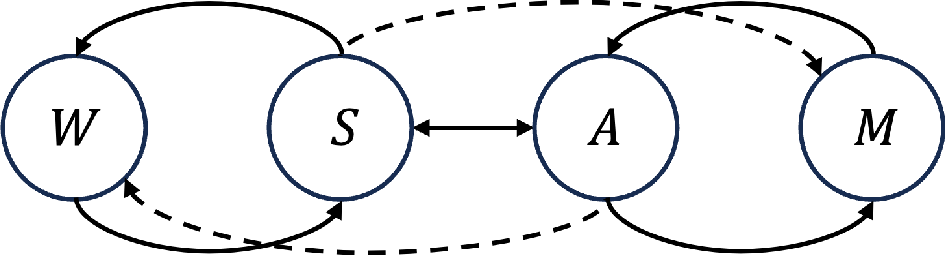
Solid lines represent influences between components. Dash lines represent directed influence from sensory to internal or from action to external, which correspond to the two stages of active inference.
Is there an intrinsic utility for self‑organizing collective systems to operate at the critical regime?
In attempting to explore this question, we overviewed notable intrinsic utility measures, using both information‑theoretic and thermodynamic perspectives. The considered measures were directly compared using a common example that we constructed in order to connect the canonical 2D‑Ising model to the perception‑action loop.
The connection is established by conceptualizing each site in the Ising lattice as an agent possessing sensory‑motor capabilities, thereby linking the model to the perception‑action loop framework. The choice of spin‑flip dynamic is analogous to the embodiment of the agents. Optimization of the control parameter—the coupling strength J—may be considered analogous to choosing the sensory channels that maximize specific intrinsic utility given the embodiment.
Optimal J values were computed for different approaches, including predictive information maximization, empowerment maximization, free energy minimization and thermodynamic efficiency maximization.
For the considered example, each approach exhibited a distinct optimal range of parameter values, offering intuitive insights into the underlying driver shaping collective behaviour:
— Predictive information maximizes at sub‑critical coupling strength for Metropolis dynamics and near‑critical regime for Glauber dynamics, balancing sensory richness with predictability;
— Empowerment maximizes at super‑critical coupling strength, where the individuals have maximal influence over the environment;
— Free energy minimization (with intrinsic component only) also leads to super‑critical coupling strength, where local observations align most closely with the global configuration, hence surprise is minimized;
— Thermodynamic efficiency maximization optimizes near the critical regime, achieving maximum entropy reduction per unit of work expended.
Thus, thermodynamic efficiency, measured by the entropy reduction or predictability gain relative to the associated thermodynamic work carried out, might be a candidate for the intrinsic utility of criticality.
 Surtil :