“Collective intelligence as collective information processing”
- We propose that Collective Information Processing (CIP) underlies CI.
- CIP distinguishes two forms of individual- and group-level processing.
- CIP enables identification and classification of phenomena labeled as CI.
- CIP advances debates about agency and causation within CI studies.

Collective intelligence research spans multiple disciplines and focuses on a broad range of collective behaviors, including group problem-solving, flocking in social animals, and the formation of social knowledge.
It is not apparent what these different forms of collective intelligence have in common, apart from being instances of collective behavior.
In this paper, we develop a framework that enables us to better classify different forms of collectively intelligent behavior in relation to one another based on the information processing mechanisms involved. We argue that these behaviors share a common foundation, which we call collective information processing, or CIP.
CIP involves two key mechanisms:
(1) individual processing of group information and
(2) group processing, or group-level sensitivity to the arrangement of individual information.
We operationalize the CIP framework to analyze different forms of collective intelligence, both classifying them in relation to one another and in alignment with generalized quantifiable measures of information processing.
Our account of collective intelligence as CIP offers a novel framework for identifying and classifying forms of collective intelligence across a wide range of disciplinary contexts. This framework is meant to unify and subsume, rather than simply challenge, existing attempts to define collective intelligence.
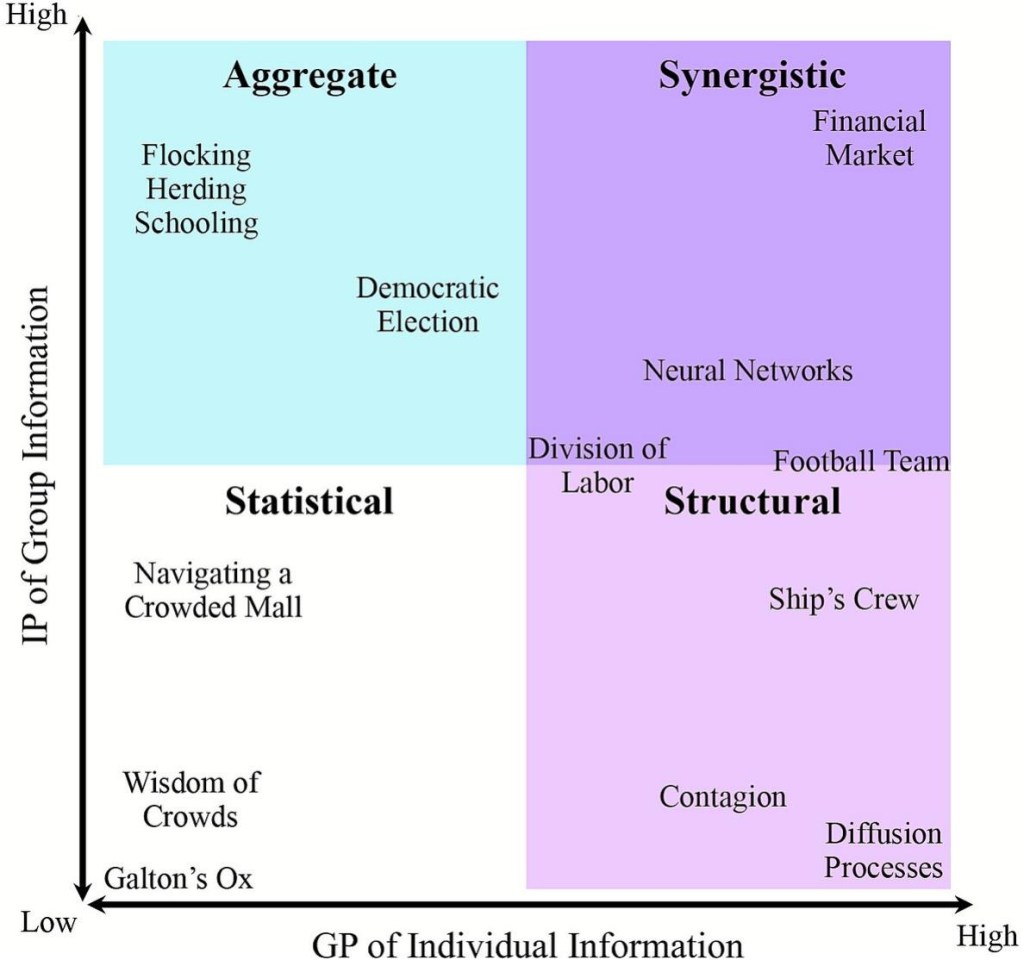
The CIP spectrum includes four categories of CI: Statistical (low IP and low GP; shown in white), Aggregative (high IP and low GP; shown in blue), Structural (low IP and high GP, shown in pink), and Synergistic (high IP and high GP; shown in purple).
The boundaries between these categories are not rigid. Many collective intelligent behaviors will fall between categories. Particular instances of a form of collective intelligence may even fall into different categories, depending on the details of that instance. For example, a football team which adheres to a predefined strategy, where individuals do not deviate from their predetermined role, is better categorized as structural intelligence, whereas a football team which plays with some combination of predefined formation and real-time adaptation on the field may require higher IP and thus is better categorized as synergistic intelligence.
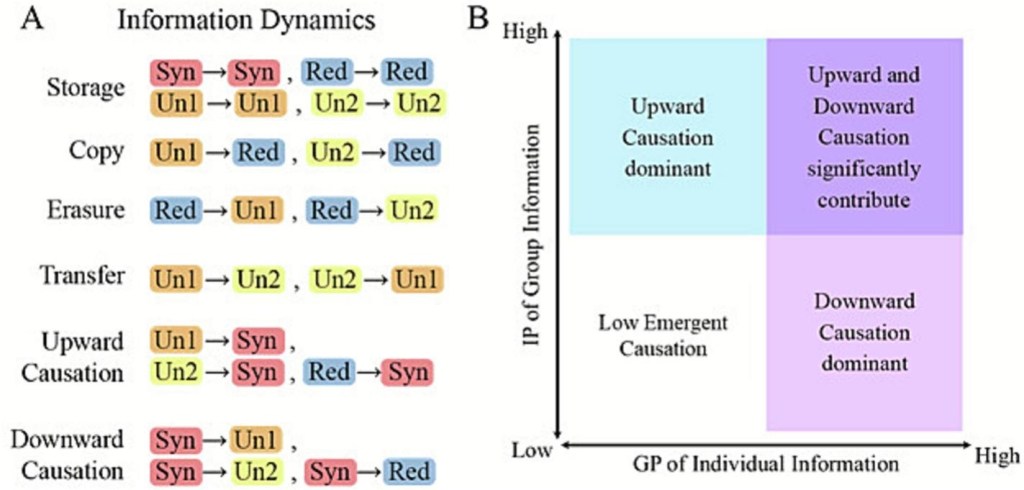
Labels: Unique Information (Un), Redundant information (Red), Synergistic information (Syn).
A: Information dynamics for a system at times t and t + 1, corresponding to information atoms for distinct phenomena. Storage: information remains in a given element. Copy: information duplication; Erasure: deletion of redundant information; Transfer: information moving from one element to another.
B: CIP spectrum outlining which information integration dynamics are dominant within each CIP category.
Increased interest in collective behavior is symptomatic of parallel shifts across different disciplines to reconsider overly individualistic treatments of thought, action, behavior, and causation.
However, as interest in collective behavior grows, and as the breadth of application of the term ‘collective intelligence’ widens, a unifying framework for understanding the nature of collective intelligence and its underlying mechanisms is urgently needed to ensure work in this area is productive and directed at some shared phenomenon.
We have advanced Collective Information Processing as the phenomenon underlying many of the collective behaviors under inquiry in this area.
We have detailed the two key information processing mechanisms involved in CIP and outlined how they help advance CI inquiry by classifying forms of CI and offering a fine-grained framework for analyses of causation and agency within instances of CI.
In advancing this framework, we have attempted to contribute to the kind of comparative inquiry needed to tell a sufficiently broad yet fruitful story about collective intelligent behavior.
Understanding what enables groups to act together in a way that does not misrepresent or reduce a group’s unique ability to affect certain outcomes, the contributions of individuals, the importance of individuals’ structural relations to the group, or the importance of individuals’ interactions with other members of the group requires is essential for capturing the full picture of collective behavior.
As a theoretical framework which offers potentially quantifiable metrics, CIP is an important first step towards that goal. A critical next step, then, is proper formalization of CIP to both further assess its utility and to enable productive empirical inquiry into collective intelligence. Taking these steps is critical for understanding the mechanisms which underlie and give rise to certain distinctive forms of collective behavior.
If anything binds the vastly different phenomena which have, across many disciplines, fallen under the label of collective intelligence, researchers invested in this area ought to find out what precisely that is.
 Surtil :