
“The Dark Factor of Personality”
A unified theory of aversive personality
Ethically, morally, and socially questionable behavior is part of everyday life and instances of ruthless, selfish, unscrupulous, or even downright evil behavior can easily be found across history and cultures. Psychologists sometimes use the umbrella term “dark traits” to subsume personality traits that are linked to these classes of behavior — most prominently, Machiavellianism, Narcissism, and Psychopathy. Over the years, more and more allegedly distinct and increasingly narrow aversive traits have been introduced, resulting in a plethora of constructs lacking theoretical integration.
In proposing D — the Dark Factor of Personality — we specify the basic principles underlying all aversive traits and thereby provide a unifying, comprehensive theoretical framework for understanding aversive personality. In analogy to the general (g) factor of intelligence, D represents the one basic general dispositional tendency from which specific aversive traits arise as manifestations. All commonalities between various aversive traits can thus be traced back to D, so that D represents the common core of all these traits.
For example, D may be evident in Narcissism and/or Psychopathy, but also in any other specific traits such as Amorality, Egoism, Greed, Machiavellianism, Psychopathy, Sadism, or Spitefulness, as well as in any combination thereof. Thus, instead of saying that an individual is an amoral, egoistic, narcissistic psychopath who selfishly acts according to her/his own interests and, in doing so, engages in sadistic and spiteful behaviors, one may just say that this individual displays high levels in D.
D explains why aversive traits are connected and thereby forms the theoretical basis for the emergence of aversive personality in general.
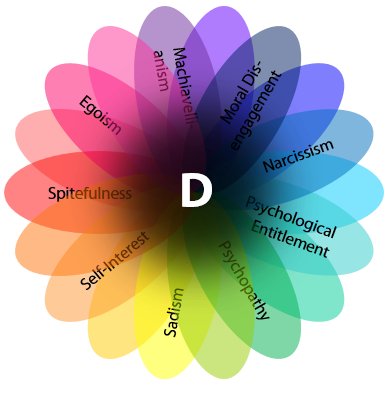
D is defined as:
The general tendency to maximize one’s individual utility — disregarding, accepting, or malevolently provoking disutility for others —, accompanied by beliefs that serve as justifications.
Put simply, D describes the tendency to ruthlessly pursue one’s own interests, even when this harms others (or even for the sake of harming others), while having beliefs that justify these behaviors.
For very informative summaries about the idea of D take a look at Scientific American and Psychology Today.
“Einmal ist keinmal”
It basically means that you can’t conclude anything about someone’s character from a single situation.
D, the dark factor, is according to Ingo Zettler, the factor the “underlying core” of a total of nine dark personality traits:
Sadism, Narcissism, Psychopathy, Machiavellianism, Sense of superiority, Selfishness, Self-promotion, Malice and Unconscionability
And what is that core?
What do the nine habits have in common?
“In short: you put your own interests above those of others, at their expense. And you find ways to justify your behavior.”
What you need to be aware of in relation to others is whether someone repeatedly exhibits what Zettler calls in psychological terms “deviant behavior.”
If someone repeatedly behaves narcissistically or selfishly, their D-factor is probably not on the low side.
There are always both personal and situational factors that determine behavior.
Humans differ in their levels of aversive (“dark”) personality traits such as egoism or psychopathy.
Building upon theories suggesting that socioecological factors coshape the development of personality traits, it can be predicted that prior aversive societal conditions (ASC) (herein assessed via corruption, inequality, poverty, and violence) explain individuals’ levels of aversive personality (assessed via the Dark Factor of Personality, the common core underlying all aversive traits).
Results considering individuals, published in 2025, from 183 countries and 50 US states support the idea that aversive societal conditions coshape individuals’ levels of aversive personality.
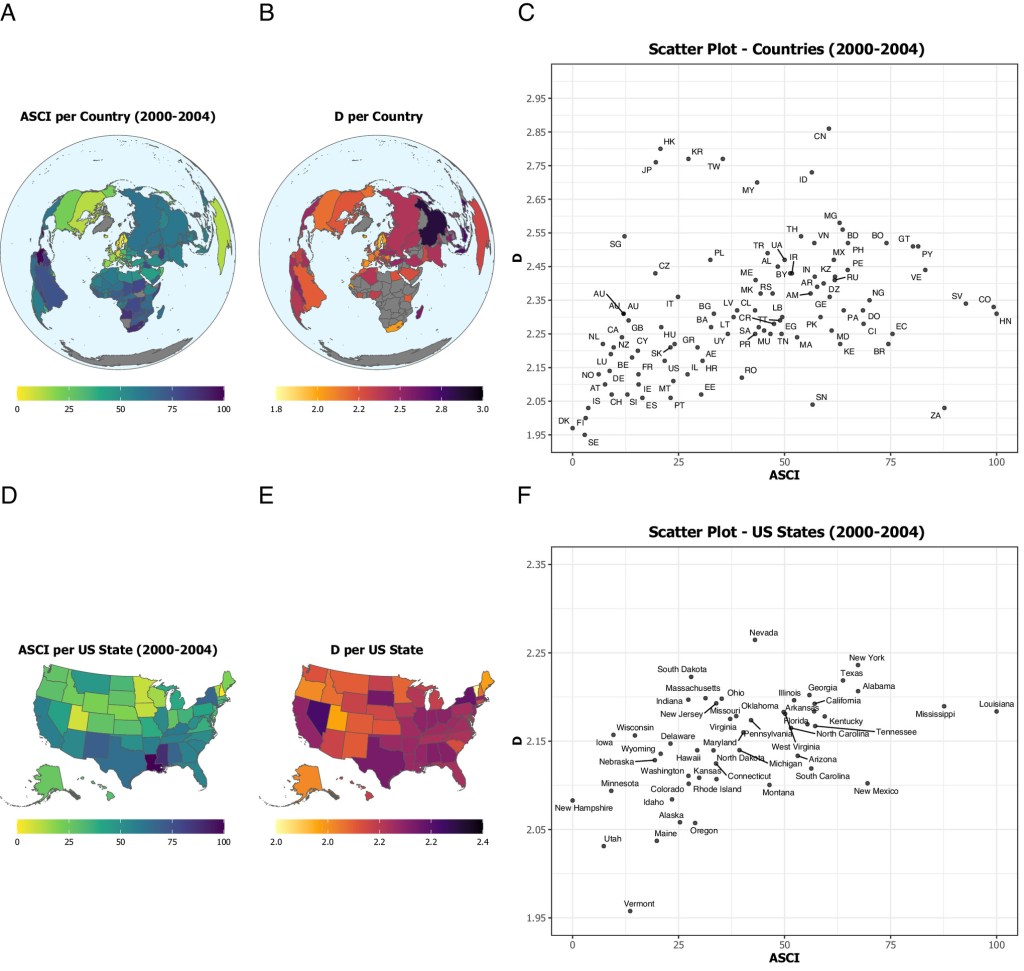
(B) Differences in mean levels of D across countries with at least 100 participants.
(C) Scatterplot of ASCI and mean levels of D by country with at least 100 participants.
(D) ASCI across US states.
(E) Differences in mean levels of D across US states with at least 100 participants.
(F) Scatterplot of ASCI and mean levels of D by US state with at least 100 participants.
Except for panels (A) and (D), we excluded countries/states with fewer than 100 participants to avoid potentially misrepresenting a country/state based on very few participants only. The theoretical range of the ASCI is 0 to 100, and the theoretical range of D is 1 to 5. The means of the ASCI were 38.26 (SD = 23.24) for the worldwide and 46.26 (SD = 17.09) for the US analyses, and the means of D were 2.52 (SD = 0.74) for the worldwide and 2.17 (SD = 0.74) for the US analyses.
We find that the extent to which countries and US states are characterized by ASC is associated with individuals’ aversive personality levels about 20 y later. This finding aligns well with theories suggesting that socioecological factors coshape the development of personality traits and substantially extends existing evidence regarding the essence of aversive personality.
 Surtil :
One response to “D: The Dark Factor of Personality”
[…] D: The Dark Factor of Personality […]
LikeLike