
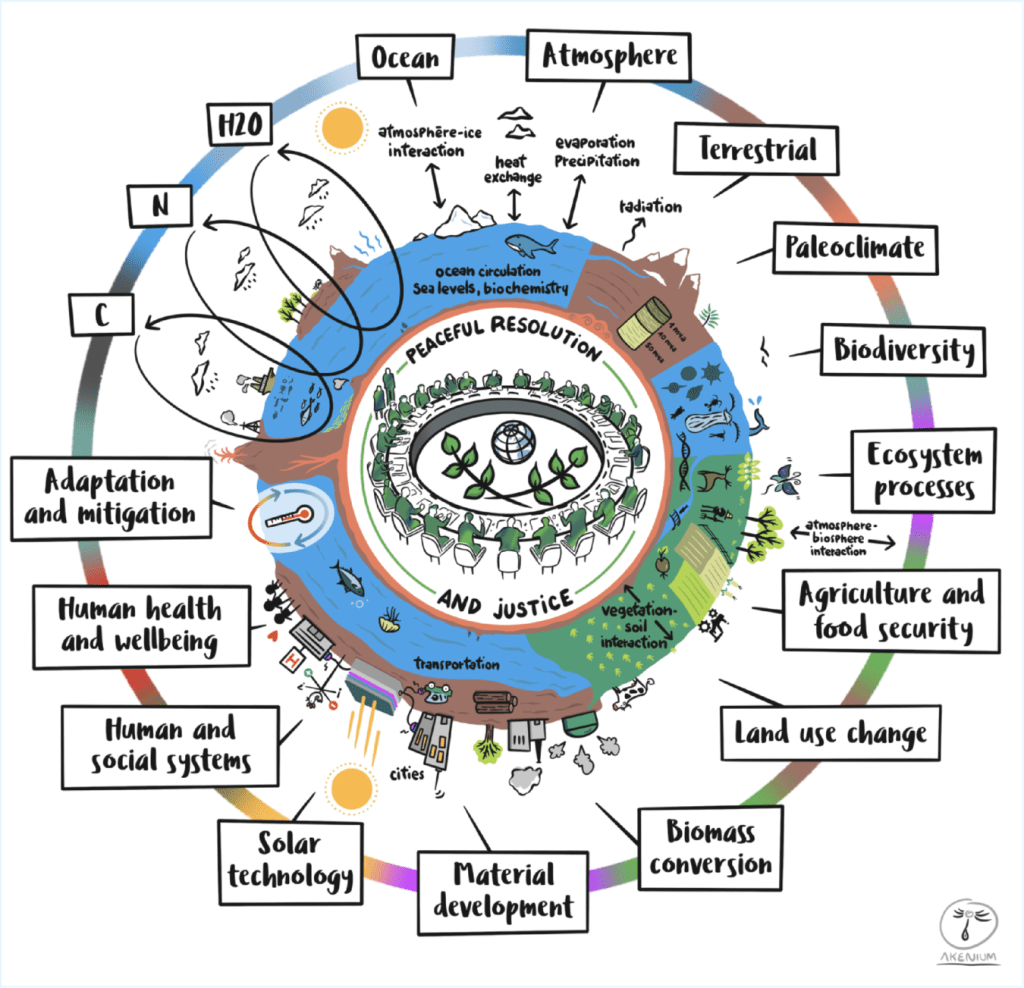
Global change poses “wicked problems” that have become ever more complex, pervasive, and damaging. Developing innovative solutions increasingly require diverse research approaches. The Franco-German Make Our Planet Great Again (MOPGA) program was designed to create a unique international network of top-level research, from fundamental to solution-oriented projects. MOPGA stands out from other large research initiatives by focusing not on a singular central research challenge but on facilitating multidisciplinary interactions between traditionally separated fields. MOPGA recognized that social, natural and engineering sciences share a unifying aim to address global change. In addition to addressing timely and innovative research questions within disciplines, MOPGA worked to improve communication across disciplines via annual meetings for all laureates and their research groups, scientific board exchanges, and public online seminars. Drawing on our MOPGA experiences, we discuss how such exchanges should be extended to meet the needs identified by the scientific community, international policy-makers, and regional stakeholders. In the current political landscape of scientific suppression and heightened mistrust in scientific expertise, the need for such bold, independent and collaborative scientific initiatives is greater than ever.
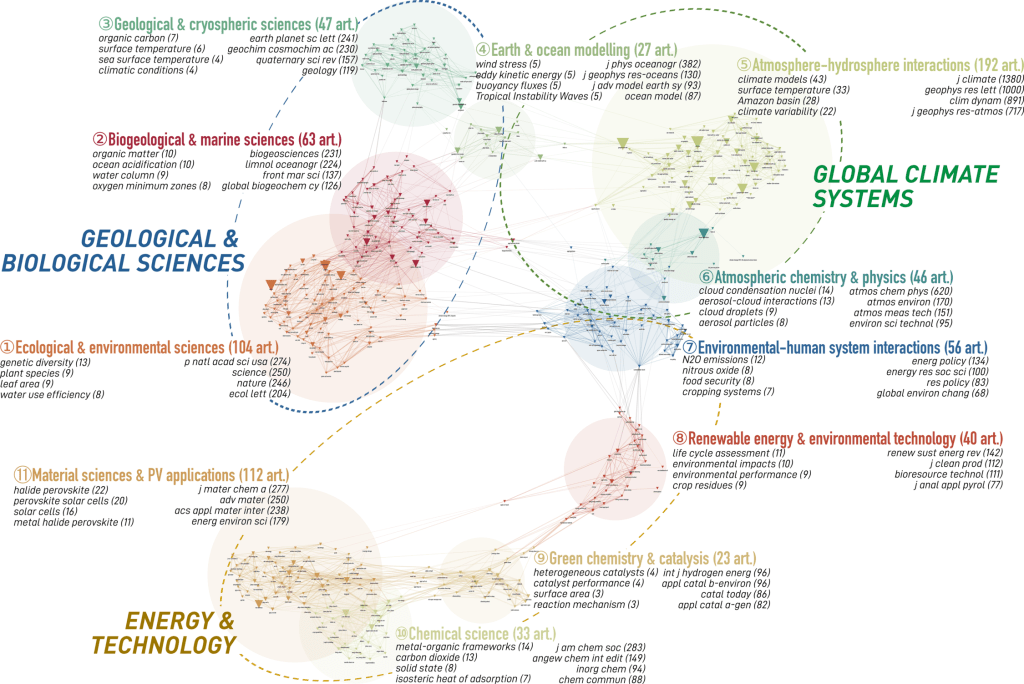
The initial corpus is made of the top 5% cited journals (460) in 752 MOPGA publications that were searchable on Web of Science.
The clustering obtained with a standard community detection algorithm reveals 11 clusters of most salient and distinctive associations of cited-journals across the program. To elicit the analysis of the map, some information has been added aside from each computed cluster: the title of the cluster with the total number of documents within it, the top 4 keywords and the top 4 cited journals. The relative positioning of these clusters reflects their internal constitution and their external relationships, depicting an epistemic landscape of cited journals, which are all indications of citation practices attributable to disciplinary or interdisciplinary configurations. At the macro level, we interpret connectivity between clusters as indicative of three macro-areas of scientific knowledge production:
1) under the remit of Geological & Biological Sciences, three central clusters concern Ecological, Environmental, Biological, Marine, Geological and Cryospheric sciences (clusters 1-3, top-left);
2) under the remit of Global Climate Systems, two central clusters concern Atmosphere-hydrosphere interactions and Atmospheric chemistry and physics (clusters 5-6, top-right);
3) under the remit of Energy & Technology, four central clusters concern renewable energy, environmental technology, green chemistry, catalysis, chemical science, material sciences and PV applications (cluster 8-11, bottom).
Lastly, two clusters have an intermediary position, bridging between our three macro-epistemic areas: cluster 4 on Earth & ocean modelling that establishes a “bridge” between the macro-areas Geological & Biological Sciences and Global Climate Systems and cluster 7 on environmental-human system interactions which supports many edges between cited-journals that link the 3 macro-epistemic areas, showing the interdisciplinary nature of this cluster where some journals focused on social sciences and humanities mostly appear.
The findings of the MOPGA program span an array of disciplines reflecting the complexity of global environmental problems and prospects for their resolution. Similar to the structure of the three working groups of the IPCC, researchers addressed the physical processes of global change on various scales, the natural and coupled human impacts of global change and a variety of technological, social and policy oriented mitigation and adaptation strategies. The program was successful in terms of producing 946 products. Based on products with a doi, we performed a scientometric analysis of the 752 MOPGA publications that were searchable on Web of Science (Methodological note in the supporting information).
The resulting network map of co-cited journals demonstrates that the citation landscape of MOPGA products is multidisciplinary in nature, reflecting the variety of scientific fields (disciplinary and interdisciplinary) within which the funded projects were inscribed and echoing the grouping of topics covered in MOPGA projects. The 11 distinct computed clusters all share an explicit link to climate and sustainability, and can be analytically aggregated into three macro-areas: Geological & Biological Sciences, Global Climate Systems and Energy & Technology. This analysis emphasizes how MOPGA provided a propitious opportunity for effective interactions across these diverse disciplines. We argue that building on this type of momentum will be a critical component in overcoming disciplinary boundaries. Some of the most important lessons came from these cross-disciplinary interactions.
Despite many challenges, the interdisciplinary exchange among laureates influenced within-discipline research questions, interpretations of data and general conclusions. The success achieved in the MOPGA framework highlighted that increasing interdisciplinary cross-talk and networking is as important to moving our understanding forward as is generating specific disciplinary projects. At the closing meeting in Berlin, MOPGA laureates articulated that future programs should support research projects that embrace ecological, geophysical, social and technological solutions from the start. The need for such bold, independent scientific initiatives is now greater than ever.
 Surtil :