
“Cultural evolutionary behavioural science in public policy”
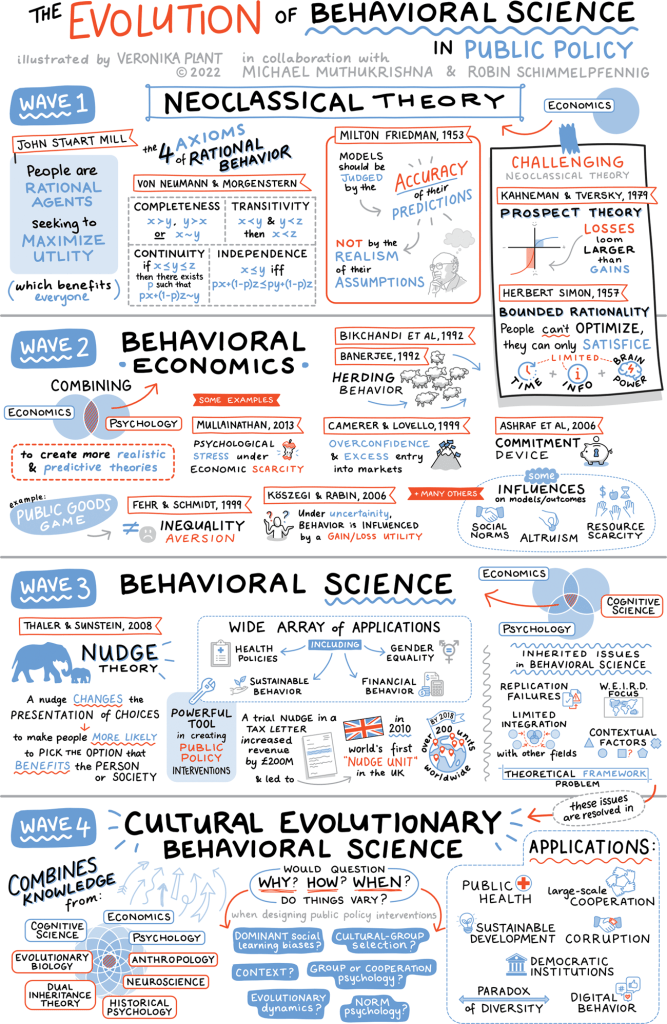
Interventions are to the social sciences what inventions are to the physical sciences – an application of science as technology. Behavioural science has emerged as a powerful toolkit for developing public policy interventions for changing behaviour. However, the translation from principles to practice is often moderated by contextual factors – such as culture – that thwart attempts to generalize past successes. Here, we discuss cultural evolution as a framework for addressing this contextual gap. We describe the history of behavioural science and the role that cultural evolution plays as a natural next step. We review research that may be considered cultural evolutionary behavioural science in public policy, and the promise and challenges to designing cultural evolution informed interventions.
Finally, we discuss the value of applied research as a crucial test of basic science: if theories, laboratory and field experiments do not work in the real world, they do not work at all.
If it does not work in the real world, it does not work at all
As scientists, our goal is to develop theories and models to explain the world. Often the methods we use to test these models and theories are not in the world but in a more constrained lab or online setting. But of course, the ultimate test of our theories is the real world. If our theories do not work in the real world, they do not work at all. Thus, cultural evolutionary behavioural science in public policy is not just a useful extension of the cultural evolutionary framework and research program, it is essential to the development of the science. It offers a true test of cultural evolution as a theory of human behaviour. Basic and applied science go hand in hand. Electrons and molecules behave the same way in a lab as they do in the real world. People do not.
The marriage between cultural evolution and behavioural science can produce more effective methods for developing public policies. We have shown how this combined approach can guide researchers and practitioners in designing legitimate, ethical and sustainably effective policies and programmes. But the intersection of cultural evolution and public policy is not just a useful approach for policymakers. Cultural evolutionary public policy is critical to the future of the discipline.
 Surtil :