
Peter S. Park published a very interesting research on decisions and inference: “The evolution of cognitive biases in human learning”. Some text snippets I like to share:
Cognitive biases like underinference, the hard-easy effect, and recurrently non-monotonic confidence are evolutionarily puzzling when viewed as persistent flaws in how people learn from environmental feedback.
To explain these empirically robust cognitive biases from an evolutionary perspective, the author proposes a model of ancestral human learning based on the cultural-evolutionary-theoretic hypothesis that the primary selection pressure acting on ancestral human cognition pertained not to learning individually from environmental feedback, but to socially learning task-specific knowledge.
In the model presented—which is inspired by classical Bayesian models—an ancestral human learner (the student) attempts to learn task-specific knowledge from a role model, with the option of switching between different tasks and role models.
Suppose that the student’s method of learning from their role model is a priori uncertain—in that it can either be successful imitation learning or de facto innovation learning—and the ecological fitness costs of meaningfully retaining environmental feedback are high. Then, the student’s fitness-maximizing strategy does not retain their environmental feedback and—depending on the choice of model parameters—can be characterized by all of the aforementioned cognitive biases.
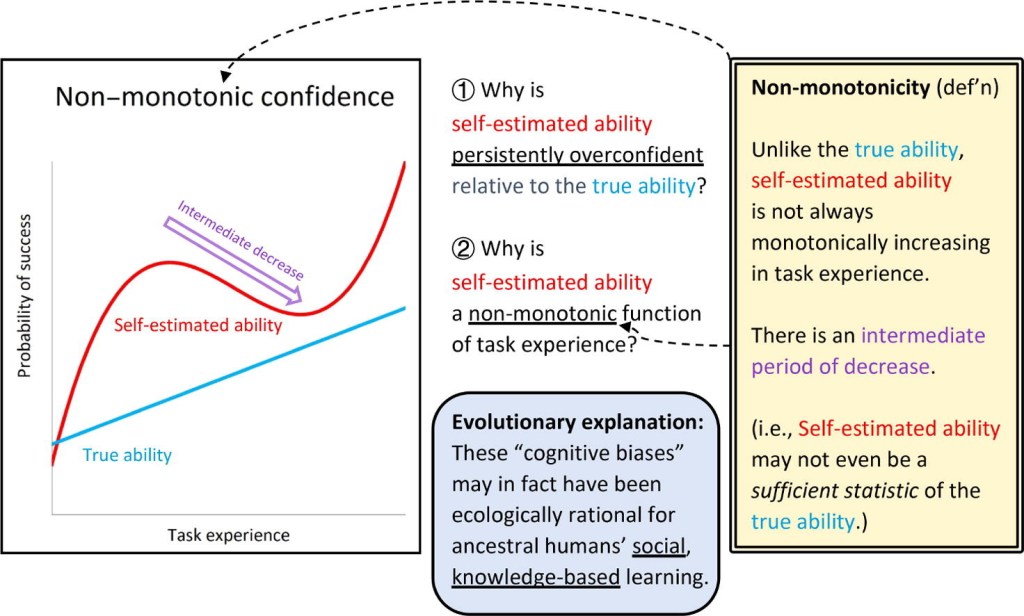
Specifically, in order for the evolutionarily optimal estimate of confidence in this learning environment to be recurrently non-monotonic, it is necessary (as long as the environment’s marginal payoff function satisfies a plausible quantitative condition) that a positive proportion of ancestral humans’ attempted imitation learning was unknowingly implemented as de facto innovation learning.
Moreover, an ecologically rational strategy of selective social learning can plausibly cause the evolutionarily optimal estimate of confidence to be recurrently non-monotonic in the empirically documented way: general increase with an intermediate period of decrease.
We thus find that several classes of cognitive biases can be parsimoniously explained as evolutionary byproducts of the idiosyncratically knowledge-based and social nature of ancestral humans’ hypothesized learning environment.
Often thought of as structural flaws in humans’ individual learning, cognitive biases may instead be evolutionarily rooted in two hypothesized characteristics of our ancestral environment:
– first, the primarily knowledge-based and social—not individual—nature of human learning in natural settings, as theorized by cultural evolutionary theory; and
– second, ecological fitness costs of meaningfully retaining environmental feedback—due to cognitive constraints—and the consequent pressure to rely instead on setting-specific sources of information, as theorized by the ecological rationality hypothesis.
Needles to say, this research has a great link with the ideas expressed in a previous post on the work of Donald HoffMan: “Fitness” Beats “Truth”
 Surtil :