
“The students will have an understanding and empathy that they will hold in their minds and hearts due to the spiritual and cultural teachings they are learning through the land. They will have a new lens.”
Joy Joseph-McCullough, Squamish Nation
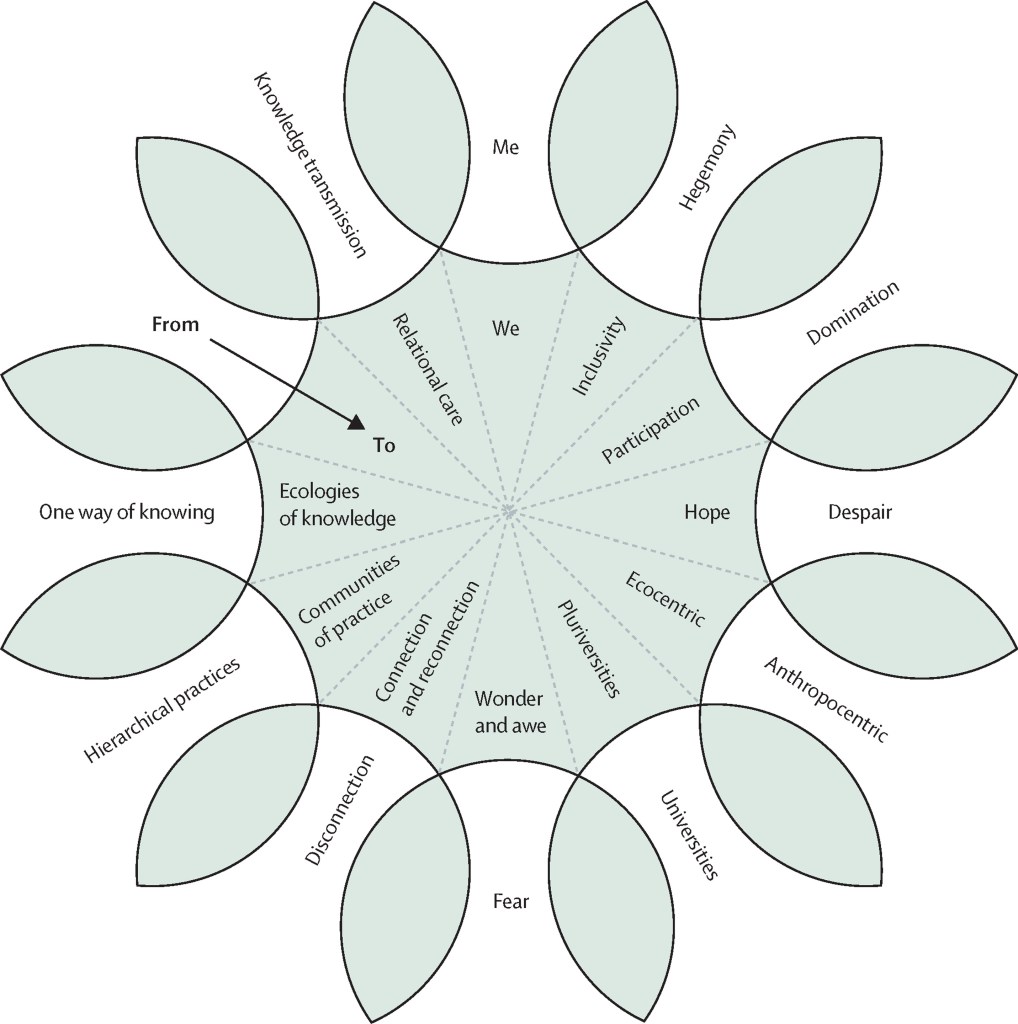
Fuelled by the intersecting challenges of climate change, biodiversity loss, pollution, and profound social, economic, and environmental injustices, calls for new ways to work together for a healthy, just, and sustainable future are burgeoning. Consequently, there is a growing imperative and mandate across the higher education space for transformative, inclusive, integrative—and sometimes disruptive—approaches to learning that strengthen our capacity to work towards the goals and imperatives of planetary health. This educational transformation requires attention to pathways of societal, policy, and system change, prioritising different voices and perspectives across jurisdictions, cultures, and learning contexts. This Viewpoint seeks to explore the developing areas of education for planetary health, while additionally reflecting on a praxis for education in the Anthropocene that is rooted within the confluence of diverse knowledges and practice legacies that have paved the way to learning and relearning for planetary health.
“The overarching paradigm of higher education upholds dominant ideologies of individualism and meritocracy, seeking to maintain oppressive hierarchies.”
Wright-Mair R. A work of heart: practicing critical compassionate
pedagogy in the face of adversity

Global bird migrations, watersheds of South America within the fractal, watersheds and river deltas, braided rivers, Nechako River within the fractal, trees and branches, cracks in ice, tree within the fractal, fungal hyphae, and coronary arterial tree within the fractal

The convergence of these three elements, compassion–knowledge–reflection, translates to a form of emancipatory, decolonial, and resurgent practice that will better enable the formation of planetary stewards (we use the concept of planetary stewardship here put forward by 126 Nobel Prize laureates in their 2021 statement, Our planet, our future. An urgent call to action).
 Surtil :