
Thomas Metzinger’s latest book from MIT Press is focused on the experience of “pure awareness” as an investigation of the most basic fundamental nature of consciousness This specific experience, is the most important thing I have ever experienced in my life, as a personal attestation It is available for free here or also as pdf free here.
If one wants to know the nature of a thing, one must examine it in its pure state,
—Plotinus (205–270), Enneades, IV.7
since every addition to a thing is an obstacle to the knowledge of that thing.
Here is the intro:
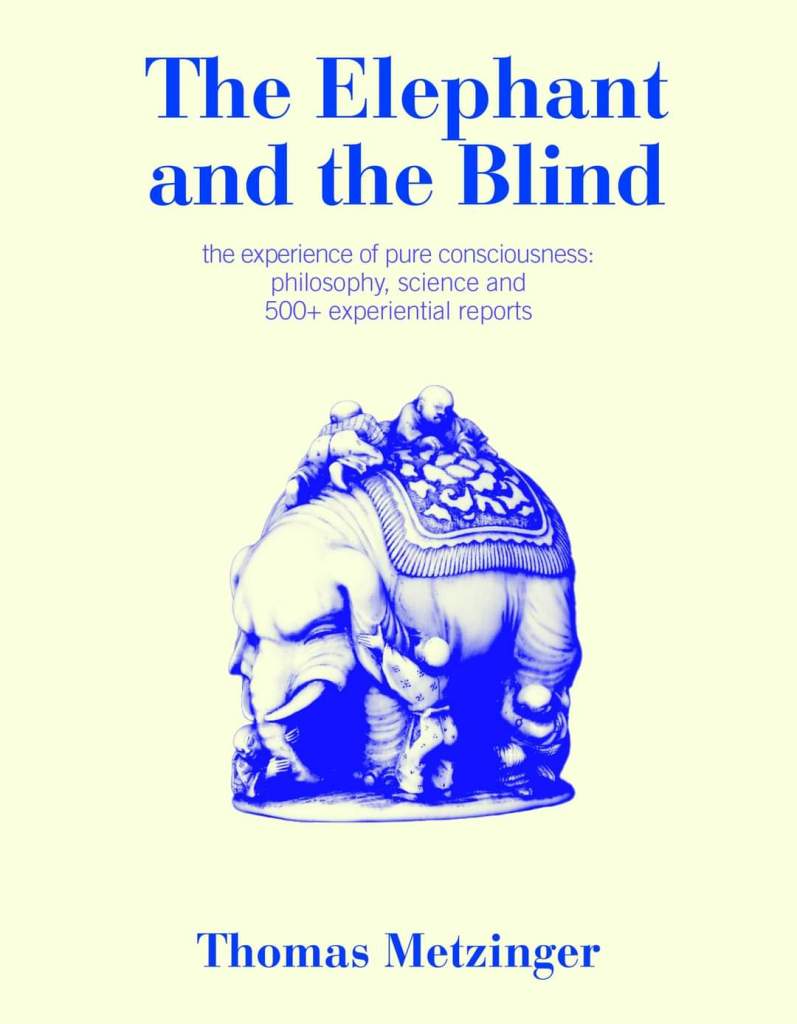
The Elephant and the Blind By Thomas Metzinger
What if our goal had not been to land on Mars, but in pure consciousness?
The experience of pure consciousness—what does it look like?
What is the essence of human consciousness?
In “The Elephant and the Blind”, influential philosopher Thomas Metzinger, one of the world’s leading researchers on consciousness, brings together more than 500 experiential reports to offer the world’s first comprehensive account of states of pure consciousness.
Drawing on a large psychometric study of meditators in 57 countries, Metzinger focuses on “pure awareness” in meditation—the simplest form of experience there is—to illuminate the most fundamental aspects of how consciousness, the brain, and illusions of self all interact.
The more you talk and think, the farther away you get.
—Inscription on Faith in Mind, Seng-ts’an
(Third Chinese Zen Patriarch; † 606)
… But there is one last point that we should not forget: There is an elephant in the room.
One simple yet striking result from our first study is just how many human beings all over the planet actually have these experiences but never really speak about them in public.
… T(t)hese individuals are ready to do so, if actively approached under conditions of anonymity and in the context of a serious research project, but also that there is a lot for academic consciousness research to learn from them.

Quite simply, … “MPE” (minimal phenomenal experience) seems to be a phenomenological prototype of humankind—at least, the pure-awareness experience is something that many hundreds of participants from fifty-seven countries consistently reported. …
There really is an elephant in the room because there seems to be something genuinely profound here—but there is also some reason why global society has been unable to see its importance. Maybe, as in the old Tibetan saying: it is simply too close for us to see, too profound for us to fathom, too simple for us to believe, or even too good for us to accept.
It’s so close you can’t see it.
—“The Four Faults of Awareness”
It’s so profound you can’t fathom it.
It’s so simple you can’t believe it.
It’s so good you can’t accept it.
Shangpa Kagyu tradition of Tibetan Buddhism
Let us return to the fable of the elephant and the blind one last time.
There are many things that the congenitally blind cannot see—things that they will never know.
One of these is that the elephant itself is not blind: It might actually be looking at the blind people while they try to touch and understand it. Of course, they could touch one of its eyelids or even an eyeball by chance, but they would never fully understand what they are touching or what kind of understanding this eye affords. They would not know the special form of visual knowledge that is made possible by eyes, and therefore they could not wholly grasp the fact that they might actually be visually perceived themselves. If they were seen by the elephant while trying to make contact with it, they would know nothing of this fact. But the elephant would always already know them in a way they could never know themselves.
Could it be that the elephant is looking right at you, right now?
 Surtil :