
Ingrid Robeyns’s Limitarianism: The Case Against Extreme Wealth, a powerful case for limitarianism–the idea that we should set a maximum on how much resources one individual can appropriate. A must-read! (so says Thomas Piketty).
Ingrid Robeyns’ Limitarianism is a recent addition in a long line of critiques – such as Thomas Piketty’s Capital and Branko Milanovic’s Visions of Inequality – of the soaring wealth and income gaps of recent decades.
Limitarianism focuses on personal wealth, which is much more unequally distributed than incomes, and is arguably the most urgent of these trends. It draws most closely on the United States, where, according to Forbes, nine of the world’s top 15 billionaires are citizens.
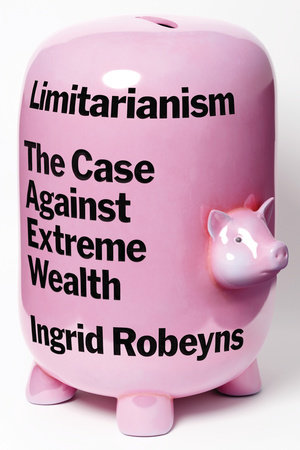
Robeyns argues that given the wider damage from the enrichment of the few, with its negative impact on economic strength and on wider life chances and social resilience, we must now impose a limit on individual wealth holdings. Thinkers have been making the case for this “limitarianism” and the capping of business rewards for centuries. The book offers an original, bold, and convincing argument for a cap on wealth by the philosopher who coined the term “limitarianism.” How much money is too much?
Is it ethical, and democratic, for an individual to amass a limitless amount of wealth, and then spend it however they choose? Many of us feel that the answer to that is no–but what can we do about it?Ingrid Robeyns has long written and argued for the principle she calls “limitarianism“–or the need to limit extreme wealth. This idea is gaining momentum in the mainstream – with calls to “tax the rich” and slogans like “every billionaire is a policy failure“–but what does it mean in practice?
The limitarian thesis.
Robeyns, Ingrid. 2017. Having too much
There is an upper limit to how many resources people
can permissibly have
Robeyns explains the key reasons to support the case against extreme wealth:
– It keeps the poor poor and inequalities growing
– It’s often dirty money
– It undermines democracy
– It’s one of the leading causes of climate change
– Nobody actually deserves to be a millionaire
– There are better things to do with excess money
– The rich will benefit, too
»We can still enjoy equal or even higher levels of wellbeing, while putting less pressure on ecological resources and ecosystems.«
Robeyns, Ingrid. 2017. Freedom and Responsibility – Sustainable Prosperity through a Capabilities Lens
This is an authoritative trade book to unpack the concept of a cap on wealth, where to draw the line, how to collect the excess and what to do with the money. In the process, Robeyns will ignite an urgent debate about wealth, one that calls into question the very forces we live by (capitalism and neoliberalism) and invites us to a radical reimagining of our world.
The standard common-sense view that we can make our own decisions fully individually is not applicable in most cases which concern the use of ecological resources.
Robeyns, Ingrid. 2017. Freedom and Responsibility – Sustainable Prosperity through a Capabilities Lens
There is a podcast and a YouTube recording from London School of Economics, where Ingrid Robeyns explains the ideas about the book.
Robeyns sets out a powerful moral case against today’s wealth divide and asks the all-important question: “how much is too much?”. She calls for setting limits to the size of individual fortunes that would vary across countries. In the case of the Netherlands, where she lives, “we should aim to create a society in which no one has more than €10m. There shouldn’t be any decamillionaires.” This, she argues should be politically imposed. She also adds a second aspirational goal, an appeal to a new voluntary moral code applied by individuals themselves: “I contend that … the ethical limit [on wealth] will be around 1 million pounds, dollars or euros per person.”
All people currently alive, as well as the people who will be alive in the future, all have prima facie an equal moral right to use those natural resources.
Robeyns, Ingrid. 2017. Freedom and Responsibility – Sustainable Prosperity through a Capabilities Lens
Although there are many critics who dismiss the philosophical concept as either unfeasible or undesirable, history suggests the idea is far from utopian. Limits operated pretty effectively among nations – including the UK and the US – in the post-war decades and became an important instrument in the move towards greater equality.
Moral philosophy will hold up a mirror to those who are trying to escape their moral responsibilities by offering rationalisations of the status-quo.
Robeyns, Ingrid. 2017. Freedom and Responsibility – Sustainable Prosperity through a Capabilities Lens
Robeyns makes sure to present how limitarianism will benefit the rich.
I appreciate that she did this, but the cynical part of me says that she didn’t account enough for the rich that want to control the rest of us. She didn’t account for how the rich consider themselves better than the rest of us, which maybe because of who she’s talked to amongst the rich.
She wants the rich to participate in limitarianism and offer their thoughts and opinions. And Robeyns isn’t “blaming” the rich so much as asking them to take responsibility for their actions and for their consumption. In fact, she’s asking all of us to take the same responsibility.
 Surtil :
One response to “Limitarism – A bliss”
[…] life of humans and their societies are facing many challenges, not unknown to mankind, but still lacking appropriate […]
LikeLike