
Laughter may be the tool that nature gave to mankind to help it survive while traveling along the evolutionary path, claims Carlo V. Bellieni in “Laughter: A signal of ceased alarm toward a perceived incongruity between life and stiffness“
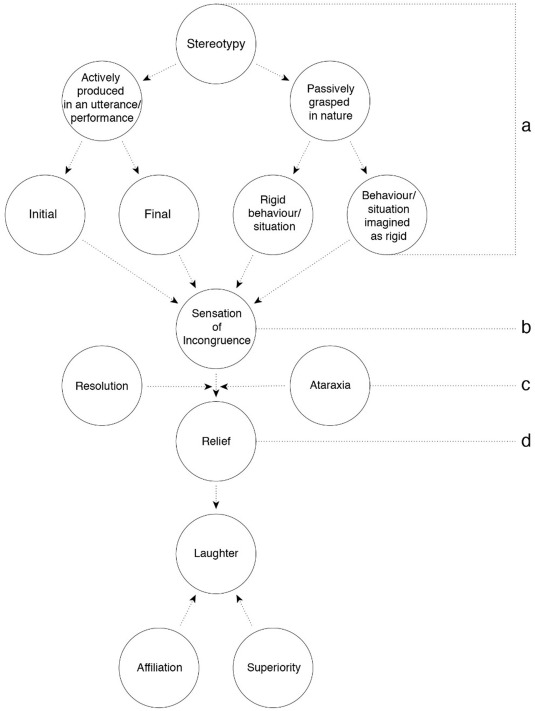
Humor is provoked by
a) “stiffness in life” that is perceived as
b) an incongruence, but that is then
c) solved noticing its innocuity, with the effect of
d) relief. This provokes laughter, the sign of ceased alarm.
“Initial” and “final” are referred to whether the stereotypy in the utterance is present at its beginning or its end.
Also affiliation and superiority can provoke laughter.
This feature of human behavior that precedes language development (infants as young as three months old are able to laugh) provides a host of physiological, psychological, social and economic benefits. Humor has always been a way of helping people to cope with stress and anxiety, boosting positive emotions while mitigating the “perceived intensity of negative life events”.
Laughter is described as a three-step process. First, the situation that seems “odd” may trigger a sense of incongruity. Second, the “stress” the incongruous situation that has been provoked must be overcome, or resolved. And, finally, the actual release of laughter acts as a signal to alert others bystanders that they are “safe“.
Accordingly, the professor claimed, laughter could have been used by people for millennia to show others that a “fight or flight” response is not needed, as there is no “threat”.
Like shedding tears, laughter acts as a “release mechanism” for the body, as the brain centers that regulate this behavior are those which control emotions, fears and anxiety. Thus, laughter relieves tension and floods the body with relief.
Laughter can have several causes. It can arise from a superiority feeling or from the need of complicity and affiliation. In most cases, it is due to humor, and one of the main theories about it is the incongruity/resolution process.
We can extend this definition and say that laughter castigates not only human behaviors, but all that in life is static and stiff. It is the signal of a ceased alarm, when this stiffness is acknowledged as innocent and safe; it is announced all around to the bystanders with its rhythmic form, such as a siren.
This is the main finding of this research: an apparently secondary behavior such as laughter, is in reality a potent weapon against the reduction of people to objects, against all reifications of people and nature.
Ancient Roman people used to say “ridendo castigat mores” (“laughter stigmatizes the behaviors”). We might now be more precise and write: “laughter stigmatizes rigid behaviors”. Is laughter a potent ally of our survival, unconsciously alerting against our moral destruction?
We can now respond affirmatively.
 Surtil :