
Participatory action research (PAR) is an approach to research that prioritizes the value of experiential knowledge for tackling problems caused by unequal and harmful social systems, and for envisioning and implementing alternatives. PAR involves the participation and leadership of those people experiencing issues, who take action to produce emancipatory social change, through conducting systematic research to generate new knowledge.
This Primer sets out key considerations for the design of a PAR project.
The six building blocks for PAR project design are:
1. building relationships;
2. establishing working practices;
3. establishing a common understanding of the issue;
4. observing, gathering and generating materials;
5. collaborative analysis; and
6. planning and taking action.
Challenges faced by PAR projects are,
– mismatches with institutional research infrastructure;
– risks of co-option;
– power inequalities; and
– the decentralizing of control.
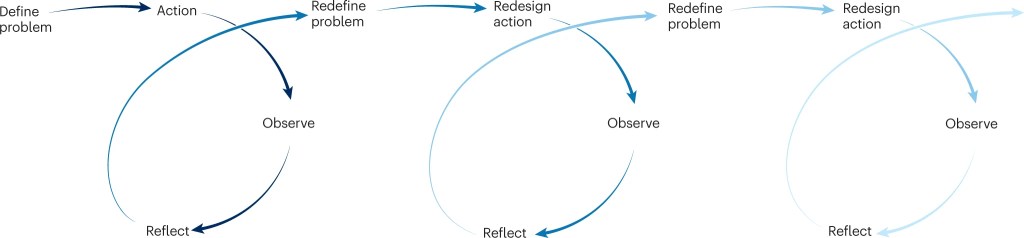
To counter such challenges, PAR researchers may build PAR-friendly networks of people and infrastructures; cultivate a critical community to hold them to account; use critical reflexivity; redistribute powers; and learn to trust the process.
PAR’s societal contribution and methodological development, we argue, can best be advanced by engaging with contemporary social movements that demand the redressing of inequities and the recognition of situated expertise.
Two participatory tools for problem definition
The Five Whys Method aims to support critical thinking to identify the structural roots of problems.
Participants first identify a problem that they experience, usually generating immediate problems such as dirty school premises or lack of suitable health services. Using the Five Whys Method, in facilitated small group discussions, participants first turn the problem into a ‘why’ question, asking why the premises are dirty or they do not have access to suitable health services, and generating five (approximately) answers. The most plausible of these answers is then chosen, to ask again why that is the case, and this questioning process is repeated five times. In this process, participants theorise the multiple and multidimensional causes of problems, thus opening up multiple sites for action. The five layers of questions aim to develop collective thinking beyond individual-blaming answers to structural or processual roots of the immediate problems, which could be tackled with a wider ranging effect.
The Problem Tree is a tool to structure a facilitated discussion to analyse the causes and consequences or effects of a particular problem.
Participants begin with the immediate and pressing problem they face, such as a threat of eviction or the burdens of being a young carer, which forms the ‘trunk’ of the tree. Participants then discuss ‘roots’ or causes of the problem, which are labelled on the diagram, followed by labelling the secondary roots branching off the main roots. Attention then turns to the branches leading out of the trunk, to identify consequences of the problem, and the branching further consequences of those consequences. Thus participants produce a wider ranging analysis and contextualisation of their problem. The problem tree can be developed into a ‘solution tree’ by brainstorming and labelling solutions or responses to the various causes and effects.
 Surtil :