

(A) Distinct conceptions of honesty with examples of fact-speaking and belief-speaking …
Honesty is concerned with the attributes of a person.
(B) Distinct conceptions of truth. Truth is not concerned with an individual’s position but with how the state of the world is characterized.
The top part of each panel refers to conceptions of truth or honesty that are outward-facing and hence are concerned with veracity and make contact with the world.
The bottom part refers to inward-facing conceptions that consider primarily the mental state of an individual and are not directly concerned with the state of the world.
When honesty relies on sincerity rather than accuracy
People in liberal democracies value honesty in their politicians and prioritize honesty over ‘delivering the goods’.
How can serial liars be considered honest?
This conundrum can be approached from a variety of angles. Here we apply the lens of recent theoretical work that has identified distinct subjective notions of honesty and truth. The conceptual landscape of our analysis is shown in the Figure.
The two panels in the figure differentiate between the closely related, but distinct, concepts of honesty (panel A, left) and truth (panel B, right).
Truth refers to the state of assertions vis-a-vis the world. A statement or belief is truthful if it corresponds to the state of the world, and it is false if there is no such correspondence.
Honesty, by contrast, refers to the characteristics or traits of a person. Honesty refers to a person’s ability to speak truthfully and with integrity, and their desire to avoid deception.
A crucial and novel aspect of our analysis is that it focuses on the psychological processes that translate the invariant conceptual properties of truth and honesty into a subjective, experienced perception of truthfulness and honesty.
In the case of truth, those processes describe what people consider a reliable way to arrive at the truth.
We can differentiate between an evidence-based and an intuition-based approach to truth. The former is based on the recognition that one’s beliefs must be based on analysis of evidence, whereas the latter is based on the idea that ‘gut feelings’, intuition, and attitudes are sufficient to establish the truth of an assertion. Reliance on those alternative processes can give rise to very different ‘truths’ in the eyes of different beholders.
In the case of honesty, the psychological processes are reflected in the style of rhetoric that is deployed to make an assertion, and in the observers’ perception of that rhetoric.
We can differentiate between fact-speaking and belief-speaking. The former, similar to an evidence-based approach to truth, considers the veracity of a statement and seeks to communicate the actual state of the world. The latter is concerned with sincere and authentic expression of beliefs and is thus more concerned with a person’s mental state than the state of the world.
Implications for policy and society
For democracy to function, citizens must agree on a set of facts and share common knowledge about the integrity of democratic processes such as elections. The apparent mutually reinforcing relationship between supply and demand for sincerity over truth thus endangers democratic processes.
According to the latest report by the World Economic Forum, misinformation stands out as the most significant short-term global risk, capable of disrupting elections and exacerbating societal polarization. Political leaders are expected to wield even more substantial influence in defining truth, shaping public opinion, and determining how people perceive and evaluate information in the future. Our examination of these systems points to the shared responsibility of both politicians and the public to counter those trends.
- Under what circumstances might people discount sincerity as the sole marker of honesty?
- Conversely, under what circumstances will people value the importance of factual accuracy?
- Are there interventions that might be deployed to nudge people towards valuing accuracy without curtailing their democratic rights?
Answers to those questions may be essential to secure a democratic future.
Note from “Honest behavior“
For behavior to be fully honest, individuals, groups, or organizations “must seek the truth, speak the truth, and foster understanding of the truth.”
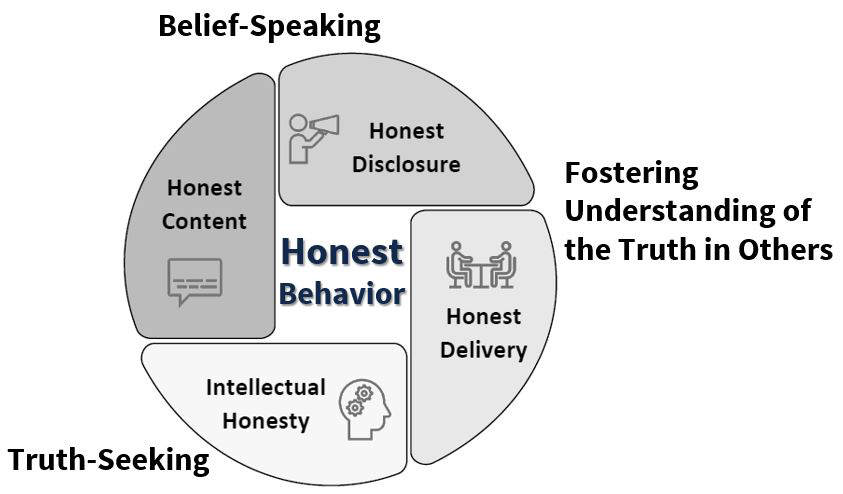
“Honest content” refers to the accuracy of the content a communicator shares.
“Honest disclosure” refers to the amount and depth of disclosure by the communicator.
“Honest delivery” refers to the manner in which the communicator shares or discloses information.
“Intellectual honesty” refers to the process by which a communicator develops, validates, and updates their beliefs.
 Surtil :