“Foresight” is on the rise.
What was a discipline restricted to a few people decades ago has become very popular. That’s good news – a wider use of foresight can have a number of benefits, as this guide explains.
However, along with that popularity, the expectations about the scope of foresight have also grown. We can even find an aura of mystery surrounding the discipline. This is less helpful, as there is a risk of creating misperceptions about the nature of foresight. That is why it is necessary to limit the scope of foresight from the outset by clearly stating what it is and is not.
Download the publication to keep reading.

Miguel Peco-Yeste served as a Policy Adviser at the Policy Planning Unit, Office of the NATO Secretary General, from 2020 to 2023. Throughout his professional career, he accumulated extensive experience in security and defence at the Spanish Ministry of Defence, NATO and the EU.
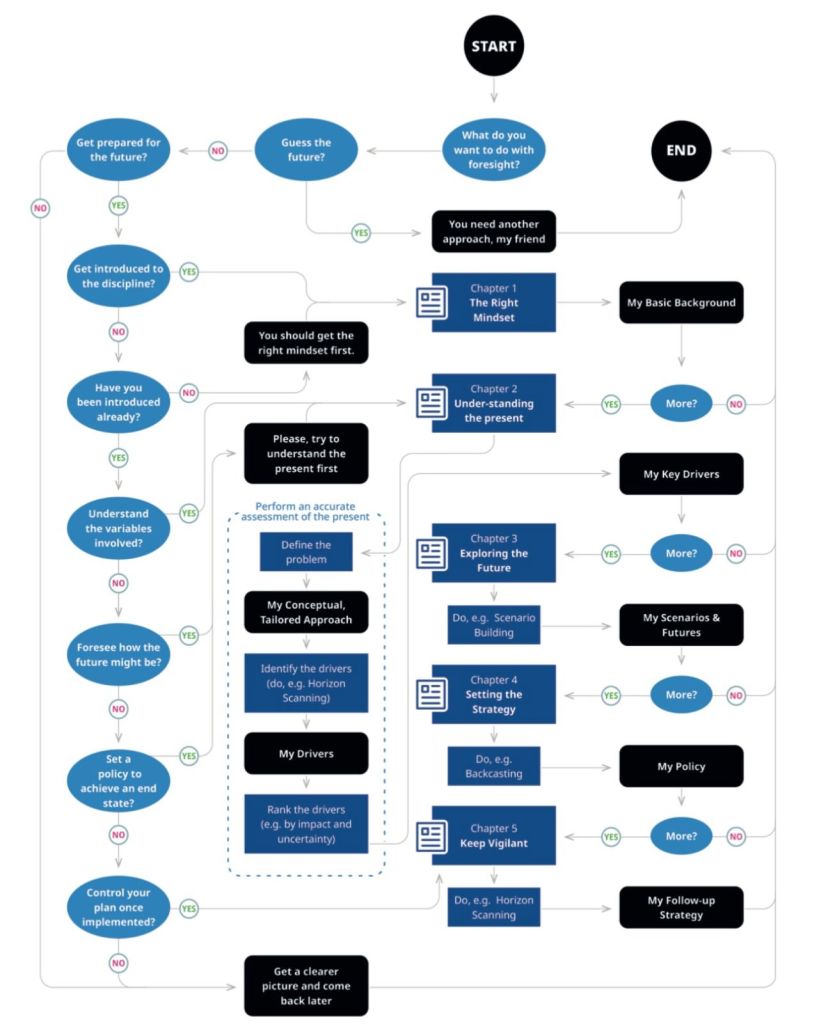
How to do Strategic Foresight!
I. The Right Mindset
1. Foresight is about gaining awareness of plausible futures that could arise based on the analysis of the present to anticipate and better prepare for change
2. Environments where a culture of foresight does not exist are frequently reluctant to implement related practices
3. Cognitive bias and wrong assumptions are always present in any foresight work
4. Finding time and resources to conduct large foresight exercises involving key staff in complex organizations could be extremely difficult. Instead, regular light-touch foresight work could be more beneficial
II. Understanding the Present
1. All foresight work begins with a strategic analysis of the current situation
2. The problem should be defined broadly enough to inspire alternative courses of action but sufficiently concise to avoid generalizations about the future
3. After identifying the drivers, ranking them by the impact on the problem identified and their degree of uncertainty will result in high impact trends and key uncertainties.
4. High impact trends and key uncertainties are the main deliverables at this stage
III. Exploring the Future
1. A range of possible futures (scenarios) will result from combining extreme values of key uncertainties to which we may add all the stable trends
2. Probable futures will result from comparing the scenarios we have identified against the current situation and then applying our judgment
3. The preferred future – or desired end state – can be identified in the range of plausible futures, but it does not necessarily have to coincide with the probable future. However, the more the preferred future differs from the probable future, the more demanding the strategy to achieve the former will be
4. Scenarios, and probable and preferable futures, are the main deliverables at this stage
IV. Setting the Policy
1. Foresight could become a useful tool to support the decision-making process and to help us prepare sound policies
2. Backcasting consists of envisioning a final desired situation, defining the objectives leading to that situation, and listing the actions necessary to achieve those objectives
3. The main deliverable at this stage is a specific policy or strategy aiming to achieve the preferable future
V. Keeping Vigilant
1. Strategic foresight is a cyclical process that requires continuous feedback
2. Organizations should be able to detect early signs of change and reorient their strategies accordingly
3. Establishing mechanisms to provide feedback to the process is also a good approach to creating a foresight culture in organizations
4. Horizon Scanning is a proper technique to detect signs of potential change in previously identified drivers