
“Nature heals: An informational entropy account of self-organization and change in field psychotherapy“
Highlights
- Disordered wandering dynamics are fundamental for therapeutic change.
- Free-energy minimization creates a field of more and less probable sensory/affective phenomena.
- Sensorily coupled free-energy-minimizing agents share a common phenomenal landscape.
- Therapy changes the phenomenal field by allowing surprise to enter the system.
- Healing intentionalities are intrinsic to any relational field.
This paper reviews biophysical models of psychotherapeutic change based on synergetics and the free energy principle.
These models suggest that introducing sensory surprise into the patient-therapist system can lead to self-organization and the formation of new attractor states, disrupting entrenched patterns of thoughts, emotions, and behaviours. We propose that the therapist can facilitate this process by cultivating epistemic trust and modulating embodied attention to allow surprising affective states to enter shared awareness.
Transient increases in free energy enable the update of generative models, expanding the range of experiences available within the patient-therapist phenomenal field.
We hypothesize that patterns of disorganization at behavioural and physiological levels, indexed by increased entropy, complexity, and lower determinism, are key markers and predictors of psychotherapeutic gains. Future research should investigate how the therapist’s openness to novelty shapes therapeutic outcomes.
Based on the intuitions derived from the Free-Energy Principle (FEP) and previous theoretical accounts, in this paper we suggest and set out to defend the following hypotheses to better understand stochastic change processes:
- Free-energy minimization creates a sensory state-space of more or less probable sensory/affective phenomena (phenomenal field), that can be visualized as a landscape with valleys (predictable states) and mountains (surprising states). Free-energy minimization then acts like a gravitational force attracting sensory experience towards the bottom of valleys.
A psychopathological pattern of feeling, thinking, and behaving can be seen has an attractor state or valley. - General synchronization implies that whenever two free-energy-minimizing agents, the therapist and the patient, are sensorily coupled they begin to share a phenomenal landscape.
Therefore, their experiential possibilities are governed by a common relational field of free-energy gradients. - Therapy aims at changing the relational, phenomenal field by allowing surprise to enter the system and reorganize it into novel attractors and patterns. This is done by embracing surprising sensory/affective states, previously residing outside the homeostatic boundary (and therefore less probable to be felt) and integrate them in the shared predictive representations of the sensory environment. In analogical terms, to use Friston’s metaphor of annealing in metallurgy, surprising states heat up rigid phenomenal fields (i.e. the brain’s free-energy landscape) that transitorily melt down and flatten the distance between valleys and mountains.
This momentary plasticity allows the system to move outside its usual attractors.

In panel A we depict perceptual learning as Bayesian inference under a Generative Model mapping from hidden inferred causes of sensations to sensory states. Each perceptual cycle updates prior predictive distribution based on the sensory likelihood conveyed by incoming sensory inputs. The posterior probability associated to sensory states defines regions of more and less surprising sensory states that define the econiche and phenotype of living organisms as shown in panel B. Homeostasis tries to reconduct actively sampled sensory states within the boundary of more predictable states which can be visualized as attractor states and local minima in the sensory/affective states space (panel C). The field of sensory experience maps regions of higher surprise associated to sensory and physiological states (in red), as it can be precipitating in free fall or being under water for a human organism, and regions of lower entropy, where the organism is more likely to be attracted, e.g. standing on solid ground. The sensory experience at point (a) is therefore characterized by lower PE, while larger PE are conveyed by sensory states at point (b).

Precision weighting of priors and sensory likelihood, that inversely depend on their variance σ2, corresponds in the FEP theory to the process of attentional allocation. The sensory likelihood precision up-weighting (and prior precision downweighting) allows larger magnitudes of posterior predictions updating, as depicted in panel A.
Overall, increasing the ratio between likelihood and prior precision makes the energy landscape or phenomenal field more plastic for change. This increased plasticity is implemented via modulations of the synaptic efficacy of inhibitory and excitatory connections conveying predictions and PWPE (precision-weighted prediction errors) respectively. The bigger arrow represents larger PWPE transmission and the consequent update of higher level predictions. Because the precision (i.e. inverse variance) of prior and posterior beliefs depends on the stability/volatility of the sensory environment, when surprising states are observed the precision of posteriors is down weighted so that σ2 post< σ2 prior. This means that through learning surprising sensory states as (a) become less surprising as represented by the flattened phenomenal field in panel B. At the same time homeostatic states at the basin of an attractor become less predictable. Overall, the free energy landscape changes and becomes flatter. PWPE: precision-weighted prediction error that approximates free energy in the short run
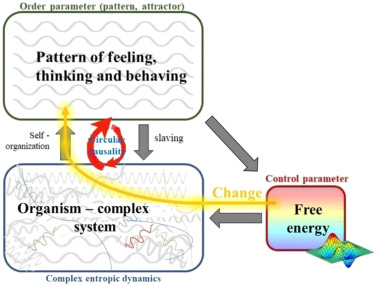
Synergetics can be applied to the organism environment interaction. In this case the control parameter might be described in terms of incoming Bayesian surprise (i.e. PWPE) approximating free energy, phenomenologically felt as salient arousing dissonance or emotional tension. This parameter feeds the complex dynamics that characterize the organism-environment interaction. The complex dynamics of self-organizing systems, here symbolized by disordered wave lines, are synchronized, and coordinated by structural elements, the order parameters. These patterns can be disturbed and globally altered by critically increasing energetic tensions, when emotional tension (control parameter) reaches a critical level. Then, entropic dynamics are enslaved and synchronized to an attractor state, which in the case of human organisms or systems of human organisms, might be a pattern of feeling, thinking and behaving.

Transient rises in surprise must be paradoxically tolerated to reach a lower less dysfunctional local minimum.
At t2, when a prediction error is encountered, a gain in free energy verifies.
On the base of previous contributions, we suggest that stochastic and contextual intervention might achieve change in a way that cannot be predetermined, by allowing free energy to enter the patient/therapist superindividual system.
In sum, throughout the paper we suggest that the intentional modulation of the therapist’s energy/information exchange can help the sensorily coupled therapist-patient organization to tolerate transient states of increased entropy associated to unpredicted sensory states, at the same time promoting the allostatic morphogenesis of their homeostatic boundary.
As previously discussed, in FEP terms, this might happen through the weakening of the estimated reliability associated with priors predictions and the parallel up-weighting of the relevance of novel surprising sensory states. In the long-run, such paradoxical exploration of surprising states can trigger self-reorganization processes.
Metaphorically, surprising “hot” states can “melt” the phenomenal landscapes that provides free energy gradients.
Thanks to this transient state of plasticity, the latter reorganizes into a landscape with novel attractor states.
Therapy might be considered as a peripatetic wandering dynamic that follows transformative intentionalities that belong to field.
 Surtil :