
Open access book, download available @ MIT Press
A new theory of Neurobiological Emergentism that explains how sentience emerges from the brain.

Sentience is the feeling aspect of consciousness. In From Sensing to Sentience, Todd Feinberg develops a new theory called Neurobiological Emergentism (NBE) that integrates biological, neurobiological, evolutionary, and philosophical perspectives to explain how sentience naturally emerges from the brain.
Emergent properties are broadly defined as features of a complex system that are not present in the parts of a system when they are considered in isolation but may emerge as a system feature of those parts and their interactions. Tracing a journey of billions of years of evolution from life to the basic sensing capabilities of single-celled organisms up to the sentience of animals with advanced nervous systems, including all vertebrates (for instance, fish, reptiles, birds, and mammals), arthropods (insects and crabs), and cephalopods (such as the octopus), Feinberg argues that sentience gradually but eventually emerged along diverse evolutionary lines with the evolution of sufficiently neurobiologically complex brains during the Cambrian period over 520 million years ago.
Ultimately, Feinberg argues that viewing sentience as an emergent process can explain both its neurobiological basis as well its perplexing personal nature, thus solving the historical philosophical problem of the apparent “explanatory gap” between the brain and experience.
Postulate 1: Sentience Is Ultimately an Emergent Feature of Embodied Life
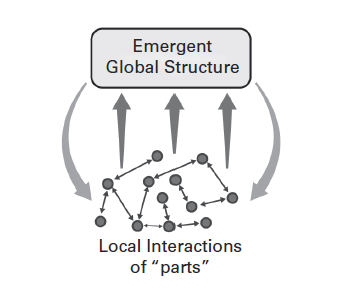
Postulate 2: Sentience Evolved in Progressive Stages That Are Characterized by an Increase in Novel Emergent Features
Postulate 3: The Increasing Degree of Standard Neurobiological Emergence Is What Makes Sentience Possible
Postulate 4: The Emergent Mechanisms of Sentience Are Diverse
Postulate 5: NBE (Neurobiological Emergentism) Can Naturally Explain and Reconcile the “Explanatory Gap”
Artificial sensors can detect and react to sensory input without feeling a thing; AI can do even more. Why can’t organisms do the same, without sentience? Neurologist Todd Feinberg tries to answer this question through the gradual ’emergence’ of sentience from unfelt sensing across billions of years of evolution. Has he succeeded? The reader must judge, but the voyage cannot fail to be a charged one.”
Stevan Harnad, Professor of Psychology, University of Quebec in Montreal
“The hard problems and explanatory gaps of consciousness are a principal focus here, where the author, a biological realist, takes a bottom-up, evolutionary perspective, with a particular focus on sentience as the basic issue to be explained. His exposition is thoughtful and conversational, with insights along the way even for those who might take a different stance on the nature and source of conscious experience.”
Thurston Lacalli, Biology Department, University of Victoria
 Surtil :
One response to “From Sensing to Sentience: How Feeling Emerges from the Brain”
[…] being spoiled by MIT Press Open Access. Not just did we just receive access to the great title “From Sensing to Sentience” , but also “A History of Bodies, Brains, and Minds: […]
LikeLike