
“Deciding how to decide: A conceptual model for consensually fostering urban infrastructure maintenance” discusses infrastructure owners facing challenges in effective maintenance decision-making due to the process’s multidisciplinary nature, spanning mathematics to cognitive science.
This study delves into enhancing maintenance for complex infrastructure systems, specifically in scenarios where a single primary owner must consider the preferences and requisites of multiple stakeholders.
In such unstructured problems characterised by diverse perspectives and potentially conflicting interests in uncertain environments, systematic decision analysis is paramount.
In response, this paper proposes a generic conceptual model to outline the primary critical consideration of decision-making through a holistic scheme of the decision problem; it facilitates discovering shared views when defining the decision problem, eliciting objectives early in the decision-making process, and ensuring that selected agendas align with desired outcomes and core values. It provides valuable guidance for decision-modellers in infrastructure rehabilitation. These claims are reinforced with the application of the proposed model to case studies, illustrating its practicality in real-world settings.
While complexity in infrastructure has factually existed in some form, the evolving approach to infrastructure management goes beyond defining assets solely in terms of physical components; instead, it should recognise infrastructure as part of a complex process. This claim holds validity as complex systems often exhibit emergent behaviour, a phenomenon arising from interactions among components that surpass the sum of individual behaviours. In this context, decision-making in infrastructure management becomes increasingly challenging due to the multidisciplinary nature of urban infrastructure issues, conflicting stakeholder objectives, extensive information, and limited budgets.
These factors contribute to ill-defined problems that lack clear parameters or solutions, making them difficult to define and address effectively.
Four key areas essential for effective infrastructure management decision-making:
– recognizing complexity and uncertainty,
– coordinating across stakeholders,
– applying systems thinking, and
– facilitating collaborative decision-making to achieve shared understanding.
Above the mathematical modelling of alternatives and outcomes, the model integrates economic, cognitive, and natural problem aspects to structure subjective and objective information for a holistic problem understanding.
The overarching aim of this study is to develop an integrated problem structuring guide pertaining to infrastructure maintenance within decision-making contexts.
In this matter, where complexity, uncertainty, and multi-stakeholder conflicts are multifaceted issues, this paper’s objectives are to
i) highlight the role of systems thinking in infrastructure asset management, focusing on decision clarity, core values, and the comparative analysis of alternative models to enhance informed and transparent decision-making;
ii) offer a systematic guide for implementing problem structuring agendas, covering data aggregation, stakeholder engagement, and the cognitive aspects of decision science in the context of infrastructure asset management;
iii) collaborate with a broad spectrum of stakeholders (those who are experiencing the problem), including urban planners, policymakers, industry leaders, etc. to incorporate diverse perspectives into the problem structuring process;
iv) facilitate stakeholder involvement when organising participatory workshops and group discussions to gather practical insights and assess the usability, transparency, and practicality of decision models, and
v) evaluate case studies addressing similar decision challenges from multiple perspectives, examining decision outcomes to extract valuable lessons.
The desired employment of the proposed model is characterised by choosing the appropriate decision frame, obtaining relevant and reliable information, identifying objectives and criteria, clarifying values and trade-offs, and ensuring stakeholders’ commitment to implementing the decision that is made.
The conceptual model, hereafter called the infinity mirror model (IM model), is composed of four main features related to influential factors time, uncertainty, the system setup, and aggregation in the decision-making process as almost every decision is influenced by at least one of these four elements. The main features and influential factors are combined into the model to describe the dynamic nature of decision-making within the rehabilitation of infrastructure projects, specifically urban water networks. The four distinct yet related features involved in the model are the input data, strategies and interests, values and utilities, and uncertainties.
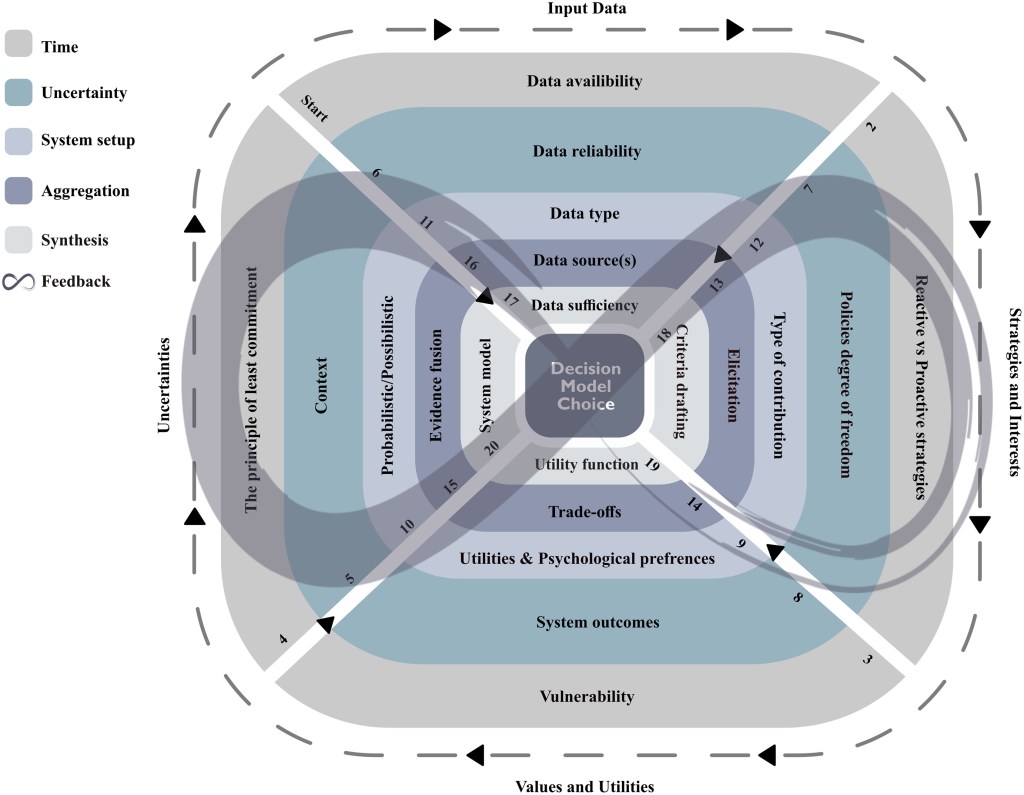
Encircling the nucleus are the input data, strategies and interests, values and utilities, and uncertainties, where these features are influenced by time, uncertainty, the system setup, and aggregation approaches.
To effectively manage uncertainty, decision makers must have a comprehensive understanding of the different levels of uncertainty that exist, ranging from complete certainty to total ignorance. Four levels of uncertainty are outlined; they are characterised by external forces (Context), the system model (R), the system outcome (O), and the valuation of outcomes (Weights).

Level 1 uncertainty arises from a lack of knowledge and can be addressed through sensitivity analysis. Level 2 uncertainty, or risk, can be statistically analysed, while Level 3 uncertainty, or ignorance, involves multiple probable outcomes without assigned probabilities. The deepest level, Level 4 uncertainty, is characterised by a lack of knowledge and data.
Occasionally, the decision makers can wait as long as possible before deciding to gather information to maximise the chance of making sound decisions; this is called the principle of least commitment.
To manage uncertainty, decision makers must know the entire spectrum of different levels of uncertainty, ranging from the unachievable ideal of complete certainty at one end to total ignorance on the other side.
Different kinds of literature have indicated that the classical probabilistic approach may have some limitations.
Possibility theory, terms such as linguistic variables, and fuzzy numbers have proven to be practical alternatives to precise probability for adequately modelling uncertainties of different kinds.
As such, the applicability of possibility theory as a particular case of imprecise probability can be evaluated against conventional probability theory for solving a decision problem. Methods for fusion of evidence from several sources, including big data, monitoring, condition assessment models, inspections, and expert opinions, might help reduce uncertainty reasonably.
Through aggregating and interacting with uncertainty, decision makers should consider employing evidence fusion techniques when they have learned about several sources of information or pieces of evidence in the previous steps.
To effectively navigate the multitude of decision-making modalities, it is crucial to structure the decision-making process based on a comprehensive understanding of a specific phenomenon from the perspective of those directly involved in it.
The proposed model emphasises the importance of systems thinking for transparent and informed decision-making, provides a systematic guide for problem structuring implementation, fosters collaboration with diverse stakeholders to incorporate multiple perspectives, encourages stakeholder involvement through workshops, and extracts valuable lessons from case studies to address complex decision challenges effectively.
This infinity mirror approach ensures that the chosen decision technique, out of the many available, has explicitly considered different levels of uncertainty and would be the best-established solution for a particular type of problem, organisation, and stakeholder.
 Surtil :