
“Personality organization and anxiety symptoms: Investigating the mediation of perfectionism“
Personality functioning has increasing significance in the assessment of mental health and mental disorders. Otto Kernberg’s model of personality organization is an extensively applied, theoretically grounded approach to categorizing the severity of personality impairment based on intrapsychic and interpersonal functioning.
This study aimed to investigate the mediating effect of perfectionism on the relationship between personality organization and anxiety.
In psychoanalytic theory, the concept of personality functioning has been well-known. Otto Kernberg described it under the term personality organization (PO) and developed the theory of three different levels of PO with increasing rates of personality dysfunction:
(1) normal/neurotic level (NPO),
(2) borderline level (BPO), and
(3) psychotic level (PPO) of personality organization.
The borderline level of PO can be divided into more and less severe subgroups.
Kernberg describes the level of personality organization through three basic dimensions: identity (i.e., integrated, stable and realistic sense of self and others, instead of unstable, poorly integrated, and unrealistic experiences), quality of defense mechanisms (i.e., unconscious methods of emotion-regulation which can work on a broad spectrum ranging from mature defenses to a dominance of primitive defenses) and reality testing (i.e., ability to distinguish between self and non-self, external and internal stimuli). Identity diffusion and primitive defense mechanisms are specific mechanisms of BPO, while the additional impairment of reality testing is a sign of a PPO.
Perfectionism can be defined as a multidimensional personality trait, suggesting that trait perfectionism has three stable dimensions. Self-oriented perfectionism (SOP) involves setting high personal standards and expecting excellence from oneself. In contrast, other-oriented perfectionism (OOP) covers prescribing these high standards to others, assuming them to be perfect. Socially prescribed perfectionism (SPP), however, relates to the belief that others expect perfection from oneself. Various studies imply that SOP and SPP are related to depressive experiences, maladaptive rumination and symptoms. Perfectionism, in general, but especially SPP, is also strongly associated with hopelessness, suicidal thoughts and dysfunctional attitudes. Consistent with this, a meta-analytic study demonstrated a significant and strong weighted correlation between SPP and anxiety disorders in a meta-analytic study, while the weighted correlation between SOP and anxiety disorders was non-significant. OOP has been associated with other blame, authoritarian and domineering characteristics, but there is less evidence of a link between OOP and psychological distress. There are also contradictory results: SOP is also shown to correlate with high self-esteem and resourcefulness.
Perfectionism was a common trait of depressed patients with narcissistic personality disorder; it was not common, though, in depression without personality disorder.
According to Kernberg’s model, personality organization is deeply rooted in early developmental experiences, particularly the quality and consistency of caregiving relationships. These interactions shape the individual’s ability to integrate self and object representations, resolve aggressive and libidinal impulses, and develop mature defenses, identity cohesion, and reality testing. Such foundational processes profoundly influence an individual’s psychological resilience, interpersonal functioning, and susceptibility to psychopathology.
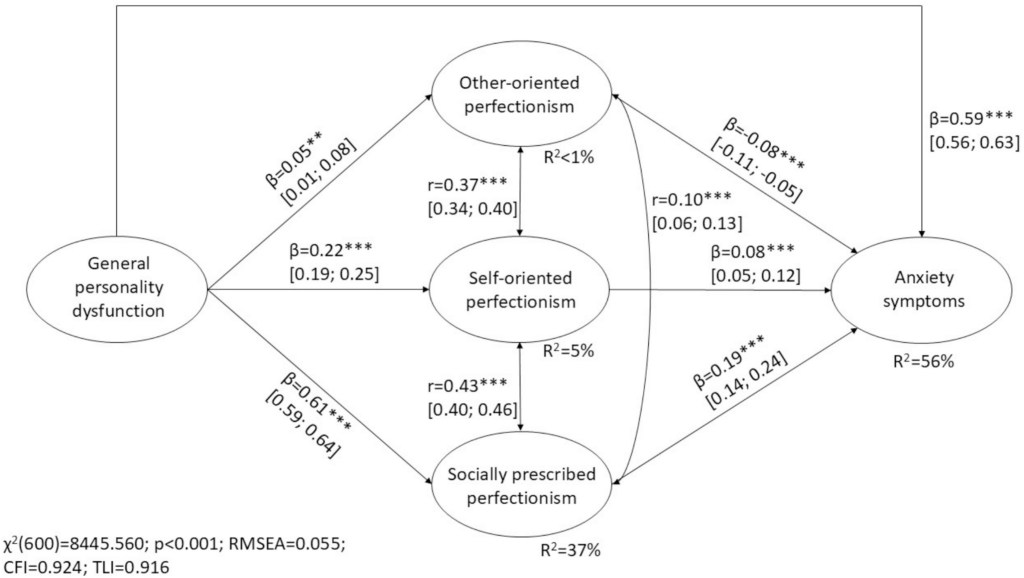
Significant standardized regression (β) and correlation (r) coefficients are shown by *p < .05; **p < .01; ***p < .001. Specific factors of identity diffusion, primitive defenses, and reality testing are not presented in the figure, but these latent variables were included in the structural model (see further: bifactor model).
Data demonstrated that a higher level of general personality dysfunction is associated with higher self-oriented (SOP) and especially higher socially prescribed perfectionism (SPP), which correlated with more severe symptoms of anxiety.
General personality dysfunction is also associated with higher levels of other-oriented perfectionism (OOP).
These findings supported our hypothesis that two dimensions of perfectionism (SOP, SPP) may have mediating roles in the relationship between personality dysfunction and anxiety. This result is also in line with recent research reviewed, which suggests that the interpersonal components of perfectionism are associated with borderline pathology. However, we have also found a strong, direct positive relationship between general personality dysfunction and anxiety.
 Surtil :