
“Resilience phenotypes derived from an active inference account of allostasis“:
Within a theoretical framework of enactive allostasis, we explore active inference strategies for minimizing surprise to achieve resilience in dynamic environments.
While individual differences and extrinsic protective factors traditionally account for variability in resilience trajectories following stressor exposure, the enactive model emphasizes the importance of the physical and social environment, specifically the “enactive niche,” which is both shaped by and impacts organisms living in it, accounting for variable success in allostatic prediction and accommodation.
Enactive allostasis infers or predicts states of the world to minimize surprise and maintain regulation after surprise, i.e., resilience. Action policies are selected in accordance with the inferred state of a dynamic environment; those actions concurrently shape one’s environment, buffering against current and potential stressors.
Through such inferential construction, multiple potential solutions exist for achieving stability within one’s enactive niche.
Spanning a range of adaptive resilience strategies, we propose four phenotypes—fragile, durable, resilient, and pro-entropic (PE)—each characterized by a constellation of genetic, epigenetic, developmental, experiential, and environmental factors.
Biological regulatory outcomes range from allostatic (over)load in the fragile and durable phenotypes, to allostatic recovery in resilience, and theoretically to increasing allostatic accommodation or “growth” in the proposed PE phenotype.
Awareness distinguishes phenotypes by minimizing allostatically demanding surprise and engenders the cognitive and behavioral flexibility empirically associated with resilience.
We further propose a role for awareness in proactively shaping one’s enactive niche to further minimize surprise. We conclude by exploring the mechanisms of phenotypic plasticity which may bolster individual resilience.

This conceptualizes the brain, operating as a self-organizing agent, within an entropic environment. In the process of self-organization, the agent interacts with the environment, with the potential of shaping the environment, as the environment simultaneously shapes the agent’s behavioral interactions. This forms an enactive niche.
Specific elements include: Generative Model(s) are probabilistic models of the cause-effect structure of the environment. They generate predictions of incoming sensory inputs using relevant prior models engendered by genetic, epigenetic, development, and previous experiences. These Bayesian priors are adjusted by active inference to reduce (precision-weighted) prediction error, or surprise. These models generate predictions in all sensed modalities (i.e., exteroceptive and interoceptive) and, in deep or hierarchical predictions of predictions of precision (c.f., metacognition and attention, respectively) necessary for awareness. Prediction Error is the difference between predicted and sensory inputs and is synonymous with surprise. Mathematically, free energy is a computable upper bound on surprise. Precision scores the reliability, confidence or efficacy afforded predictions and prediction errors. Higher sensory precision, as indicated by darker lines, results in predictions with less tolerance for sensory error, leading to greater belief updating in the face of precise sensory information. Bayesian Model (a.k.a., belief) Updating uses precision weighted prediction errors to revise or update prior Bayesian beliefs into posterior beliefs (i.e., after seeing sensory input). Perceptual Inference provides the “best explanation” for the causes of sensory input by which predictions of sensory input enable prediction errors to update prior beliefs. Perception is part of active inference and includes exteroception, interoception, and proprioception. Active Inference selects policies to change the enactive niche to better align with predictions. As indicated by the lower arrow, active inference can also act upon awareness, effectively linking the environment and awareness. This results in an enactive niche linking the agent with all environmental and social elements with which the agent interacts. Active inference allows for the niche to shape the agent and the agent to shape the niche.
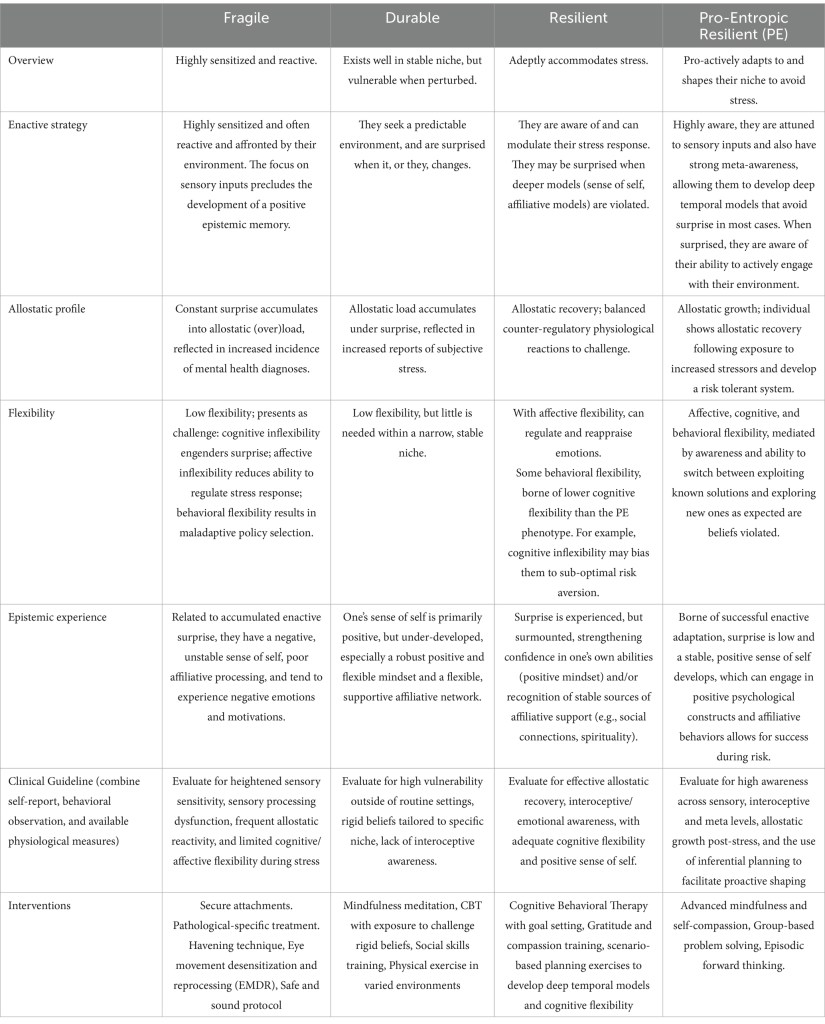
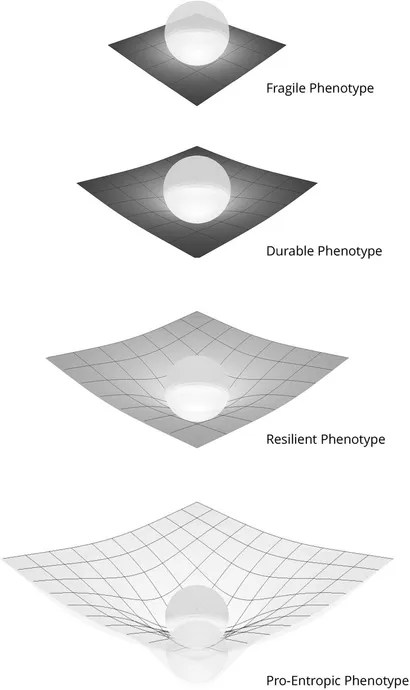
These schematics depict the relationship between the agent, as represented by the orb, and their enactive niche reflected by the grid. Three aspects of the grid are relevant: (1) the size: reflecting the range of physical and social diversity within the agent’s niche, (2) the shade: indicating the characteristic prediction error within the niche, lighter less error, and (3) the depth of the orb within the grid indicating the degree to which the agent has enactively shaped the niche.
Fragile exists within a small niche with a limited range of accurate predictions. It exerts minimal influence on its enactive niche, rather exists as a slave to its senses.
Durable has a well-defined niche within which it makes accurate predictions. Within this narrow niche it can shape the environment, provided the niche forwards minimal surprise.
Resilient exists within a broad, diverse niche with a wide range of accurate predictions and an ability to accommodate surprise. It shapes its niche to better support its predictive allostasis.
Pro-entropic has the characteristics of the Resilient with the addition of proactive enactive awareness; allowing context-sensitive and adaptive predictions even in novel niches, as suggested by the superimposition of the orb.
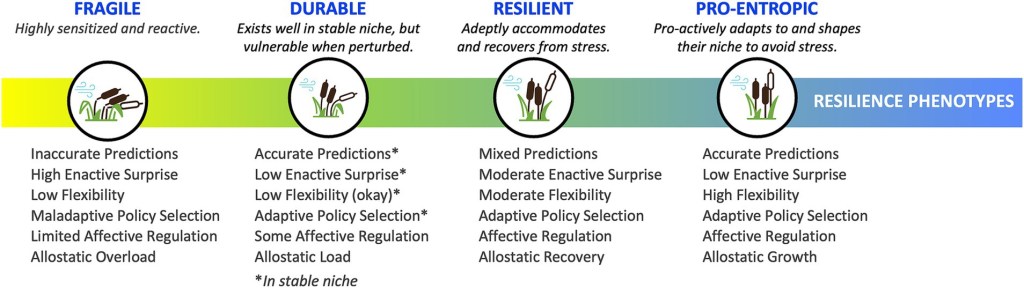
The four resilience phenotypes exist along a continuum—from fragile to durable to resilient to pro-entropic—and are characterized along key dimensions
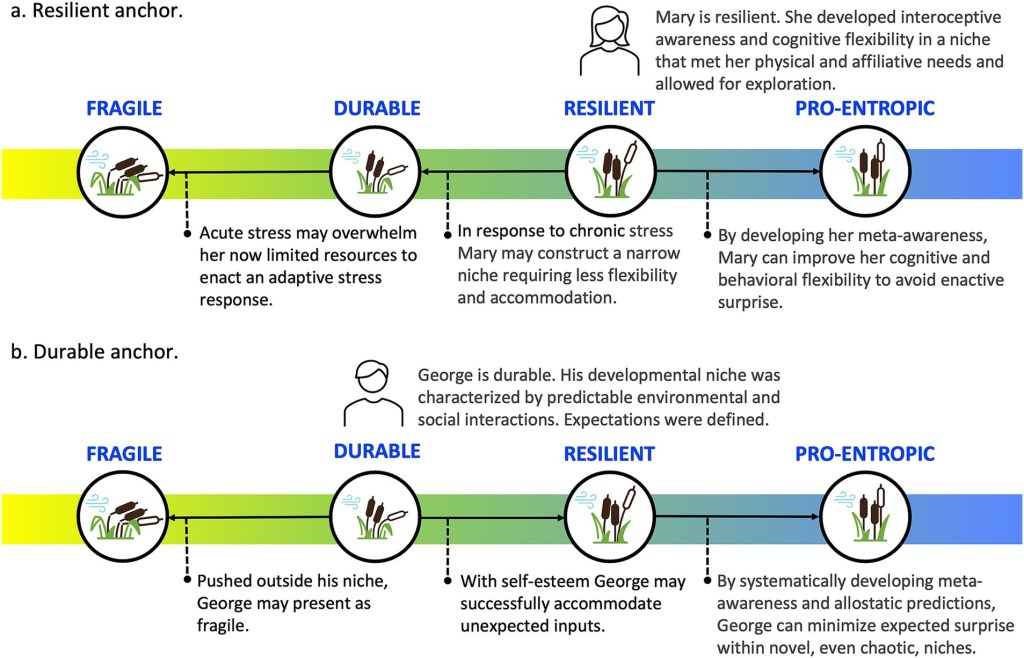
Highlighting the plasticity of the resilience phenotypes, we provide examples of two individuals’ current phenotypic presentation (“anchor”) and factors that can induce their movement along the resilience continuum. In these transitions, we emphasize the impact of different types of awareness on allostatic responses to changes in the enactive niche.
(a) Mary presents as the resilient phenotype.
(b) George serves as a durable example.
Within the theoretical framework of enactive allostasis, we propose four resilience phenotypes: fragile, durable, resilient, and pro-entropic resilient. Within this model, individual differences in adaption to one’s environment can be predicted at various levels of inquiry; from genetics and epigenetics to counter regulatory physiological systems, to epistemic awareness and concomitant affective, cognitive, and behavioral flexibility.
In this enactive allostasis framework, the environment or enactive niche is inseparable from the individual, as is highlighted by the distinction between the fragile and PE phenotypes. Both are sensitive to the sensory inputs provided by their environment and body. These inputs are the central focus of the enactive niche within which the fragile exists, often leading to overly precise predictions without a clear reduction in uncertainty due to constrained sampling of sensory inputs. Consistent with an account of active versus passive coping best mitigating against physiological “wear and tear” experienced with stress and aging, with the PE sensory inputs are predicted within a broader enactive niche, allowing for a wider sampling strategy and utility of epistemic memory and deeper temporal models.
Given the large amount of phenotypic variability and plasticity inherent in this model, advanced quantitative analytic techniques are needed to confirm the model. Such a measurement schema has been advanced as a principled Bayesian model of emotional valence. Relying on the assumption that feeling good or bad, i.e., emotional valence, is critical to survival and is largely predictable using deep active inference to estimate overall model fitness. Understood at psychological, neuronal, behavioral and computational levels, second-order beliefs (beliefs about beliefs) track affective change. The concept of criticality, defined as the dynamic of persistent attractors between a stable and an unstable phase, has been suggested to be informative in understanding differences between such states as allostatic load and allostatic repair, i.e., resilience, and will be important as efforts to model resilient phenotypes and their plasticity proceed.
 Surtil :