“The cultural macroevolution of arcade video games: innovation, collaboration, and collapse”
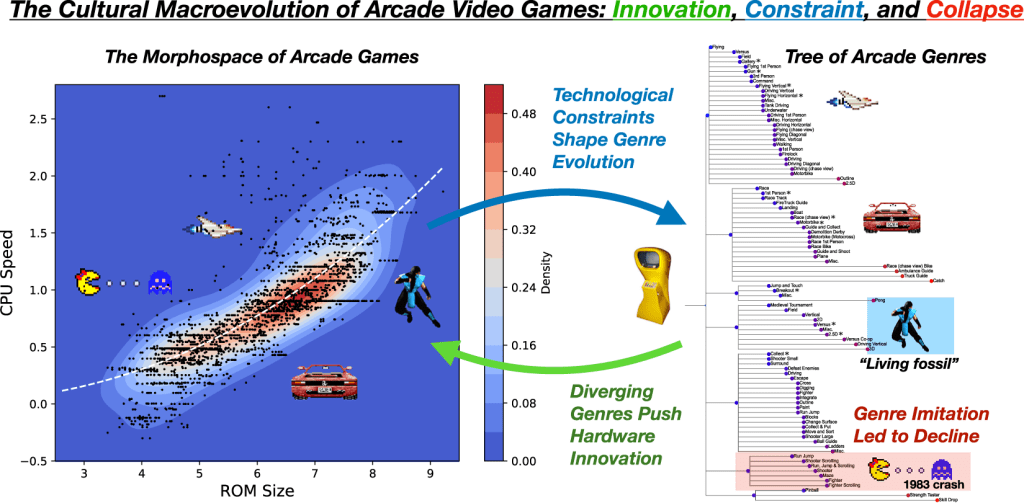
Arcade video games evolved in a constrained design space, following patterns of diversification, stabilisation, and collapse that mirror macroevolutionary processes.
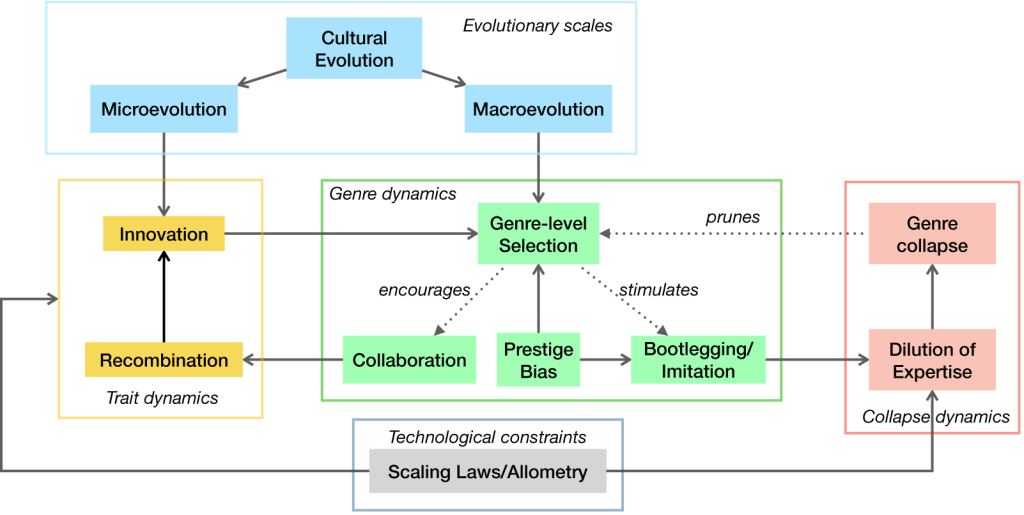
Despite their historical significance and detailed digital records, arcade games remain underexplored in cultural evolution research. Drawing on a dataset of 7,205 machines spanning four decades, we reconstruct the evolutionary trajectories of arcade niches using a multi-scale framework that integrates trait-level innovation, genre-level selection, and systemic constraints.
We identify two contrasting dynamics:
(1) resilient genres—such as Fighter and Driving—maintained long-term viability through innovation and collaboration networks, while
(2) early Maze and Shooter subgenres collapsed due to imitation and weak collaboration.
Morphospace analysis reveals how technological traits—specifically CPU speed and ROM size—co-evolved with gameplay complexity, shaping the viable design space. We argue that genres operated as evolving cultural-ecological units—structured niches that shaped trait evolution through reinforcement, constraint, and feedback.
This multi-scale perspective positions arcade games as a rich model system for studying cultural macroevolution.

(a) Schematic of the Battlezone arcade system (Atari, 1980), a ‘Shooter/Tank Driving’ game, illustrating both external and internal components. Adapted from Atari Inc.’s ‘Operation, Maintenance, and Service Manual’ (1980), the front view highlights user interaction elements (e.g., control panel, viewing window), while the rear view reveals key internal hardware, including the Auxiliary PCB and Analog Vector-Generator PCB.
(b, c) Temporal distribution of logarithmic CPU clock speed (b) and logarithmic ROM size (c) across arcade machines, demonstrating the increasing complexity of arcade hardware over time. The position of Battlezone within both distributions is marked (black dot).