
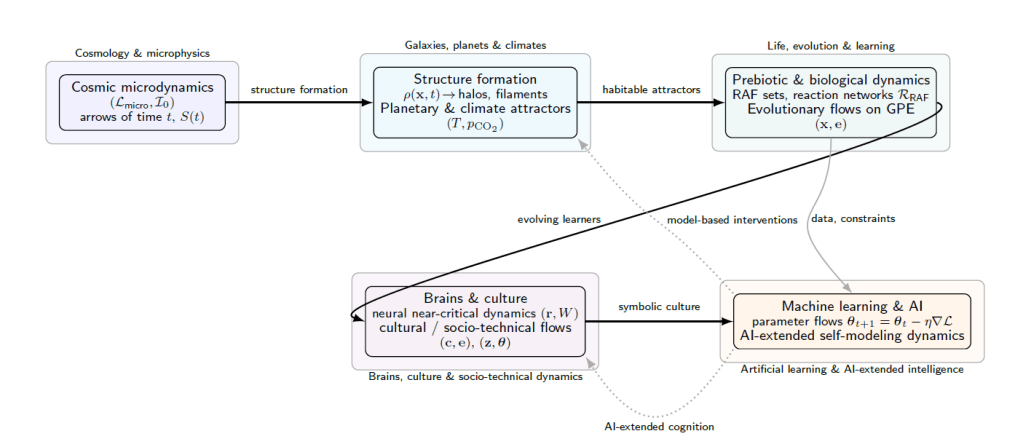
We develop a unified, dynamical-systems narrative of the universe that traces a continuous chain of structure formation from the Big Bang to contemporary human societies and their artificial learning systems. Rather than treating cosmology, astrophysics, geophysics, biology, cognition, and machine intelligence as disjoint domains, we view each as successive regimes of dynamics on ever-richer state spaces, stitched together by phase transitions, symmetry-breaking events, and emergent attractors.
Starting from inflationary field dynamics and the growth of primordial perturbations, we describe how gravitational instability sculpts the cosmic web, how dissipative collapse in baryonic matter yields stars and planets, and how planetary-scale geochemical cycles define long-lived nonequilibrium attractors.
Within these attractors, we frame the origin of life as the emergence of self-maintaining reaction networks, evolutionary biology as flow on high-dimensional genotype-phenotype-environment manifolds, and brains as adaptive dynamical systems operating near critical surfaces.
Human culture and technology-including modern machine learning and artificial intelligence-are then interpreted as symbolic and institutional dynamics that implement and refine engineered learning flows which recursively reshape their own phase space.
Throughout, we emphasize recurring mathematical motifs-instability, bifurcation, multiscale coupling, and constrained flows on measure-zero subsets of the accessible state space.
Our aim is not to present any new cosmological or biological model, but a cross-scale, theoretical perspective: a way of reading the universe’s history as the evolution of dynamics itself, culminating (so far) in biological and artificial systems capable of modeling, predicting, and deliberately perturbing their own future trajectories.
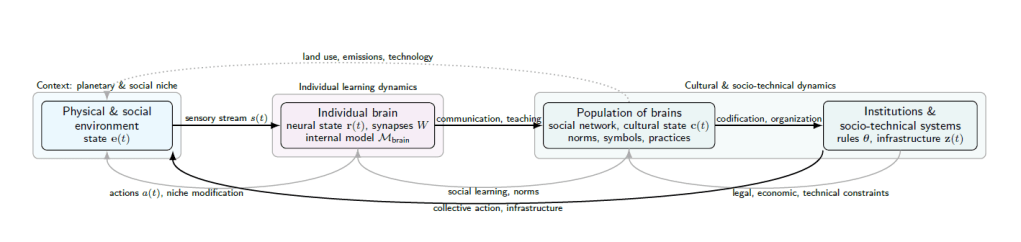
Individual brains implement fast neural dynamics and internal modelsMbrain that couple sensory streams from the physical and social environment e(t) to actions. Populations of brains, connected by social networks, give rise to cultural states c(t) and institutions with rule–like variables θ, which in turn reshape both the social niche and the physical environment. This panel provides the context within which AI systems are designed, deployed, and interpreted.
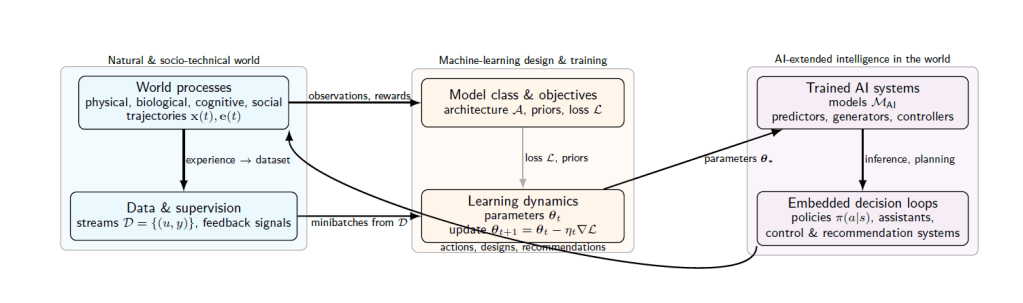
World processes (physical, biological, cognitive, social) generate data streams D and feedback signals that feed into model design (choice of architecture A, priors, and loss L) and learning dynamics for parameters θt. Trained AI systemsMAI are then embedded in decision and control loops that act back on the world, altering future data and thereby closing the learning–deployment feedback. Human brains and cultural institutions supply the scientific priors, objectives, and governance structures that shape these dynamics.
Seen through the lens of dynamical systems, the history of the universe is not just a story about states evolving under fixed laws. It is also a story about the emergence of new levels of description, new effective variables, and new learning mechanisms that act on those variables. From this viewpoint, each major transition in our narrative—from cosmic inflation to galaxies, from planets to life, from evolution to brains, from culture to machine intelligence—is a step in the evolution of dynamics itself : what the universe is doing, and how it organizes what it is doing, become progressively richer.
The universe began in a state that knew nothing of state spaces, flows, or attractors. Through a long chain of instability, self-organization, and learning, it has come to contain subsystems that not only instantiate these concepts but also manipulate them. A cosmos of fields and particles gave rise to galaxies and planets, then to cells and organisms, then to brains that map their surroundings, then to cultures that construct science and mathematics, and now to machines that share, extend, and operationalize
those models.
In this sense, the story we have told is reflexive.
The dynamical-systems framework we use to describe the universe is itself a product of particular dynamical processes (brains, cultures, AI models) operating within that universe. To the extent that we can understand and shape the future, it will be by further developing such frameworks—by building better models of learning and control, and by embedding them in institutions and technologies that steer us toward dynamical regimes we judge desirable.
Whether self-modeling, self-modifying dynamics are a rare cosmic curiosity or a common late-time attractor remains an open question. What is clear is that, for us, they are the regime in which we now live. To study the evolution of dynamics itself is therefore not an idle metaphysical exercise, but a way of clarifying the stakes of our own continued trajectory—as one small set of flows, among many, in a universe whose capacity for structure and learning we are only beginning to glimpse.
 Surtil :