“The paradox of predictability provides a bridge between micro- and macroevolution”
The relationship between the evolutionary dynamics observed in contemporary populations (microevolution) and evolution on timescales of millions of years (macroevolution) has been a topic of considerable debate. Historically, this debate centers on inconsistencies between microevolutionary processes and macroevolutionary patterns. Here, we characterize a striking exception: emerging evidence indicates that standing variation in contemporary populations and macroevolutionary rates of phenotypic divergence is often positively correlated. This apparent consistency between micro- and macroevolution is paradoxical because it contradicts our previous understanding of phenotypic evolution and is so far unexplained. Here, we explore the prospects for bridging evolutionary timescales through an examination of this “paradox of predictability.” We begin by explaining why the divergence–variance correlation is a paradox, followed by data analysis to show that the correlation is a general phenomenon across a broad range of temporal scales, from a few generations to tens of millions of years. Then we review complementary approaches from quantitative genetics, comparative morphology, evo-devo, and paleontology to argue that they can help to address the paradox from the shared vantage point of recent work on evolvability. In conclusion, we recommend a methodological orientation that combines different kinds of short-term and long-term data using multiple analytical frameworks in an interdisciplinary research program. Such a program will increase our general understanding of how evolution works within and across timescales
“How wonderful that we have met with a paradox. Now we have some hope of making progress.”
Niels Bohr
In this review, we explore the proposition—implied by the quote from Niels Bohr—that the paradox of predictability offers an exciting research opportunity to deepen our understanding of how microevolutionary processes are related to macroevolutionary patterns.
We outline a research program that goes beyond the largely correlational evidence documenting the divergence–variance relationships to secure a mechanistic understanding of the processes that cause the correlations. Such an understanding should incorporate data, concepts, methods, and results from many disciplines that have explored different dimensions of the paradox from the standpoint of recent work on evolvability: the capacity of a population to evolve in response to selection. Those disciplines include paleontology, quantitative genetics, evolutionary developmental biology, experimental evolution, comparative morphology, and theoretical biophysics. With this in mind, we first clarify why the divergence–variance correlation is a paradox. Second, we confirm the generality of the correlation between variation and the rate and direction of phenotypic divergence through analyses of newly assembled time-series data. Then we show how different evolvability-oriented disciplines, including quantitative genetics, the comparative study of morphology, evo-devo, and paleontology, offer powerful complementary approaches to resolving the paradox. We conclude with a list of outstanding questions that help to clarify how distinct disciplines and approaches might be integrated, thereby advancing research on the paradox of predictability.
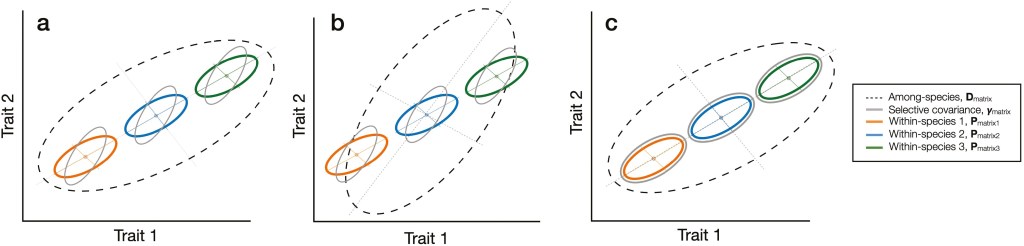
(a) D is proportional to P, suggesting that the pattern of divergence is shaped by the pattern of variation, supporting the constraint hypothesis.
(b) D is proportional to 𝞬, suggesting that the pattern of divergence is shaped by multivariate stabilizing selection, supporting the selection–shapes–variation hypothesis.
(c) D is proportional to both P and 𝞬. The relationship is consistent with both hypotheses, and one cannot disentangle the two from these relationships.
The prevalence of positive correlations between standing variation in contemporary populations and macroevolutionary rates and the direction of phenotypic divergence is paradoxical. However, it also offers novel prospects for bridging evolutionary timescales.
Historically, the relationship between microevolution and macroevolution has been posed primarily as a substantive, single question with two options:
(i) macroevolution is the summation of microevolutionary processes and
(ii) macroevolution involves distinct processes from microevolution.
More than a decade ago, it was argued that “We lack a comprehensive understanding of evolutionary pattern and process because short-term and long-term data have rarely been combined into a single analytical framework”. Our discussion of the paradox of predictability points to a common analytical framework that could bridge timescales in evolutionary analysis. Instead of a single question to be answered, we are challenged to identify short-term and long-term data that can be related to each other. Building such relationships forms an open-ended research program that can be pursued using multiple analytical frameworks.
 Surtil :