
“The active construction of past episodes”
Episodic memories – declarative memories of past events, characterized by rich spatiotemporal context – play a central role in guiding perception and behaviour.
Here, we advance a model that integrates episodic memories within the active inference framework. We describe how episodic memories are incorporated into the generative models used in active inference to support the re-construction, replay and communication of past events. In doing so, we foreground two foundational themes.
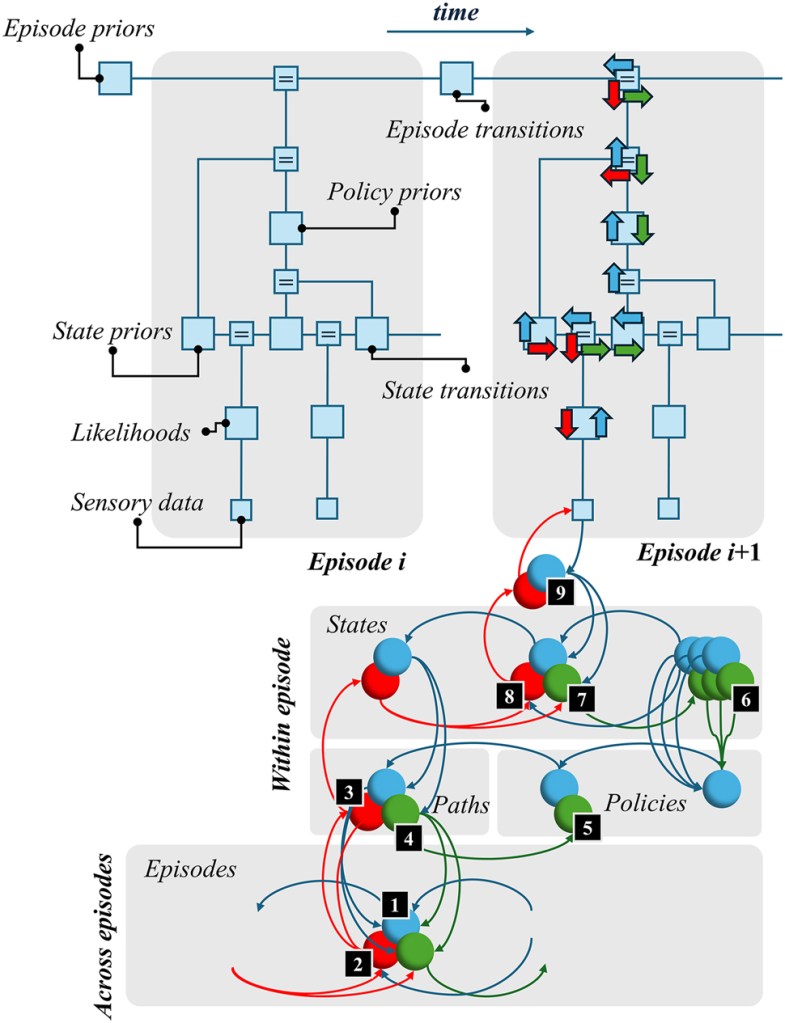
The first is the message passing in deep temporal models that allow one to actively construct memories of episodes.
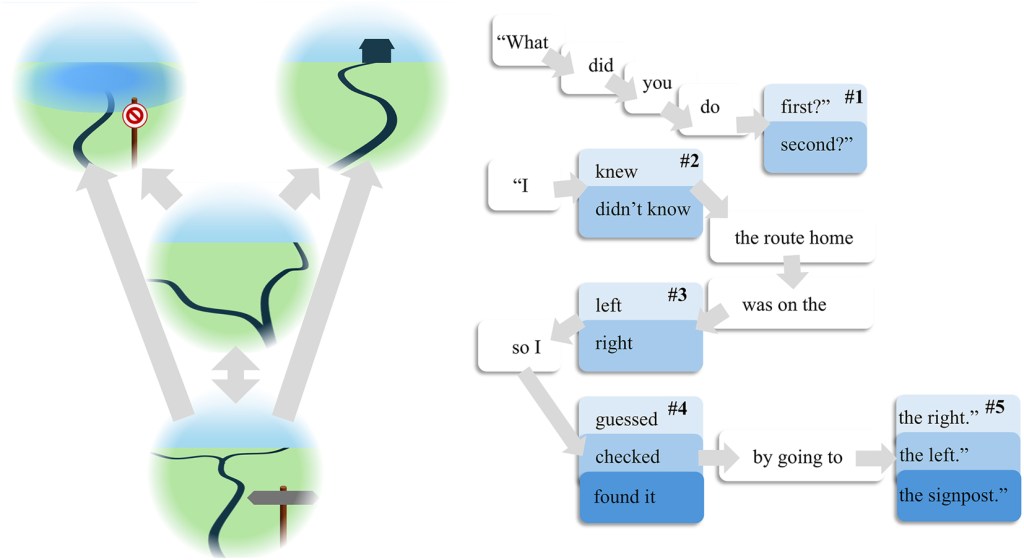
The second is the communicative aspect of declarative memories, and the way in which one might recount something from one’s autobiography.
In effect, this means that the message passing that supports episodic memory propagates information about what we have done – or what we would do – given past circumstances to draw inferences about how to communicate those beliefs.
Together, these themes emphasise that we are not passive recorders of the things that happen to us. We are active participants in the events we recall and in the telling of stories about them.
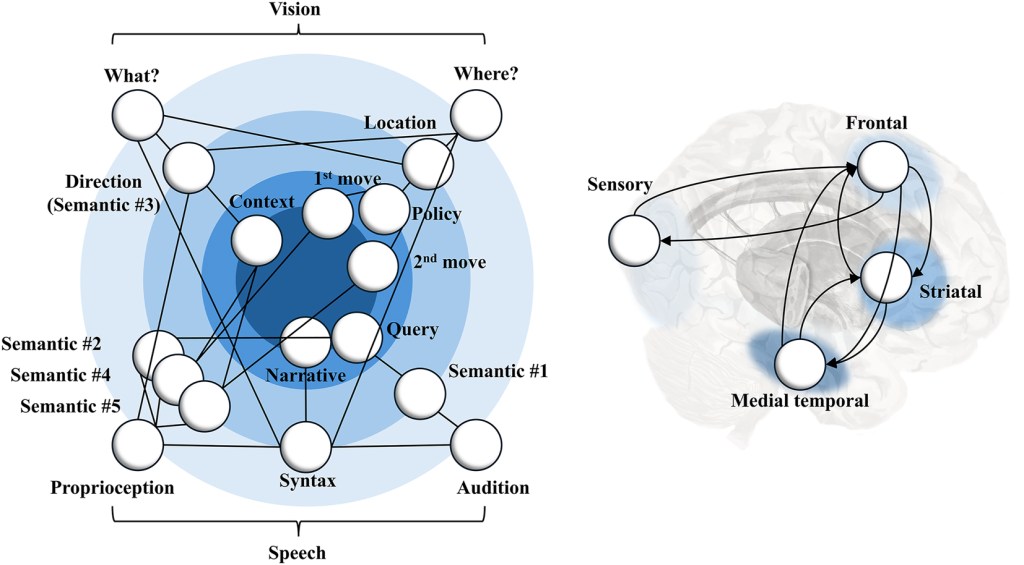
From the perspective of active inference, behaviour is accounted for in terms of the internal generative world model a brain uses to guide inference (by synaptic message passing) and action. The core idea is that, by predicting the sensory data one would expect if all were going well, our nervous systems can select the actions that realise those predictions. Framed in this way, the definition above tells us two things. A generative model for a creature capable of declarative memories must include a communicative component. If the requisite declarations are verbal, it would need to predict the sensory (e.g., auditory) consequences of speech. For it to be episodic, it must entail statistics about the place and time at which an event occurred.
Memory in natural creatures is a constructive process – not an exhaustive recording of all that has happened in the past. During encoding of memories, a compressed representation is formed that can subsequently be used for reconstruction of the event during recall. However, this poses a problem. If we draw inferences based upon a generative model, how do we go about reconstructing the inferences we made in the past when trying to explain current sensory data? This tells us that a further aspect of memory is the ability to transiently suppress the influence of current sensory data – i.e., to attenuate their precision – during the recall of a memory. Otherwise, the constraints imposed by the world, as it currently is, make it difficult to entertain inferences about the world as it was at some point in the past.
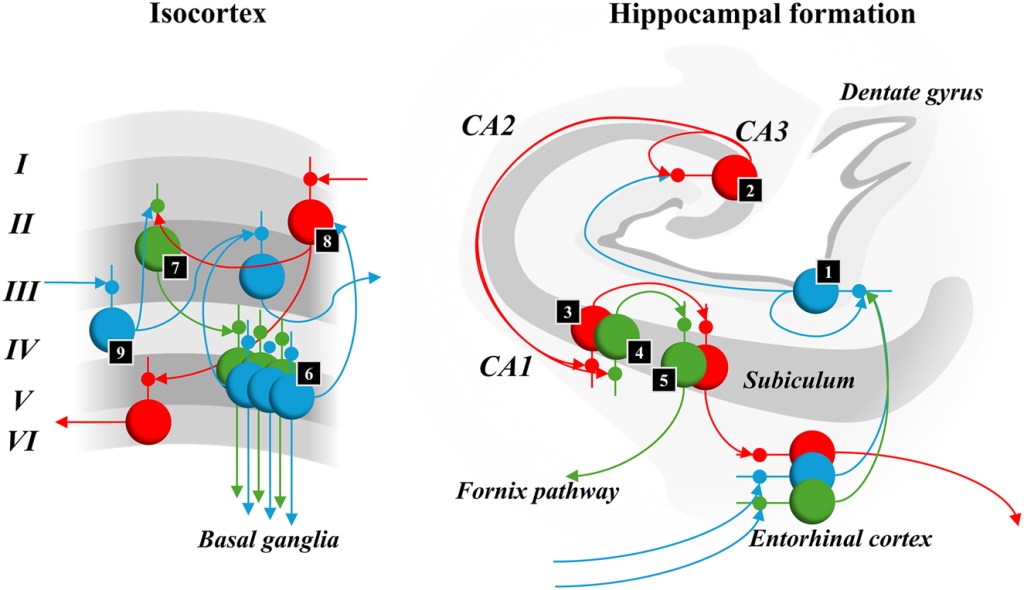
The isocortical layers are shown from superficial (layer I) to deep (layer VI) in the vertical dimension.
The hippocampal formation is shown as a coronal slice.
For each of these, we preserve the connectivity implied by the model of Figure 1 and the patterns of laminar connectivity known from empirical research as summarised in the main text. The convergence of ascending and descending messages onto population #7 in the isocortex graphic facilitates prediction of several possible alternative futures (populations labelled #6). Perhaps the relative complexity of the 6 layered neocortex is that it predicts futures conditioned upon actions which, communicated to the basal ganglia via layer V, help in adjudication between plans. In contrast, 3 layered allocortex may predict sequences that offer compressed representations, that are only unpacked into predictions of policies and of states conditioned upon those policies through projections either to neocortex or basal ganglia.
[…] Emerging developments in theoretical neurobiology, specifically active inference, might play a role in our understanding of episodic memory.
The contribution of active inference here is the idea that memory is an active process in which one constructs imagery of the past based upon empirical prior beliefs about how one acted, or would have acted, in a given context.
The definition of declarative memory is inherently active in the sense that it implies the ability to declare or communicate the contents of a memory.
This underlines the importance of developing models that capture both the behaviour during the episode to be recollected but also the declarative process of communicating those events.
By modelling the communicative part of memory, we move a step closer to a computational account of the measurements taken by clinicians, implicitly, while listening to a patient’s story.
 Surtil :