
“Music as a scientific metaphor for mind and brain”
Metaphors have long played multiple roles in conceptualizing the mind and brain, guiding the development and refinement of theoretical models and empirical questions. Early analogies (comparing the brain to hydraulic systems, telephone exchanges, factories, or libraries) offered shortcuts to understanding aspects of cognition, memory, and brain dynamics. From theoretical frameworks, metaphors like the mind as a computer evolved into central scientific metaphors, shaping core theoretical frameworks, inspiring predictions, and informing research methodologies. As such, metaphors play a key role in guiding scientific inquiries.
Building on that premise, we propose music as a scientific metaphor for understanding multiple brain dynamics and cognitive functions. Unlike metaphors focusing on static components or linear flows, music emphasizes continuous adaptation, context-dependence, and cultural embedding, and presents a model for simultaneous engagement with multiple layers of meaning. Integrating analytical techniques from music theory and experiential insights from performance and listening, we can deepen our understanding of mind and brain dynamics and provide fresh epistemological pathways for interdisciplinary research.
Music has a hierarchical structure, temporal complexity, and capacity to integrate multiple processes that parallel key features of the brain’s architecture and cognitive functions. Drawing from research on neural oscillations, plasticity, predictive coding, and emotional processing, we illustrate how the musical paradigm can capture the rich entanglement of mind and brain, from large-scale brain dynamics and developmental trajectories to the emergence of consciousness and the interplay of affective states.
| Source domain | Metaphor | Target domain |
|---|---|---|
| Mechanics | Hydraulic | Brain activity as fluid flow; mechanistic understanding |
| Communication | Telephone exchange | Neurons as wires; signal transmission |
| Industrial process | Factory | Brain regions as specialized workers; compartmentalization |
| Knowledge management | Library | Memory storage and retrieval as accessing books |
| Performance | Theatre | Consciousness as a spotlight on a mental stage; attention |
| Agriculture | Gardening | Neural pruning as maintenance/growth; weeding out connections |
| Communication | Network | Brain as a global network; connectivity and information flow |
| Mechanics | Clockwork | Brain as a precise, deterministic machine |
| Hierarchical organization | Military structure | Brain as a command center; hierarchical control |
| Management | Business | Prefrontal cortex as CEO; ‘executive’ functioning |
| Architecture | Construction | Learning as incremental building |
| Transportation | Traffic system | Neural pathways as highways; bottlenecks and flow regulation |
| Energy systems | Energy grid metaphor | Neurons as power stations; signal distribution |
| Optical technology | Hologram | Memory/perception as holistic, distributed representations |
| Warfare | Battlefield | Competing neural signals as internal conflicts |
| Hydrology | River flow | Thought as a continuous stream; continuity of consciousness |
At its core, music provides a set of phenomena to map the continuously evolving, context-sensitive, and richly temporal orchestrated system—akin to musical performance shaped by multiple levels of structure and variability Approaching the brain–mind system through the lens of music emphasizes that cognition is temporally extended, context-dependent, and dynamically patterned. Here we discusssome common basic concepts derived from this metaphor.
Multiscale architecture: Musical form encompasses a wide range of structures, consisting of a quasi-infinite number of discrete inter-relationships between pitch, rhythm and dynamics, all micro-temporal fluctuations in an informational space. Phrasing, groove, and timbre enrich these inter-relationships due to their layering of complexity in combination with pitch, rhythm, and dynamic space. Similarly, brain networks operate across multiple scales of organization: from molecular synaptic events up to large-scale cortical-subcortical networks, and from moment-to-moment coordination to developmental trajectories over multiple-year periods.
Integration, segregation, and predictive structuring: Music is often structured in a profoundly predictive manner. Western music, in particular, fosters anticipations that guide interpretation, create tension and release, and allow listeners to form expectations about unfolding structures. Analogously, the brain’s predictive coding frameworks underscore that perception, memory, and decision-making arise from continual hypothesis-testing about the environmen. In a musical metaphor, top-down predictions resemble compositional guidelines, and bottom-up signals are like performed notes that confirm, challenge, or refine these expectations. Integrative models and predictive coding theories can be merged within a musical paradigm, we can learn conceptual architectures where functional integration, selective segregation, and predictive inference coalesce into dynamic patterns.
Plasticity, adaptation, and contextualization: The brain’s plasticity and dynamics reorganize in response to learning, cultural context, injury, and changing demands. Neural resonance theory suggests that brain–body dynamics physically embody musical dynamics. The integrated metaphor of music finds alignment with an embodied and enactive philosophy of mind and could even be a guide to a better conceptual integration of predictive coding and enactive characterizations of human cognition. Music is not solely in the notes but emerges from performance, interpretation, and cultural practice. Context, embodiment, and active engagement shape neural tuning and mental phenomena, with differences across musical genres such as classical and jazz music.
Meaning, emotion, and multilevel polysemy: Musical sounds convey meaning not through static symbolic units but through evolving relations, tonalities, and textures that elicit affective and interpretative responses. Musical meaning is highly contextualized across individuals depending on one’s cultural upbringing, familiarity, personality traits, and social contexts. Similarly, meaning in cognition emerges from patterns of neural activity, cultural narratives, and situational factors. Emotions are not separable modules but emerge as dynamic tonal shifts. A music-based theoretical architecture aligns with a view of the mind as inherently relational, continuously integrating multiple streams of information (sensory, affective, semantic) in real time, producing layered meanings rather than a single, fixed representational code.
These principles can inform insights from connectivity, consciousness, emotional modulation, plasticity, predictive processing, learning, memory, parallel processing, and disease via an integrated meta-theoretical conceptualization. Studying the mind and brain with a focus on dynamic, contextually modulated, structurally layered, and intrinsically relational processes resonates with the study of music properties. In philosophy of mind, this corresponds to frameworks emphasizing emergence, distributed functional organization, and the inseparability of cognitive phenomena from temporally extended, interactive contexts. Music can guide hypothesis generation, model construction, and empirical testing, serving both as a conceptual lodestar and an evaluative benchmark for theories.
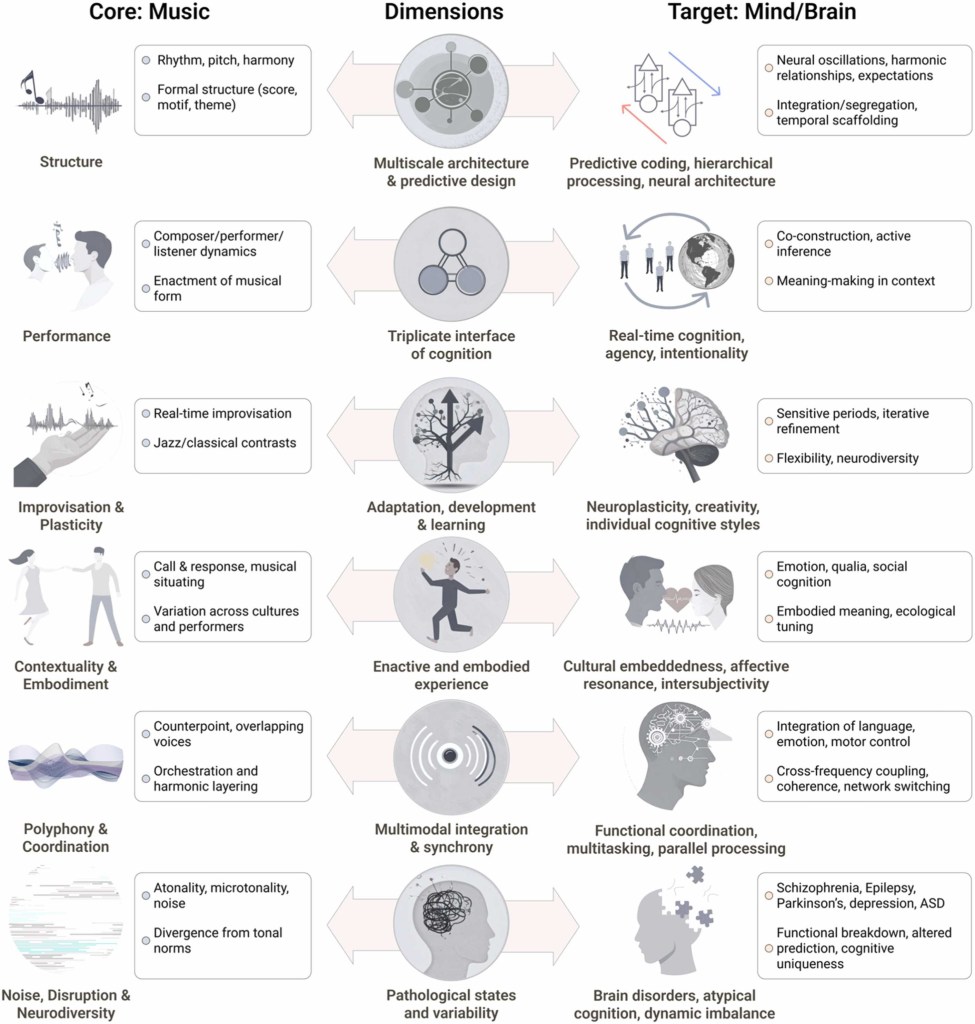
Key components of musical practice and theorization can serve as structured metaphors for understanding mind and brain processes. Each row links a core musical domain (left column), including structure, performance, improvisation, contextuality, polyphony, and noise, with a corresponding conceptual dimension (middle column) and a target mind/brain domain (right column). For instance, musical structure maps onto multiscale brain architecture and supports models of predictive coding and temporal scaffolding. Performance reflects the triplicate interface of cognition, encompassing real-time processes of agency, inference, and meaning making. Improvisation and plasticity relate to neurodevelopment and creative adaptation, while contextuality and embodiment resonate with cultural meaning-making and intersubjectivity. Polyphony highlights multimodal integration and synchrony, critical for parallel processing and cognitive coordination. Finally, noise and divergence from tonal norms metaphorically capture neural diversity and the altered dynamics observed in pathological brain states. These mappings illustrate how musical concepts can scaffold the understanding of complex neural and cognitive dynamical variability through a multidimensional, new metaphor-driven framework. ASD: Autism spectrum disorder.
Like music, the mind and the brain are systems of nested temporal structures, predictive processes, and dynamic embodied and situated performances.
Although emergent and preliminary, the music metaphor offers a framework for advancing theoretical and experimental approaches in cognitive neuroscience. The emphasis of temporal structure, anticipatory dynamics, embodied affects, and contextual embeddedness invites a shift from static, computational models toward more process-oriented and performative conceptions of mind and brain.
This perspective encourages the design of experiments that treat cognition and brain dynamics as an unfolding performance, foregrounding relational and spatiotemporal patterns over discrete, reified components.
 Surtil :