
“Not just heard, but judged: a multidimensional perspective on auditory attention in everyday life”
This review examines how listeners evaluate sounds in everyday contexts and how auditory attention research has approached this process.
While experimental paradigms have yielded important insights into auditory processing, their constructs often rely on task-specific definitions that may not fully reflect how sounds are perceived and interpreted outside the laboratory.
We argue that auditory evaluation is shaped by the interaction of acoustic properties, affective tone, task demands, and contextual framing. To account for this, we propose a multidimensional framework based on arousal, valence, and context, which enables a more flexible characterization of how sounds are judged in everyday listening. We also examine how different methodological approaches highlight distinct facets of this evaluative process.
By focusing on the conditions under which sounds are experienced, this review contributes to a more integrative understanding of auditory attention across both controlled and naturalistic settings.
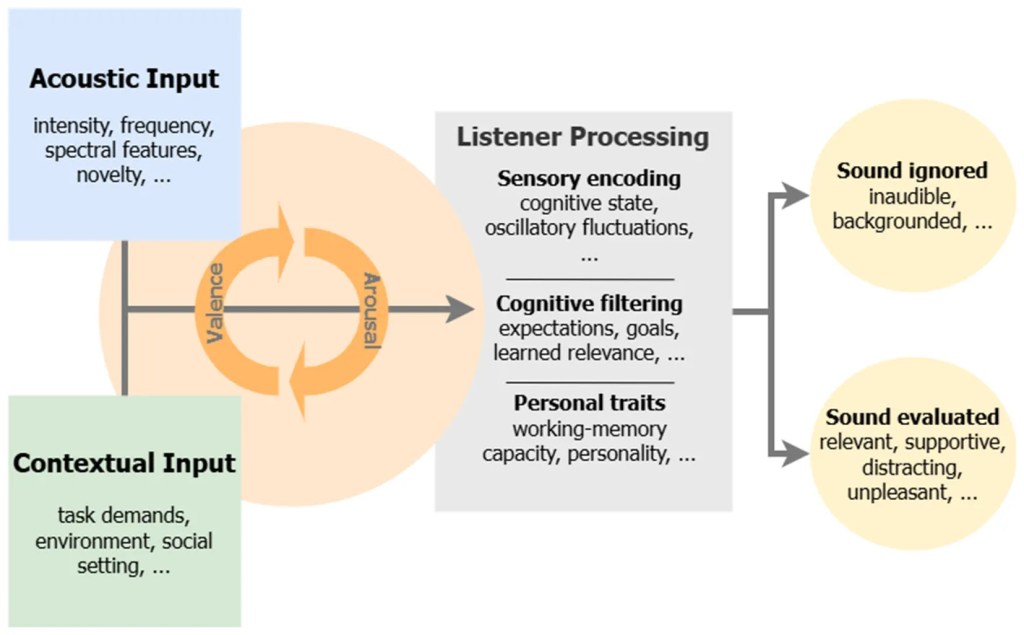
Acoustic features and contextual factors interact with affective dimensions (arousal and valence) and listener characteristics to shape the interpretation of sound. Everyday sounds can occupy different positions along these dimensions depending on situational framing. For example, a phone notification may be experienced as helpful in one moment (e.g., an expected message) but distracting in another (e.g., during focused work), and even a nominally high-arousal sound such as an alarm can be perceived as reassuring or aversive depending on context. These examples illustrate that the interpretation of a sound is not fixed but emerges from dynamic interactions across acoustic, affective, cognitive, and contextual domains.
This article argues that concepts such as distraction and relevance are not neutral descriptors of sound, but scientific constructs that have been operationalized primarily within laboratory reference frames—typically through explicit task goals, stimulus roles (target vs. non-target), and performance-based outcomes.
Within such paradigms, these constructs enable precise inference: laboratory studies can isolate mechanisms, quantify effects, and support strong causal conclusions about when and how a sound disrupts performance or facilitates goal-directed processing.
However, outside these tightly specified frames, the same labels become increasingly context-dependent and therefore harder to apply without additional information about goals, expectations, and situational constraints. In everyday listening, a sound may simultaneously support one goal and disrupt another, and the distinction between “distractor” and “relevant signal” can shift over time within the same environment.
Future research should therefore either
(i) explicitly re-specify the reference frame that makes these constructs interpretable in natural settings, or
(ii) acknowledge where laboratory-derived labels lose explanatory power when detached from their original operational definitions.
Progress lies in systematically bridging the gap between laboratory operationalizations of distraction/relevance and the more weakly specified reference frames of real-world listening. We advocate for incremental steps toward ecological validity. Rather than moving directly from simplified lab tasks to unconstrained field contexts, researchers should gradually introduce complexity, for example, by relaxing constraints on task demands, environmental variability, or participant behavior. This stepwise approach enables researchers to identify where laboratory-derived findings hold, where they diverge, and why, providing a more nuanced understanding of auditory attention across contexts.
Careful formulation of research questions is essential when designing these intermediate steps. In natural settings, this risk is amplified because the reference frame that defines “relevance” or “distraction” (goals, expectations, competing demands) is often implicit and may vary across moments.
Each method captures different aspects of auditory processing, and contradictory findings often reflect differences in methodological scope rather than true inconsistencies.
By aligning the research question, context, and measurement tools—whether behavioral, neural, subjective, or acoustic—researchers can ensure that results remain interpretable and comparable across levels of ecological validity.
 Surtil :