
“Has AI Ended Thought Leadership?”
As generative AI and content platforms make it effortless to sound authoritative, organizations are being overwhelmed by polished insight that rarely translates into real change.
The growing gap between those who talk about the future of work and those who actually build it has turned expertise into performance, leaving leaders stuck.
What creates progress instead is a different discipline: hands‑on experimentation by operators willing to test ideas in messily real conditions, learn from failure, and share unvarnished results
I am a “thought leader.”
I’ve spent decades at the intersection of innovation and storytelling, building companies, selling them, breaking things, and starting over.
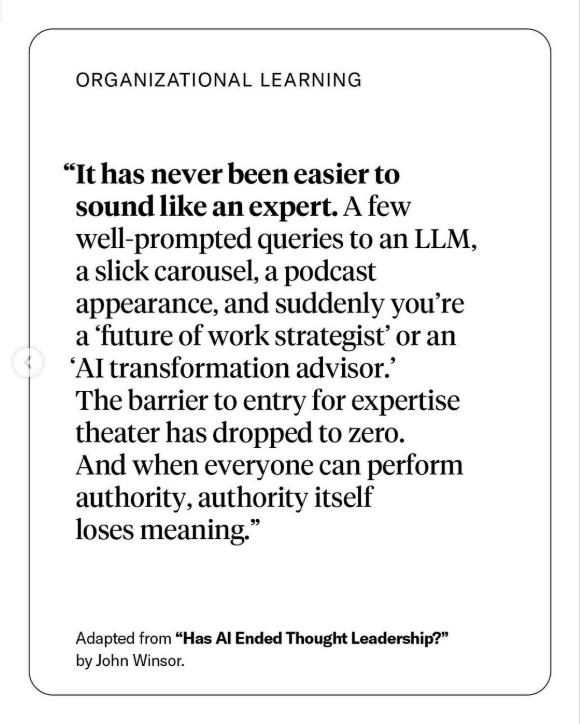
Generative AI has created a faux-expert crisis.
I’ve developed a pretty reliable nose for faux expertise.
Here are the tells:
The absence of scar tissue.
Real operators have stories about what went wrong. They can tell you about the pilot that cratered in week three, the partnership that looked brilliant on paper and collapsed under its own complexity, the team that resisted a change initiative for reasons nobody anticipated. If someone’s narrative is all wins and frameworks, they’re performing, not reporting.
“Altitude lock.”
Faux experts are comfortable at 30,000 feet—the macro trends, the big shifts, the sweeping predictions. Ask them to drop to ground level, though, and they falter. What vendor did you use? How did you handle the procurement process? What happened when the union pushed back? What did the P&L look like in month four? Operators can move fluidly between altitude levels because they’ve lived at all of them. Performers can’t, because their knowledge was assembled from other people’s summaries.
Generalities and platitudes concerning failure.
Anyone can say “we learned a lot from our mistakes.” That’s content. A thought doer will tell you: “We assumed our internal team could manage the freelance marketplace integration alongside their day jobs. By week six, response times had tripled, the hiring managers were routing around the platform entirely, and we had to bring in a dedicated ops person we hadn’t budgeted for.” That’s knowledge. The difference is granularity, which can’t be faked.
Rapidly accrued expertise.
The faux-expert pipeline has a very specific shape: Someone reads about a trend, produces content about it, gets engagement on that content, and then starts advising on it, all within a matter of months, with no operating experience in between. Real expertise accrues slowly. If someone’s thought leadership on a topic predates any plausible period of hands-on work in that domain, that should be a red flag.
Too much consistency.
Operators update their mental models constantly because reality keeps forcing them to. Performers rarely revise their positions because their authority depends on the appearance of prescience. If someone’s point of view hasn’t evolved over two years in the fastest-moving technology landscape in human history, they’re not learning from experience. They’re protecting a brand.
To my fellow thought leaders—the writers, the speakers, the advisors, myself very much included—I’ll say this: The era where a well-crafted argument was sufficient to justify our value is ending.
Our audiences are more overwhelmed and more burned out than ever. They’ve sat through the keynotes that didn’t translate. They’ve bought the frameworks that gathered dust.
If we want to remain relevant, we need to be in the arena. We need to be building alongside the people we advise. We need to show our work.
The future won’t belong to the people who describe it best.
It will belong to the people who build it first.
 Surtil :