
“Are Mathematical and Musical Abilities Related Beyond Intelligence?”
Numerous studies have aimed to improve mathematical achievement via musical interventions because it is argued that music and mathematics draw on related representations and similar skills.
However, findings on their effectiveness are inconclusive. This might be because studies neglect to investigate the cognitive mechanisms that might link musical and mathematical abilities.
Therefore, this study aimed to systematically investigate the relationships between facets of musical and mathematical ability while taking into account intelligence as a possible explanation for this link. Among 170 young adults with backgrounds in mathematics and/or music, as well as control subjects, we measured mathematical abilities using basic numerical abilities, arithmetic fluency, and higher mathematical competencies. Musical abilities were assessed using beat alignment, mistuning perception, and melodic discrimination.
Intelligence was assessed using a verbal, figural, and numerical scale of an intelligence test.
Using a latent variable model, we found a moderate to strong positive association between mathematical and musical abilities.
However, after including intelligence as a predictor for both mathematical and musical abilities in our model, the relationship between mathematics and music became nonsignificant.
These results imply that intelligence accounts for a substantial proportion of the association between mathematical and musical abilities.
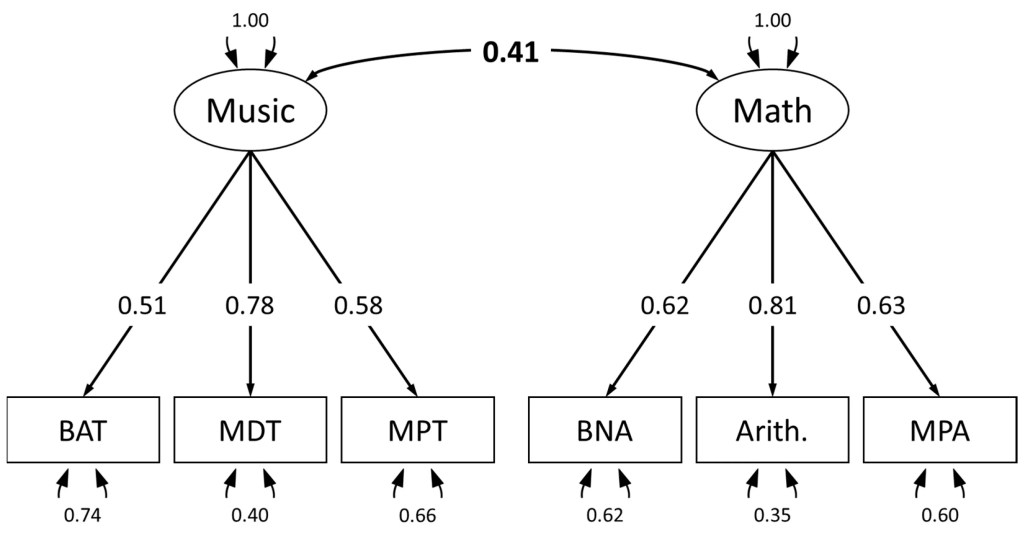
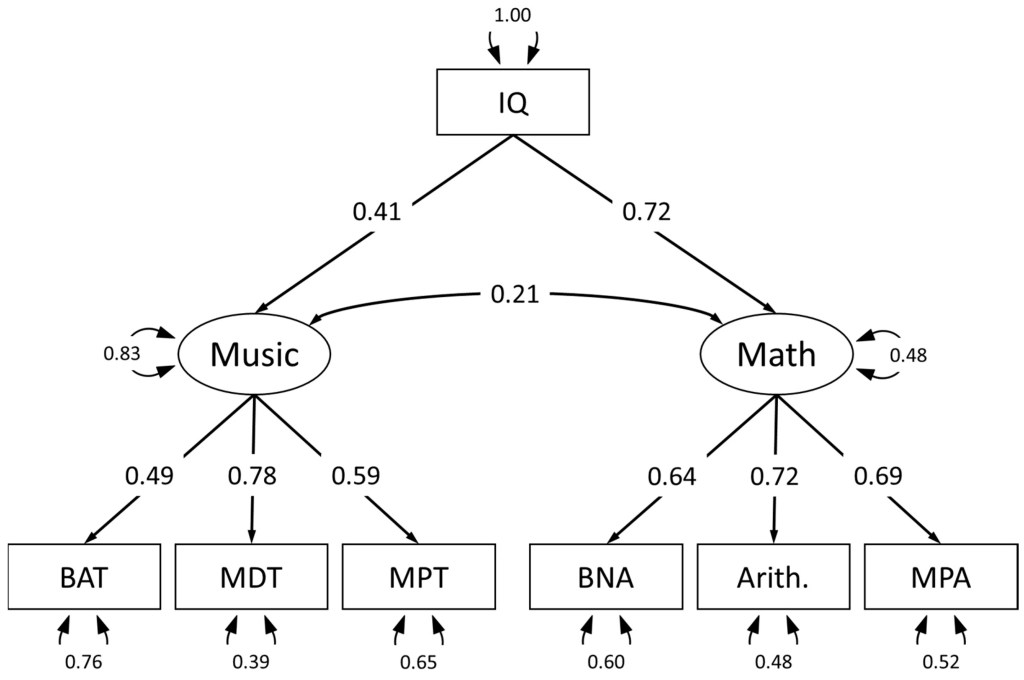
In conclusion, when a measure of general cognitive ability, such as intelligence, is included as a predictor of both music and mathematics, the association between the two latent constructs, mathematics and music, decreases significantly and becomes non-significant.
However, although intelligence explains most of the shared variance, a small, statistically reliable association between certain musical and mathematical skills remains, consistent with some domain-specific overlap.
Therefore, subsequent research should attempt to pin down what drives the unique connection between mathematics and music, and future training studies attempting to foster mathematics through musical training should incorporate and control for measures of cognitive abilities.

