
“Attention unleashed: Creative therapy for thoughtful transformation“
Various factors—motivation, interest, fatigue, and external stimuli—influence creative mental processes and attention control (AC).
Creative thinking (CT) relies on AC and involves coordinated neural networks and pathways. The cognitive function of AC requires the capacity to direct attention toward distinct features of the environment or internal thoughts. Such selectivity is a key to limiting distractions, preserving focus, and assimilating the essential information needed for CT.
Despite progress in creativity research, characterization of underlying neural mechanisms remains limited.
To address this gap, we identify the obstacles slowing progress in this area and suggest strategies to overcome them. Moving forward, establishing a collaborative research agenda across multiple disciplines is central to continuing the progress made to date.
By fostering such an interdisciplinary research agenda can open new therapeutic avenues for attention-deficit/hyperactivity disorder.
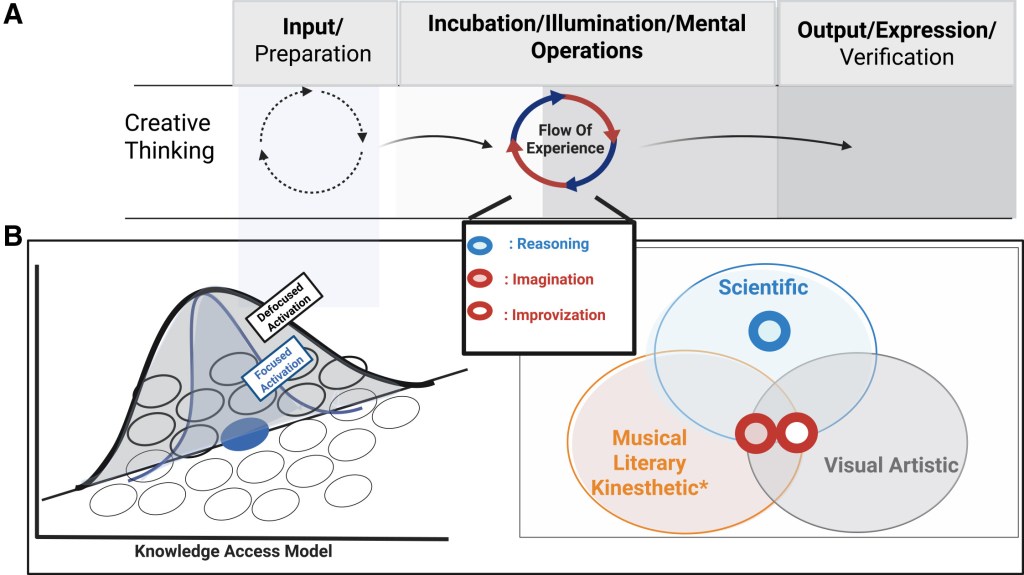
(B) refers to Mendelson’s (1976) knowledge access model. It elucidates the semantic hierarchy by activating defocused and focused attention. Experiential processes modulate the interaction between these two attentional pathways.
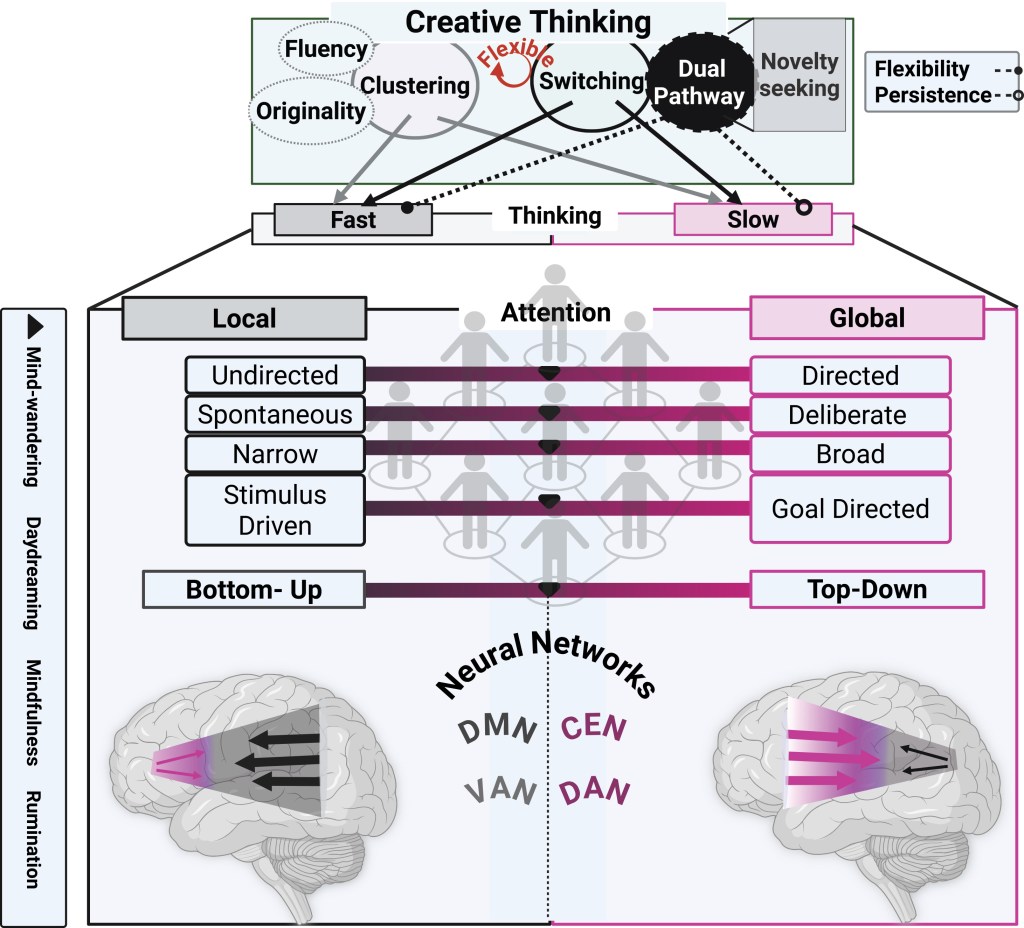
(Adaptive Decision-Making “Fast” and “Slow”: A Model of Creative Thinking Eur. J. Neurosci. 2025; 61, e70024)
It comprises two systems—clustering and switching—that function through temporal modulation, affecting both fast and slow thinking while accounting for individual differences. Clustering, associated with fluency and originality, operates alongside switching, which engages the creativity pathways of flexibility. In this context, persistence is characterized by slower transitions, while rapid transitions indicate flexibility. The interplay between bottom-up and top-down processes reinforces this duality and corresponds with the dual systems of local and global attention. These systems, in turn, highlight the trade-offs between parallel modes: undirected and directed, spontaneous and deliberate, narrow and broad cognitive modes, and stimulus-driven and goal-directed approaches. Here, the extent of interaction between bottom-up and top-down mechanisms fosters dynamic competition among the DMN, VAN, CEN, and DAN, which underscores individual variability in these trade-offs. Overall, this dynamic signature may elucidate how the brain adjusts its resource allocation in response to environmental demands, as reflected in behaviors such as mind-wandering, daydreaming, mindfulness, and rumination.
The acronyms of this illustration are DMN, the default mode network; VAN, the ventral attention network; CEN, the central executive network; and DAN, the dorsal attention network.
Our framework focuses on individual differences and how two dual processes—clustering and switching—are temporally modulated. Clustering is associated with fluency and originality, and switching is linked to flexibility and persistence (for a review, see Khalil and Brüne). This duality is also evident in the pathways of switching: a flexible pathway allows for rapid switching, while a persistent pathway supports gradual switching. Clustering and switching also operate within other dual systems. These systems combine local and global attention mechanisms and bottom-up and top-down processes. This duality exemplifies a dynamic trade-off among diverse cognitive processes: undirected vs. directed, spontaneous vs. deliberate, narrow vs. broad, and stimulus-driven vs. goal-driven.
Variations in these trade-offs among individuals shape the dynamic interactions and competition among DMN, VAN, CEN, and DAN. These differences modulate brain states such as mind-wandering and daydreaming, mindfulness, and rumination. Mapping such dynamic processes that drive dual systems may explain how the brain adapts resource allocation, responds to environmental demands, and achieves a balance of adaptability and efficiency in CT. Thus, our framework may offer a theoretical basis for forthcoming research endeavors to explain CT dynamics through AC, beyond neural circuits.
Implementing this framework in empirical research requires careful consideration of methodological limitations, sample diversity, and variations in experimental task design, as discussed in the challenges and recommendations section.
Creative activities—such as art, music, drama, and dance—may improve cognitive, emotional, and social functioning in individuals.
Engaging in these activities may benefit individuals with ADHD; however, they might not be effective for everyone. Some individuals may need alternative therapeutic approaches. This is why we emphasize individual differences.
Recent research suggests creative experiences augment neuroplasticity and may decelerate brain aging. Accordingly, engaging individuals in meaningful and expressive activities offers alternatives to conventional therapies.
By grounding the creative process in AC and individual differences, we could set new guidelines and open clear therapeutic avenues, especially for those with ADHD.

