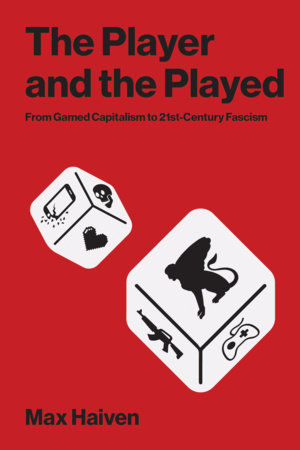
“The Player and the Played – From Gamed Capitalism to 21st-Century Fascism” – Open Access
A provocative examination of the ways our economy has been rigged by financialization, and the importance of games to our dangerous political moment.
In an age when capitalism feels like an unwinnable game, extreme reactionary ideas and politics are on the rise.
The Hunger Games, Game of Thrones, Squid Game, and much of reality TV are cultural reflections of a society of relentless, lonely competition, where each of us must become a player: a savvy risk-taker, a miniature corporation of one.
But in a gamed economy we players feel played, and new forms of fascism promise harsh justice and revenge. This book theorizes the connections between the financialization of the capitalist economy, the gamification of our lives, and the rising threat of a uniquely twenty-first century form of fascistic politics.
From vicious online swarmings to the QAnon conspiracy fantasy, from the siege of the US Capitol to the abuse of “free speech,” The Player and the Played analyzes the “playgrom” as a new form of extremist violence. Max Haiven explores how “derivative fascisms” both repeat and reinvent the terrors of the past in a financialized form. How have we learned to love the cheats who have power but loathe the cheats without it? It unpacks the worldbuilding (and world-destroying) urge of Silicon Valley. And it poses the urgent question: What is the antifascist game?
AI helped me write this 500 word summary:
The Player and the Played argues that contemporary capitalism increasingly resembles a game in which people are encouraged to see themselves as competitive players while having little control over the rules. Max Haiven calls this condition “gamed capitalism”: a form of financialized capitalism that exploits people not simply by restricting their agency, but by encouraging them to exercise it in ways that reproduce the system. Since the 1980s, financialization has increasingly shaped institutions, values, identities, and expectations around competition, speculation, investment, and short-term returns. Individuals are encouraged to treat education, housing, careers, relationships, appearance, skills, and even their personalities as assets that must be continually optimized.
The central figure produced by this system is the “cheated player.” People are told that they are free to compete and that success depends on individual effort, creativity, and strategic ability. Yet the rules are unequal and the rewards are concentrated. Most people therefore experience a contradiction: they are encouraged to believe they are autonomous players while simultaneously feeling that the game is rigged. Haiven argues that this sense of being cheated is an important condition for understanding contemporary fascistic politics.
A crucial part of the argument is that political anger can be redirected away from structural causes and toward “cheating others.” Minorities, migrants, welfare recipients, feminists, trans people, intellectuals, and other groups can be portrayed as unfair competitors who supposedly receive undeserved advantages. Conspiracy theories provide a particularly powerful version of this logic because they turn complicated economic and social problems into apparently simple stories about hidden groups manipulating the game.
Haiven also argues that cheating itself becomes normalized. Financial capitalism, colonial history, game theory, and contemporary scams all demonstrate, in his analysis, that the supposedly fair game of capitalism has always contained mechanisms for exploiting loopholes and manipulating rules. Fascistic politics can consequently present the powerful rule-breaker as an admirable “player” who understands how the world really works. The result is a politics in which power becomes more important than shared rules, truth, or fairness.
The book then applies this framework to conspiracy culture, online harassment, and political violence. Haiven uses the term “playgrom”—a combination of “play” and “pogrom”—to describe forms of playful, participatory online activity that can produce real-world racialized and gendered violence. Gamergate and extremist online communities illustrate how joking, gaming, memes, competition, and collective participation can become vehicles for political mobilization and harassment.
Finally, the book asks what an “antifascist game” might look like. Haiven argues that simply depicting fascists as enemies is insufficient. Games and political organizing should instead create forms of collective agency that challenge fascism’s ideological, economic, institutional, and everyday roots. He sees play not merely as entertainment but as a potentially transformative form of social and political practice. The broader message is that if contemporary power increasingly exploits people’s desire to play, compete, create, and exercise agency, resistance must also find ways to reclaim those capacities collectively rather than allowing them to be turned against one another.
 Surtil :