
Ordinary computing machines prohibit self-reference because it leads to logical inconsistencies and undecidability. In contrast, the human mind can understand self-referential statements without necessitating physically impossible brain states. Why can the brain make sense of self-reference?
This paper addresses this question by defining the Strange Loop Model, which features causal feedback between two brain modules, and circumvents the paradoxes of self-reference and negation by unfolding the inconsistency in time.
Also argued is the metastable dynamics of the brain that inhibits and terminate unhalting inferences.
Finally, the representation of logical inconsistencies in the Strange Loop Model leads to causal incongruence between brain subsystems in
Integrated Information Theory.
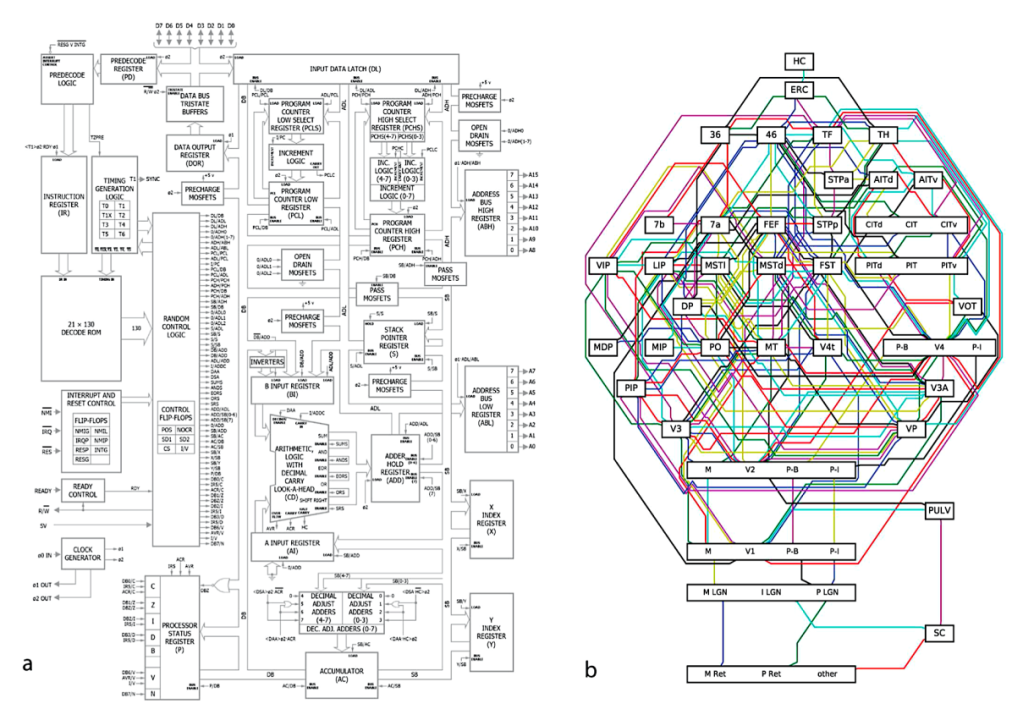
A topological analysis of (a) computer chips and
(b) brains (visual cortex organization) reveals fundamental dissimilarities
As a spoiler, the paper concludes:
[…] we conclude that the process
carried out by the brain and the computer
is different.
 Surtil :