
Adult play and the evolution of tolerant and cooperative societies
Play is generally considered an immature affair.
However, adult play is present in several mammal species living in complex social systems. This article considers the hypothesis that adult social play is favored by natural selection in those species characterized by high level of social tolerance and/or by the need of others’ cooperation to reach a goal (i.e., leverage).
The integration and comparison of bio-behavioral data on non-human primates and wild social carnivores allows drawing a comprehensive picture on the importance of adult play in facing unpredictable, novel social situations and in overcoming stressful experiences. The ability to cope with potentially competitive interactions through play can favor the emergence of egalitarian societies.
A further interesting and beneficial aspect of adult play is its role in synchronizing group activities and favoring collective decision making by renovating the motivation to cooperate in groupmates.
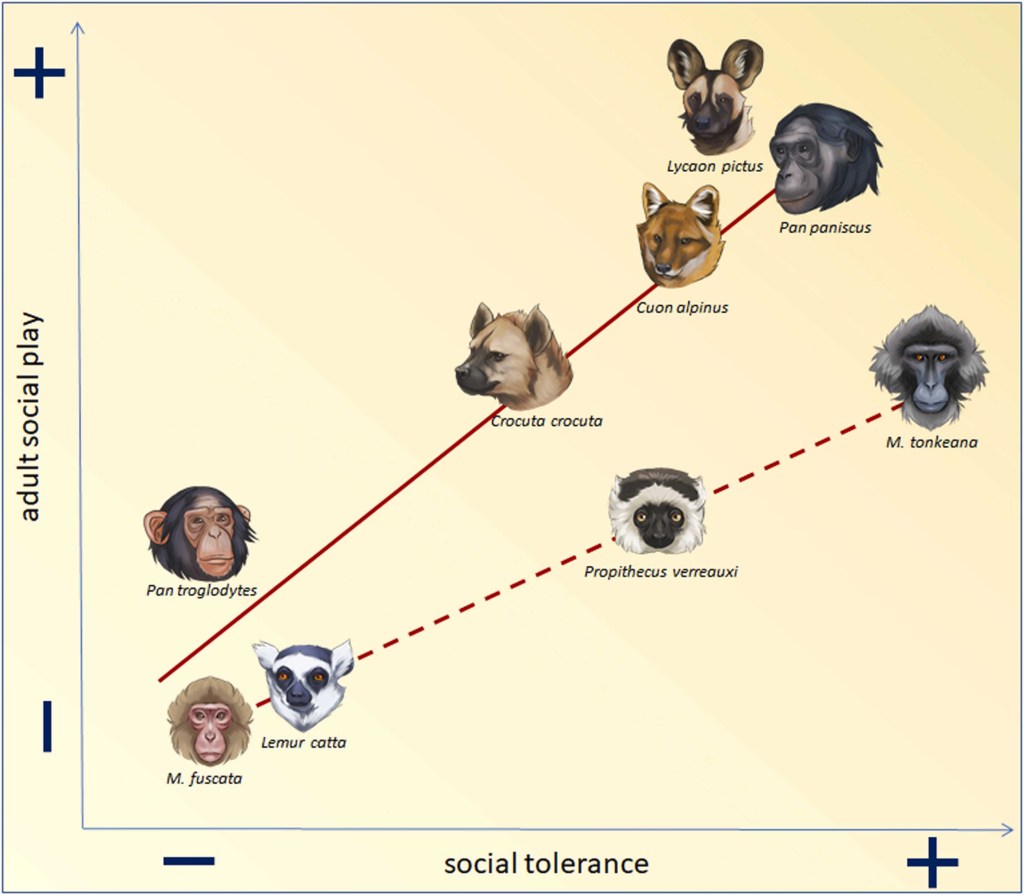
In the cooperative societies, when the dominants need the social support of subordinates (leverage power over dominants), the probability for adult play to occur increases because it becomes an important tool in social management. The species are arranged on the graph according to the data available in literature. The representation has the unique aim to illustrate the distribution from a qualitative point of view.
As a last step, some considerations about the presence of adult play in the most egalitarian and cooperative human groups (e.g., hunter-gatherer societies) allows discussing the apparent dichotomy between cultural and biological evolution of certain behavioral traits, including social play in adulthood.
- Adult play is present in several mammal social species.
- Tolerance and cooperation in societies increase the probability for adult play to occur.
- Adult play helps to face unpredictable and novel social situations.
- Adult play has a role in synchronizing group activities and favoring collective decision making.
Conclusive remarks: intellectual humility and open minds
Humans are playful animals.
Playing is a highly rewarding activity which makes us feel better, both emotionally and physically, especially when it occurs between family members and friends. No doubt that free play in our species is the expression of joy and sociality that is helpful to build social relationships. In a recent study carried out via a social network approach, demonstrated that free social play increases group cohesiveness and mitigates ethnic group avoidance in children.
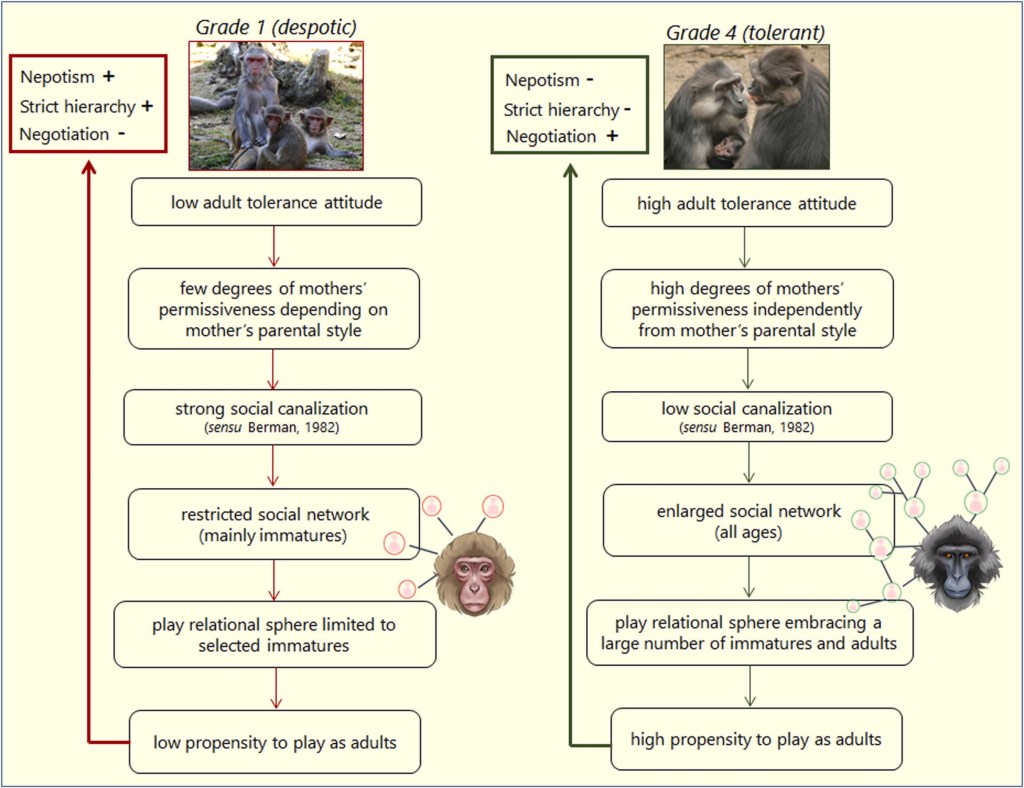
Social play can have a more or less important social roles as a function of the different human cultures we take into consideration. It has been argued that free social play has a role in restraining aggression thus favoring cooperation also in our species. Such assumption is supported by the evidence that the persistence of free play in adulthood covaries with the levels of hierarchical relationships characterizing different human social groups, with more tolerant and cooperative societies showing higher levels of adult social play.
Another evolutionary convergence, this time apparently involving culture and biology. But is this traditional dichotomy real? Hunter-gatherer societies live in small, nomadic and “politically acephalous groups that subsisted primarily by gathering wild plant foods and hunting wild animals”. If we look at the egalitarian hunter-gatherer systems, it appears clear that adult play is a means to converge on the most important collective decisions for the group, in the same way we can find in non-human primates and social carnivores. In hunter-gatherer societies, playing together means reducing aggressive tendencies and acting cooperatively (e.g., hunting, rearing offspring, food sharing) thus reaching shared goals with a lower energy expenditure. This lifestyle translates into an increased survival probability and a higher fitness at an individual level. In this societies, there is no space for cheaters or aggressive individuals that tend to have a marginal role in the group thus contributing less in the gene pool. That is how the boundaries of cultural and biological evolution of play vanish. For this reason, if we want to really understand the role of adult play in the evolution of tolerant and cooperative societies, we need to comparatively study the phenomenon in human and non-human animals by applying similar conceptual and methodological approaches.
From an intellectually humble perspective, understanding how non-human animals can manage the complexity of their social life will redefine our place in nature.
 Surtil :
One response to “Adult play – favoring collective decision making”
[…] humble and show the needed intellectual humility, to avoid failure, allowing “playful” decision making, to support the missions defined, and be […]
LikeLike