
I just finished the marvellous book from Max Bennett: “A Brief History of Intelligence“. As mentioned by the praise:
“If you are interested in understanding brains or in building human-like general AI, you should read this book.”
Dileep George, DeepMind, Co-Founder of Vicarious AI

In the book, a wonderful story is given from the evolution of life, the emergence of neurological intelligence and the link with AI. The story is build around human intelligence, but offers enough comments to other creatures to remain interesting. Max Bennett divides the evolution in 6 different steps. 5 of these steps were already discussed in an earlier paper (hypothesis and theory) in summer 2021:
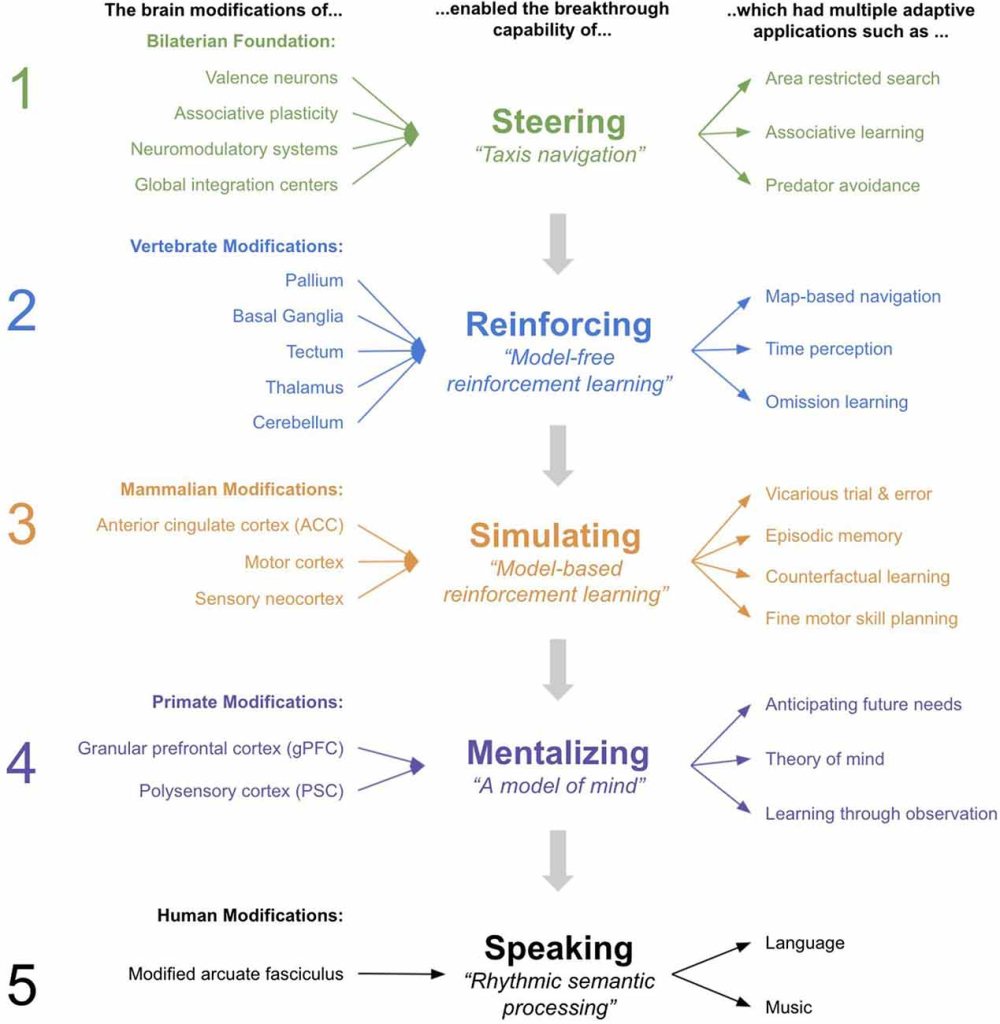
Five Breakthroughs: A First Approximation of Brain Evolution From Early Bilaterians to Humans. Retracing the evolutionary steps by which human brains evolved can offer insights into the underlying mechanisms of human brain function as well as the phylogenetic origin of various features of human behavior. To this end, this article presents a model for interpreting the physical and behavioral modifications throughout major milestones in human brain evolution. This model introduces the concept of a “breakthrough” as a useful tool for interpreting suites of brain modifications and the various adaptive behaviors these modifications enabled. This offers a unique view into the ordered steps by which human brains evolved and suggests several unique hypotheses on the mechanisms of human brain function.
The underlying principles have been discussed in the companion paper (hypothesis and theory) presenting 13 hypotheses of specific behavioral abilities that emerged at major milestones in the evolution of the human brain.
What Behavioral Abilities Emerged at Key Milestones in Human Brain Evolution? 13 Hypotheses on the 600-Million-Year Phylogenetic History of Human Intelligence. This paper presents 13 hypotheses regarding the specific behavioral abilities that emerged at key milestones during the 600-million-year phylogenetic history from early bilaterians to extant humans. The behavioral, intellectual, and cognitive faculties of humans are complex and varied: we have abilities as diverse as map-based navigation, theory of mind, counterfactual learning, episodic memory, and language. But these faculties, which emerge from the complex human brain, are likely to have evolved from simpler prototypes in the simpler brains of our ancestors. Understanding the order in which behavioral abilities evolved can shed light on how and why our brains evolved.
As indicated in the first paper, there are some caveats in the story:
By summarizing such a long history into only a handful of ‘‘breakthroughs,’’ there is an undeniably simplifying of the actual
story. The objective is to provide a view of the ‘‘forest’’ of evolution at the cost of describing ‘‘the trees’’. This approach will inevitably miss some important changes in brains and behavior. However, a surprisingly broad set of brain structures and behaviors can be understood through a remarkably small number of ‘‘breakthroughs.’’ Perhaps this is not so surprising, given that perhaps brain evolution often occurred in fits and starts, where some adaptive structure was stumbled upon, rapidly elaborated on, and then brains remained relatively stable for a long period of time afterward.
Recent neuroscience research is starting to illuminate the answer to this question.
A third component of the book is coming from an older paper An Attempt at a Unified Theory of the Neocortical Microcircuit in Sensory Cortex, also presented in a great on-line presentation (Decoding How Intelligence Is Implemented in the Brain with Bluecore):
The book combines those three great papers into a combined, readable story, finishing with an additional breakthrough #6.
This (very short) section is building on the conclusions of the previous 5 (as summarized in the final table, kindly corrected on the website).
The table shows the evolution of progressively more complex sources of learning through the breakthroughs from learning from own actual actions (Reinforcing, Model-free) to imagined own actions (Simulating, Reinforcement Model), to real others actions (Mentalizing, ToM), up to others imagined actions (Abstract Communication, Speaking, abstract model).
Unfortunately, the work Max Bennett delivers for breakthrough #6 is not at the same level of content and analysis as the previous breakthroughs. It is even very speculative and lacks the independent view of a scientist.
One can even consider it to be a ‘tech-optimist’ view.
The AI-tech-optimist fails to reflect on some of the aspects intelligence requires and are not yet evolved in the AI world. Some of these are

- Valence-related signaling is done to support the beneficial or positive-valued actions, starting from the early beginning of the evolution. It still is unclear how AI systems define (autonomous, without input from the developer or any kind of operator) the values they want to put into actions
- The book discusses mainly about exteroception (and also indirectly proprioception in #3). The first signalling in neural systems during evolution of living systems was interoception, in order to operate the body. It is still unclear how AI will work as an interoceptive system, and what equilibrium and related actions (or homeostasis and allostasis) it will define and activate.
- As is discussed in the beginning of the book, evolutionary systems have the power of (nearly perfect) self-replication. Von Neumann defined this self-replication already as a requirement.
- Also mentioned, the Free Energy Principle and Markov Blankets guides the demarcation of intelligent units. This optimisation of energy and information is key for homeostasis and survival. Linking an AI system as a unit with FEP is still a long way, taking the AI-system as a unit.
Not only does the #6 breakthrough offer a tech-optimistic view, it also hides some other insights on evolving intelligence which could be offered to the readers like e.g.
- Evolutionary transition in individuality (ETI)
- Human cooperation, working together in groups to tackle shared problems
- Collective Intelligence, information pooling or aggregation
- Liquid brains intelligence
- Novel beings, novel goals: evolution & engineering of the agential material of life (Michael Levin)
These insights are of value, valuable, since the intelligent life of humans and their societies are facing many challenges, not unknown to mankind, but still lacking appropriate action.
But, at the end, all considerations taken into account, this book offers a great story with many insights and enlightenment. As such a real recommended read; the quote at the beginning of this post is valid and true.
“This book discloses everything you always wanted to know about the brain…It is an incredible resource. It assimilates every discovery in neuroscience—over the last century—within a beautifully crafted evolutionary narrative. …. The synthesis works perfectly. Its coherence obscures the almost encyclopedic reach of this treatment.”
— Karl Friston, University College London, #1 most cited neuroscientist in the world
 Surtil :