
The Internal Dominance over External Attention (IDEA) hypothesis (I referred to earlier) asserts, contrary to the traditional view of attention as being primarily externally oriented, that attention is inherently biased toward internal information.
A related work on attention switching has been published: “Shifting attention between perception and working memory“
Most everyday tasks require shifting the focus of attention between sensory signals in the external environment and internal contents in working memory.
To date, shifts of attention have been investigated within each domain, but shifts between the external and internal domain remain poorly understood. We developed a combined perception and working-memory task to investigate and compare the consequences of shifting spatial attention within and between domains in the service of a common orientation-reproduction task. Participants were sequentially cued to attend to items either in working memory or to an upcoming sensory stimulation. Stay trials provided a baseline condition, while shift trials required participants to shift their attention to another item within the same or different domain. Validating our experimental approach, we found evidence that participants shifted attention effectively in either domain.
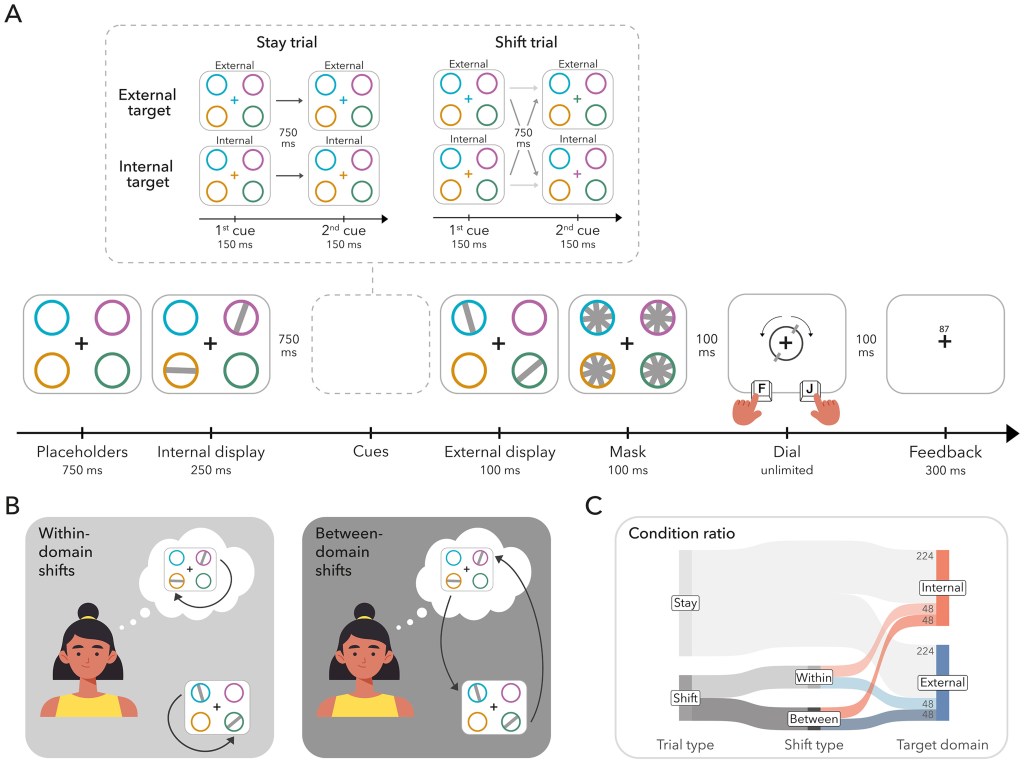
(A) Illustration of stay and shift trials. In stay trials, the second cue indicated the same item as the first cue. In shift trials, the first and the second cue indicated different items. Light-grey arrows depict within-domain shifts and dark-grey arrows represent between-domain shifts.
(B) In within-domain shift trials, participants either had to shift attention external-to-external or internal-to-internal. In between-domain shift trials, participants either had to shift attention external-to-internal or internal-to-external.
(C) Ratio of conditions and number of trials across the experiment.
Key findings.
First, our task design was effective at eliciting attention shifts to external and internal contents as evidenced by behavioural and gaze-bias findings.
Second, shifting attention between domains was associated with a higher behavioural cost than shifting attention within domains.
Third, the between-domain shift cost was asymmetric for reproduction errors; within- versus between-domain shifts differed for internal- but not for external-target reports.
And lastly, in contrast to performance measures, gaze position measures were insensitive to whether shifts occurred within or between domains.
The divergence between behavioural results and the gaze bias suggests that the cost associated with shifting attention between domains is not primarily driven by the spatial orienting functions, which the gaze bias likely reflects.

(A) Illustration of stay and shift trials. In stay trials, only a single cue was presented. In shift trials, the presentation of the second cue was followed by an interstimulus interval of either 0 ms, 250 ms, or 750 ms. Light-grey arrows depict within-domain shifts and dark-grey arrows represent between-domain shifts.
(B) In within-domain shift trials, participants either had to shift attention external-to-external or internal-to-internal. In between-domain shift trials, participants either had to shift attention external-to-internal or internal-to-external. Additionally, we manipulated the interstimulus interval between the second cue and the external display in shift trials.
(C) Ratio of conditions and number of trials across the experiment.
Participants consistently exhibited slower response times when shifting their attention between domains compared to shifting within the same domain.
Furthermore, we observed an asymmetric shift cost in reproduction errors, indicating that external-to-internal versus internal-to-internal shifts incurred higher costs than internal-to-external versus external-to-external shifts.
Given the variations […] our findings demonstrate good generalisability of the within- versus between-domain shift effects. It also became evident that the observed effects remained consistent regardless of the allocated time for attentional shifts.
This implies that the attentional system did not fully recover from the consequences of shifting between domains … . Moreover, the asymmetric between-domain shift costs in reproduction errors could not be attributed to swaps with the initially cued item.
Taken together, the findings from Experiment 2 suggest the possible existence of a distinct, additional control function engaged during shifts of attention between domains.
In addition, we observed greater costs when transitioning attention between as compared to within domains. Strikingly, these costs persisted even when participants were given more time to complete the attentional shift. Biases in fixational gaze behaviour tracked attentional orienting in both domains, but revealed no latency or magnitude difference for within- versus between-domain shifts.
Collectively, the results suggest that shifting between attentional domains might be regulated by a unique control function.
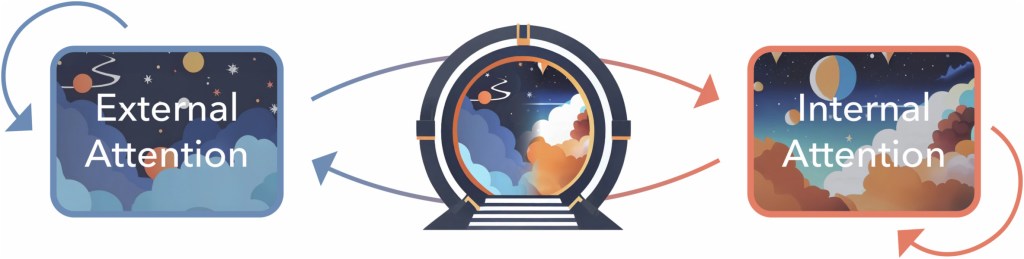
Our findings suggest the presence of an additional control point when shifting attention between domains, a feature not encountered during within-domain shifts. We can imagine this additional checkpoint as a portal mediating between external and internal attention.
 Surtil :