
“Understanding music and aging through the lens of Bayesian inference“

A Bayesian Inference is a statistical theory that describes the update of the probabilities of a hypothesis being true based on prior beliefs and current evidence for the said hypothesis. The evidence for the hypothesis is marginalized by the probability of observing the evidence without any assumption.
B Bayesian inference applied to neuroscience posits that the brain not only perceives sensory events, but also concurrently makes hypotheses for the cause of sensory events based on prior understanding about the environment that it is in. The difference between a prior hypothesis or a prediction and the incoming sensory evidence will contribute to the optimization of the beliefs of the environment.
Bayesian inference has recently gained momentum in explaining music perception and aging.
A fundamental mechanism underlying Bayesian inference is the notion of prediction.
This framework could explain how predictions pertaining to musical (melodic, rhythmic, harmonic) structures engender action, emotion, and learning, expanding related concepts of music research, such as musical expectancies, groove, pleasure, and tension.
Moreover, a Bayesian perspective of music perception may shed new insights on the beneficial effects of music in aging.
Aging could be framed as an optimization process of Bayesian inference.
As predictive inferences refine over time, the reliance on consolidated priors increases, while the updating of prior models through Bayesian inference attenuates.
This may affect the ability of older adults to estimate uncertainties in their environment, limiting their cognitive and behavioral repertoire.
With Bayesian inference as an overarching framework, this review synthesizes the literature on predictive inferences in music and aging, and details how music could be a promising tool in preventive and rehabilitative interventions for older adults through the lens of Bayesian inference.
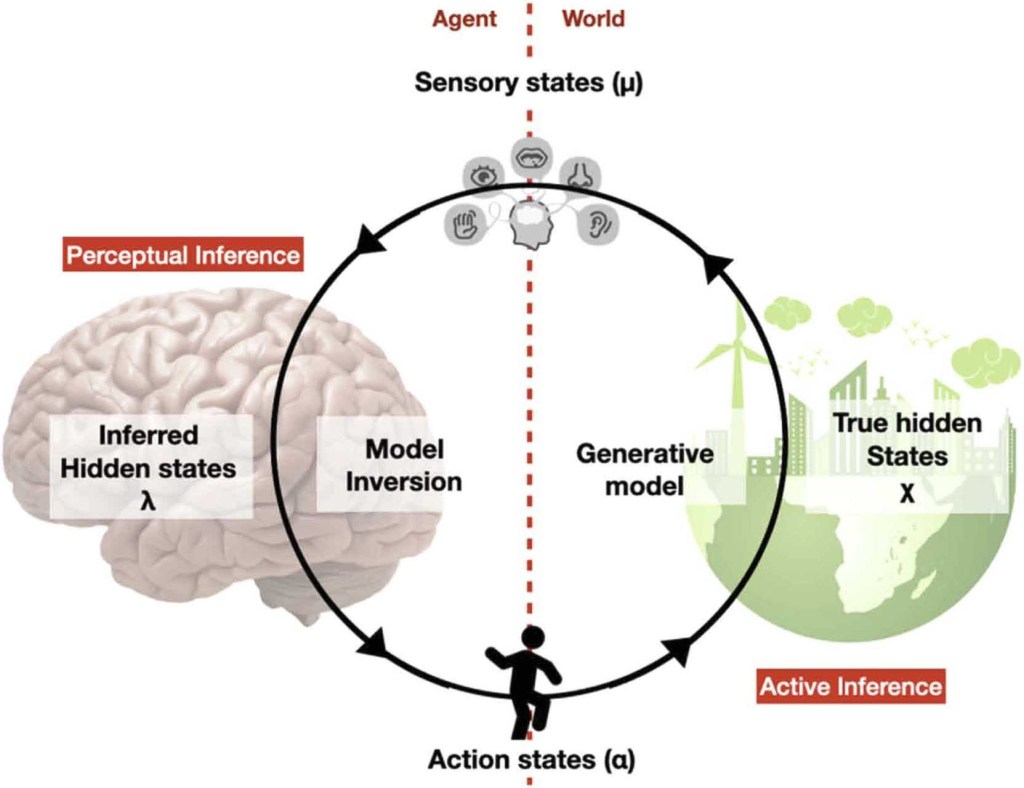
Hidden causes of environmental changes (X) generates sensory stimuli (µ) observed by an agent. The likelihood of environmental events (λ) can be inferred from probabilistic fluctuations of the hidden environmental states computed from the incoming sensory evidence. This internal model of inferred states guides the agent’s actions (α) in response to the environmental stimulus. The actions of the agent are consistent with the internal model of its environment. The internal model is also used to actively predict incoming sensations and their causes. The update and optimization of the internal model depend on the difference (prediction error) between an agent’s prior beliefs and the sensory stimulations received. Perceptual inference is the process of making sense of environmental stimulus via optimization of the internal model, while active inference is the process of embodied perception, where the agent interacts with the environment according to what he believed to have perceived to test these perceptual beliefs.
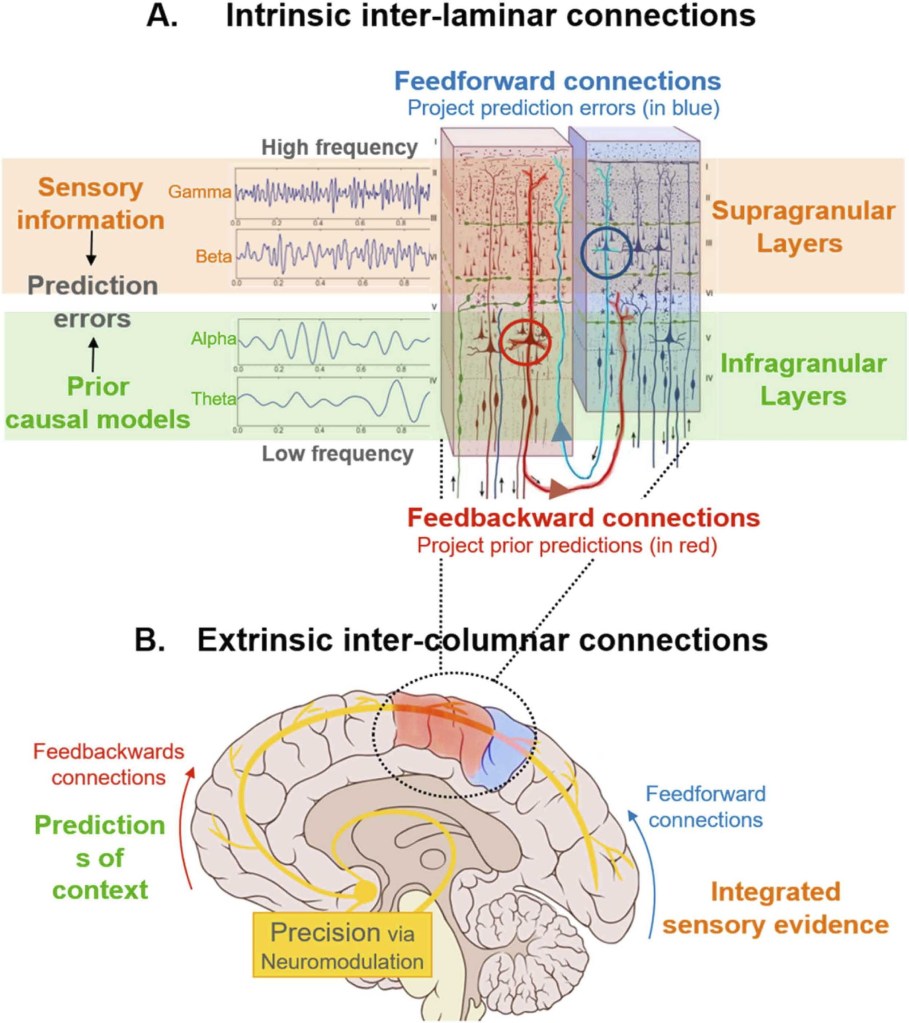
A. graded potential across the cortical layers in one single cortical column. High-frequency oscillations originate from the superficial layers that represent prediction errors, while low-frequency oscillations originate from the deep layers that represent predictions. Differences between sensory information and predictions are propagated forward to the neighboring column as information across these columns is gradually integrated at the prefrontal regions.
B. A simplified representation of sensory information integration across the anterior-posterior axis. Long-range neuromodulation (yellow, in this example, the acetylcholine pathway from the basal forebrain constellation, illustrated roughly) helps to integrate incoming sensory information into the predicted context by modulating the gains of the synaptic connections based on the precision of this information. This causes a distributed pattern of response across the brain that forms the functional correlates of hierarchical Bayesian inference.
In sum, neuromodulators such as dopamine, and norepinephrine modulate the synaptic gains of forward and backward connections under the context of uncertainty
When a specific musical feature violates, delays, or confirms the listeners’ expectations about the continuation of the music, emotions may be elicited.
(Meyer, Emotion and meaning in music, 1956).
The paradox of Bayesian aging: cognitive decline despite optimization of Bayesian Inference processes with age.
[…] aging can be seen as an optimization process of Bayesian inference; as we age, we get better at predicting environmental outcomes.
The information processing speed theory of aging proposed that one of the main factors of aging is the global decline of cognitive functions due to reduction in processing speed. The decrease in processing speed is correlated with the ability to inhibit irrelevant information and afford attention to processes that are relevant to the task at hand. From the Bayesian perspective, this can be seen as the inability to determine the precisions of different information during task performances. This may seem contradictory to the Bayesian hypothesis that precision of prior models and sensory evidence are continuously refined through life experiences.
[…] older adults seem to update their predictions (after an incorrect prediction) of the forthcoming auditory information more slowly and cautiously than younger adults.
Older adults might have difficulty learning the nuances in the environment through sensory evidence, although some research suggests that over time, they eventually arrive at an accurate and stable model. Generally, reliance on consolidated priors mediated by top-down control increases, and Bayesian model updating through bottom-up sensory learning attenuates
Posterior to Anterior Shift in Aging (PASA): […] this process enables the aging brain to solve simpler and common problems with higher accuracy, it also limits the brain’s ability to tackle novel and uncommon problems due to its reduced complexity and flexibility.
Neurochemicals, including but not limited to dopamine and norepinephrine, are crucial encoders of precision and uncertainty in the brain, which also see marked decline with age.
Sensory prediction errors, which are modulated by dopamine, provide the bottom-up representations of external stimuli during Bayesian inference. These representations guide the choice of prior predictive models and sharpen top-down executive control over posterior areas. The modulation of dopamine on frontal brain regions contributes to the complexity, sensitivity and variability in signals that is important for cognitive flexibility and precise representation of sensory prediction errors. Consequently, as older adults prioritize prior beliefs, representation of sensory prediction errors in the brain declines.
[…] aging is associated with poorer performance under uncertainty. Specifically, older adults utilize uncertainty of information to a lesser extent than younger adults, and also show smaller behavioral adjustments to prediction errors. This suggests that older adults may employ different strategies for learning and decision-making, potentially favoring more stable, and less flexible information integration compared to younger adults.
In essence, the aging brain is optimized to explain common sensory phenomena that are necessary for survival, but may not perform as well in less common and cognitively-challenging tasks. This presents a paradox as Bayesian inference is optimized through aging. To maintain efficient neural resource allocation, the aging brain increases reliance on consolidated inferences while decreasing reliance on computational resources of sensory learning. This shift in the brain’s neural milieu allows older adults to encode simpler yet accurate explanations for common sensory events, but it also limits cognitive flexibility and affects fluid intelligence.
Larger prediction errors generate more sensory learning so as to reduce the discrepancies between incoming sensory information and the internal predictive model.
In addition, musical training also necessitates heightened demands on auditory-motor coupling mechanisms that results in improved sensory learning. The combination of top-down (musical expectancy) and bottom-up (sensory stimulation) processes shapes brain structure and the ability to form music-related predictions with high precision.
Coupled with the brain’s propensity for neuroplasticity even in old age, evidence from enhanced cognitive and neural processes involved in Bayesian inference as a result of musical training provides strong motivation for music to be a prime candidate for cognitive maintenance and interventions to support aging.
In sum, music is powerful in its ability to introduce optimally complex environments ideal for sensory learning, and its ability to elicit reward prediction errors and activate the limbic network (particularly the amygdala) creates opportunities for learning and Bayesian model updating. This can potentially promote instances of musical pleasure and reward in older adults.
[…] the finding of enhanced processing speed as a result of active music-making could be reflective of better information processing abilities in older adults. Information processing can also be seen as the estimation of context uncertainties in order to engender accurate perception and fast adaptive actions. Thus, an improvement in information processing can also be regarded as an improvement in Bayesian inference (including more precise prediction errors, and more efficient encoding of probabilistic distribution of environmental events and updating of priors).

a) Music evokes emotion, results in movement and learning via Bayesian inference processes such as activating the motivational circuitry and auditory-motor coupling mechanism.
b) The Bayesian Inference framework involves the updating of sensory learning in posterior brain regions and prior expectations in the anterior frontal region, resulting in prediction errors. The precision of prediction errors are modulated via neurotransmitters such as dopamine, norepinephrine and acetylcholine.
c) In aging, sensory learning declines as reliance on prior expectations increases, resulting in an attenuation of precision via neuromodulation (represented by solid lines). Here, we postulate that music-based interventions, through its ability to promote re-engagement of Bayesian inference processes in the aging brain, could help to ameliorate the declines in older adults and therefore explain beneficial effects of music in older adults (represented by the dotted lines).
Effective executive control relies on the computation of precision and probabilistic distributions within Bayesian inference.
Music, Bayesian inference, Aging: Highlights.
| Neural principles of Bayesian inference • Inference in the brain constitutes (1) minimization of prediction error – the difference between expected sensory outcomes of an action, and sensory information received by the sensory faculties (i.e., perceptual inference), and (2) action planning and selection that will evince the current prior understanding of the environment (i.e., active inference). • Precision of prediction errors determines the impact of the signal to subsequent processing. This is represented by synaptic gain in the brain, which is mediated by attentional mechanisms (e.g., selective attention) and neuromodulators (i.e., dopamine, acetylcholine, norepinephrine) that control the postsynaptic excitability of neuronal populations encoding sensory information. Bayesian Inference in Music • The statistical regularities within a piece of music sets up predictions and expectations about the continuation of the music in accordance to prior musical exposure. • This Bayesian account of music perception could offer a holistic understanding of the neurological underpinnings of emotions, movements and learning. Bayesian Inference in Aging • Sensory learning attenuates while reliance on internal prior beliefs increases • While this is resource efficient and therefore adaptive, it limits cognitive and behavioral flexibility. Beneficial Effects of Music in Aging • Improvements in emotion, movements and learning in older adults as a result of music-based interventions could potentially be explained by mechanisms related to Bayesian inference. • Through the activation of the dopaminergic system, the experience of musical pleasure and reward in older age could potentially delay the decline in prediction error signaling. • Music, as an external cue for motor rehabilitation, taps on the mechanisms of rhythmic entrainment and auditory-motor coupling, which activate neural substrates crucial to action affordance and active inference (i.e., basal ganglia, cerebellum, and the dopaminergic system) • Active musical engagement necessitates multisensory integration, thereby necessitating the older brain to repeatedly engage in sensory learning which may otherwise have declined with age |
|---|
This review is one of the first endeavors to illustrate the potential of Bayesian inference as the fundamental principle in explaining music, aging, and the effects of music-based interventions on aging.
Through the synthesis of behavioral, neuroimaging and neurochemical studies, we suggest that music can be an important tool to reinvigorate the process of Bayesian inference in older adults as it
(1) provides an avenue to ameliorate age-related declines in neuroplasticity and behavioral flexibility,
(2) enriches the sensory exposure of older adults and increases the complexity of their predictive models, and
(3) is able to optimally challenge the musical experiences of older adults to introduce new sets of sensory events that may not be a part of their prior predictive model.
The aforementioned mechanisms encourage older adults to engage in model-updating via sensory learning, which may mitigate some of the neurological changes due to aging. By adopting the framework of Bayesian inference to understand neurocognitive changes in aging and in music perception, we hope that new research directions and queries can be generated to further our understanding of predictive processing in aging and music, and consequently develop new strategies in using music for preventive or rehabilitative purposes.
 Surtil :