
Han L. J. van der Maas published August 31, 2024 this SFI book “Complex Systems Research in Psychology“, available as PDF for free.
Prologue
This book is intended for psychologists and social scientists interested in modeling psychological processes using the tools of complex-systems research.

The book has three primary objectives. The first is to provide a comprehensive overview of complex-systems research, with a particular emphasis on its applications in psychology and the social sciences. The second is to provide skills for complex-systems research. Lastly, it strives to foster critical thinking regarding the potential applications of complex systems in psychology.
For many decades, with roots dating back to the 19th century, scientists have been studying a wide variety of complex systems. Well-known examples include lasers, tornadoes, chemical oscillations, ant nests and flocks of birds. Scientists have built mathematical and computational models of these complex systems and developed techniques to study them.
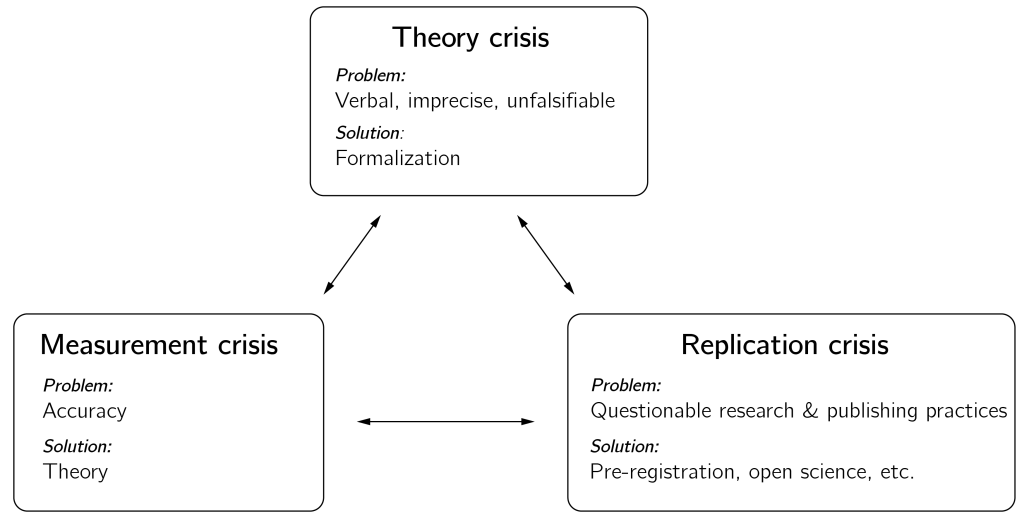
Applying these techniques requires a great deal of mathematical and technical knowledge, as well as deep understanding of the nature of the system. You don’t just create a mathematical model off the top of your head. In addition, testing such models requires extensive and reliable quantitative data. Applying complex-systems theory to the behavioral and social sciences is therefore not straightforward. Theories are often verbal, and quantitative measurement in these sciences is a longstanding issue. While there has been some reasonable progress over the past 150 years, it is fair to say that the behavioral and social sciences are less mature than the “hard” sciences.
Despite these challenges, applying complex-systems theory to the behavioral sciences is imperative. Whether we consider humans in isolation, the billions of interacting neurons in the brain, or the social networks in which we find ourselves, complexity is everywhere. We, with our complex brains embedded in various hierarchies of social systems, are the ultimate complex systems.
I believe that we can only succeed in exploring the psychological system by understanding its complexity. We need to apply the tools of complexity science to psychology, which is in desperate need of breakthroughs. After all, the modern world revolves around human beings who, through language and thought, have created an unimaginably complex world. The greatest danger now are humans ourselves, and progress in the field of psychology is necessary and urgent.

 Surtil :