
“Narrative as active inference: an integrative account of cognitive and social functions in adaptation“:
While the ubiquity and importance of narratives for human adaptation is widely recognized, there is no integrative framework for understanding the roles of narrative in human adaptation.
Research has identified several cognitive and social functions of narratives that are conducive to well-being and adaptation as well as to coordinated social practices and enculturation.
In this paper, we characterize the cognitive and social functions of narratives in terms of active inference, to support the claim that one of the main adaptive functions of narrative is to generate more useful (i.e., accurate, parsimonious) predictions for the individual, as well as to coordinate group action (over multiple timescales) through shared predictions about collective behavior.
Active inference is a theory that depicts the fundamental tendency of living organisms to adapt by proactively inferring the causes of their sensations (including their own actions).
We review narrative research on identity, event segmentation, episodic memory, future projections, storytelling practices, enculturation, and master narratives. We show how this research dovetails with the active inference framework and propose an account of the cognitive and social functions of narrative that emphasizes that narratives are for the future—even when they are focused on recollecting or recounting the past.
Understanding narratives as cognitive and cultural tools for mutual prediction in social contexts can guide research on narrative in adaptive behavior and psychopathology, based on a parsimonious mechanistic model of some of the basic adaptive functions of narrative.
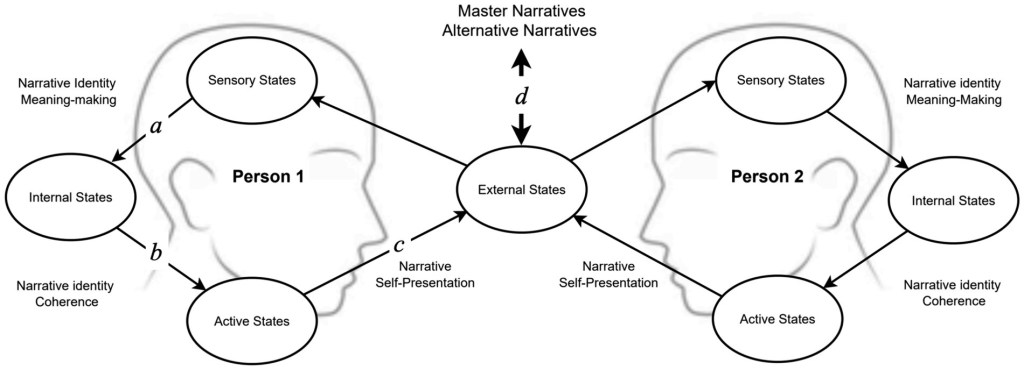
(a) Narratives are involved in the explanation and interpretation of unexpected or surprising events, updating schemas so that these new events can be predicted in the future;
(b) Narratives are used to foster consistency among specific event predictions to yield a coherent narrative identity and plan coherent action. The coherent narrative identity enables the person to generate actions that are consistent with each other;
(c) Narrative self-presentation refers to how individuals present themselves to others through the narratives they construct about their own lives. This involves the ways that people tell stories about themselves, their experiences, beliefs, values, and identity, to the external world;
(d) the actions of each person change the structure of the external world and thereby contribute to the formation of social practices and deontic cues, which may constitute a form of master narrative or provide alternative narrative templates.
A framework for understanding some of the key functions of narratives, leveraging the active inference framework to clarify the cognitive and social utility of personal and event narratives.
The contributions of our model to the literature include
(1) an integration of the cognitive and social functions of narrative,
(2) a shift towards understanding narrative as basically for predicting the future, and
(3) the potential to adapt a widely used computational toolkit for modelling narrative functions.
Despite its wide explanatory reach, this model is not meant to be an all-encompassing account of narrativity and the many roles narrative plays in human cognition and social interaction. In the course of human cultural coevolution, our narrative capacities have been put to many novel uses, each of which has its own scope and limits. In particular, our active inference model of narrativity does not aim to explain completely why narratives are so central to art and entertainment. The function of literary or cinematic fiction may be to help us get better at simulating human experience by widening and enriching the repertoire of models that are available to us to predict the future.
The key role of affect and emotion in these activities may reflect their role in organizing and justifying behavior in social interactions. However, many of the aesthetic features that contribute to the appeal of narratives may be independent from their power to predict real world events. Our model also does not aim to explain why some individuals with psychological or neurological disorders may have difficulty using narrative to accurately predict their futures—though it provides a framework that could be used to develop a typology of narrative pathologies.
 Surtil :