
“A framework for developing team science expertise using a reflective-reflexive design method (R2DM)“
Effective integration and implementation of knowledge in research are dependent on team science expertise grounded in collaboration principles and techniques that advance individual and group scientific agendas.
The Science of Team Science provides evidence-based research and best practices that strive to develop scientists’ collaborative skills so that they can work across disciplinary boundaries while developing strong and diverse teaming relationships.
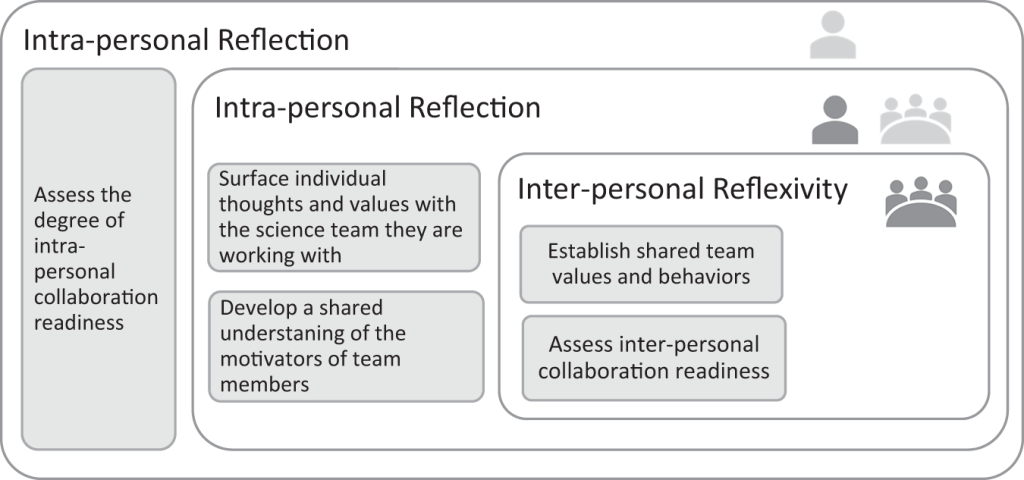
Intrapersonal reflection is represented in two types. Firstly, in the form of collaboration readiness. Secondly, in the form of intrapersonal reflection in the context of teaming. Lastly, interpersonal reflexivity which is when individuals participate in the establishment of shared values and behaviors and assess their own inter-personal collaboration readiness.
Identifying the motivations of those involved in collaborative teaming can contribute to maximizing team effectiveness and applying the knowledge emerging from understanding these to shape teams’ adaptation of a shared mutual learning mindset as a core tenet of scientific teamwork. In addition, surfacing motivations has the potential of helping team members examine their own needs in relation to their scientific and career goals.
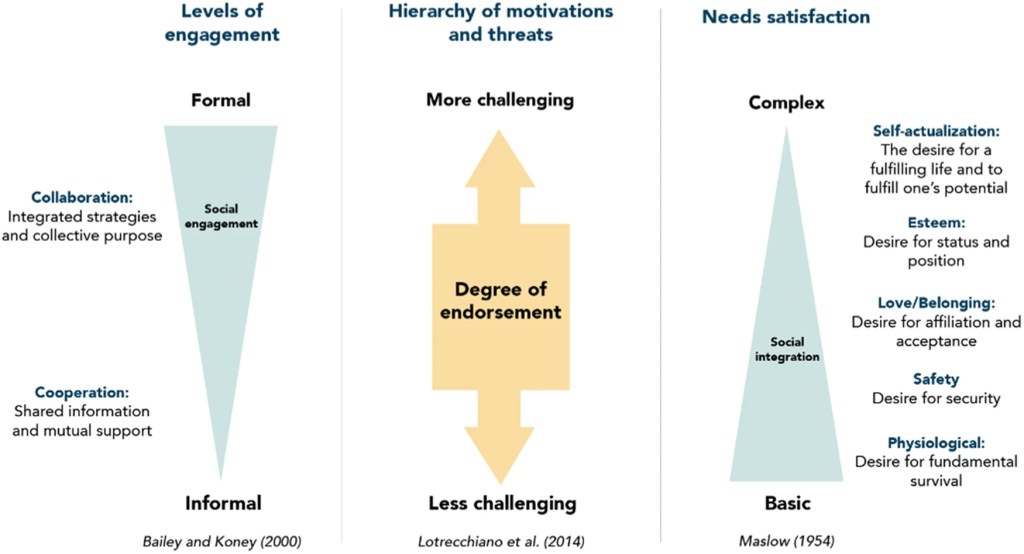
The cooperative and collaborative scales represent less to more social engagement between teaming members. Less engagement is representative as informal while more engagement represents more formal processes. Informal engagement motivations are less challenging to endorse while more formal ones are more challenging. The social integration necessary for informal less-challenging motivations to be satisfied are more basic requiring less social engagement, while more challenging formal motivations require more social engagement because of their complexity
In this paper we draw from the domains of the MATRICx framework, Maslow’s Hierarchy of Needs motivational theory, and TEMS to develop a Reflective-Reflexive Design Method (R2DM) that focuses on the development of intra-personal attributes within the context of a team.
Approaching expertise development from this design method invites individual reflection in the context of group reflexivity to serve as the cornerstone of deep team science expertise.
We used a design thinking approach to identify a framework that merges individual reflection with group reflexivity. The core questions we asked are:
(i) What constitutes expertise to succeed in science teams? and
(ii) How might we approach the design of learning engagements that enable the development of the needed expertise?
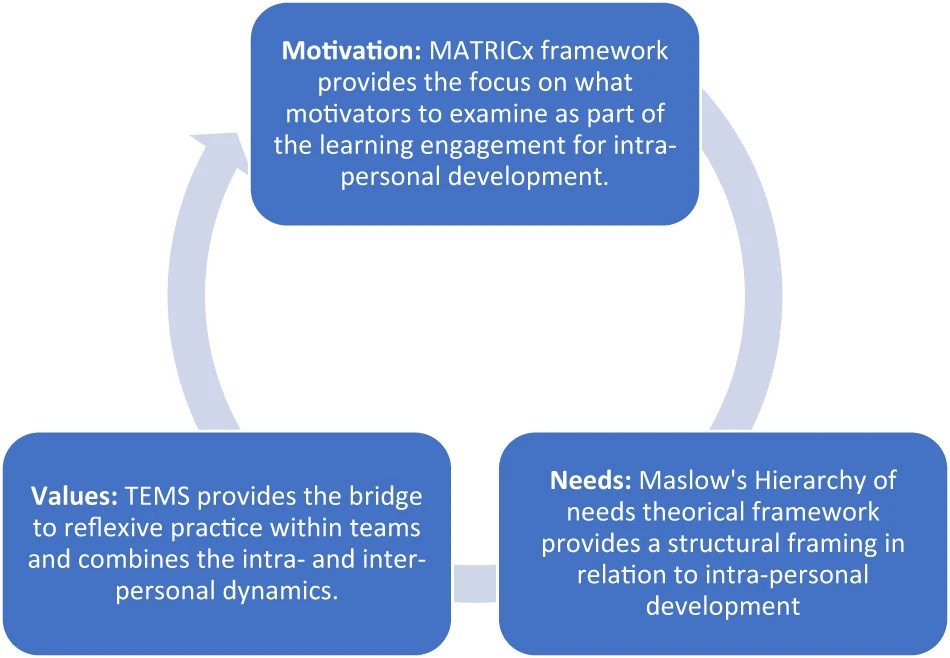
Motivation (measured thought MATRICx) provides the focus on what motivators are important top learning engagement and personal development. In turn these can be mapped along a perceived satisfaction of needs (Maslow) that serves as a structural framing for intrapersonal growth and development. This allows participations in teams to enter reflexive practice with others on the team and combine intra- and inter-personal dynamics into the construction of values and mental modes within a team.
The need for effective teaming, attention to the team dynamics, and understanding the role of mindset in team effectiveness has brought forth several competency-based training efforts that seek to instill evidence-based expertise in the efforts of science teams.
As important as collaboration skills are, they alone are not enough. Self-reflection and the development of shared norms (e.g. collaboration plans), determining how well the team is functioning now and in the future (e.g. assessments), building skills to have difficult conversations, or providing structure for roles and responsibilities only scratch the surface of what is needed because they alone cannot lead to desired changes in attitudes, skills, or competencies that are sustained over time.
While competence, abilities, and skills are observable traits in the performance of individuals in teams, there is another layer of awareness and expertise that needs to be uncovered. This layer includes the motivations and mindset needed to be experts in doing team science. This is because it is mindset that drives behavior and that in turn drives the results of the team. Desired behaviors can only be sustained over time if they align with a mindset that supports them.
Desired behaviors can only be sustained over time if they align with a mindset that supports them.
Developing a mindset congruent with achieving excellent collaborative results (performance, working relationships, individual well-being, etc.) requires purposeful decision-making on the part of the team along with a deep recognition that these results cannot be achieved without a keen connection to individual satisfaction of needs for those who choose to participate and are placed into teams. Individual goals and needs must be incorporated alongside and integrated into team level goals setting and team development.
Teams benefit when each member develops a strong self-understanding and when a shared understanding is prioritized among team members. This way the team develops its culture purposefully instead of leaving it to chance.
[…] team development is a purposeful evolution from a group of individuals to an interdependent team. This purposeful work is at the core of what team expertise is— the individual awareness, group recognition and process, bridged by mutual mindsets that emphasize and value social learning.
Thus reflective-reflexive-action can serve as a key factor in developing and sharing team science expertise.
In closing, we describe the R2DM model that relies on theoretical and applied frameworks to make visible individual needs in relation to team science goals. Motivation is a factor that cannot be overlooked when forming and sustaining teams. In addition, we recognize that motivations are fluid and change with time as individuals travel through their lives and encounter new personal and professional opportunities.
 Surtil :