
Existing research has explored how walking can stimulate creativity through the rhythm of footsteps.
Innovators (e.g., Steve Jobs and Murakami Haruki)
have mentioned that walking can stimulate their creativity when integrated with attention focus and footstep awareness
Researchers have also studied the positive effects of various sounds on creativity and creative thinking. However, the effects and potential benefits on creativity of the combination of footsteps and sounds remain unexplored. The FSI framework (Footstep and Sound Interactions) encompasses three modes – Footstep-driven Sound Stimulation (FSS), Sound-driven Footstep Regulation (SFR), and Random Footstep and Sound Interactions (RFSI). NSW indicates No Sound while Walking.
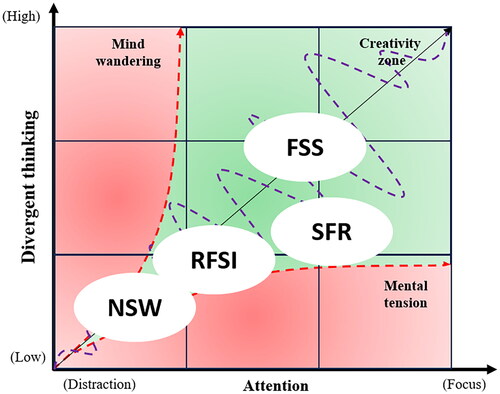
A user study in indoor and outdoor environments compares the effects of three FSI modes with a walking only condition. Results indicate that:
(1) The FSS mode demonstrated higher performance in body awareness and attention regulation in both indoor and outdoor environments;
(2) the creativity scores of indoor participants were higher than those of outdoor participants;
(3) The indoor FSS mode produced greater creativity compared to the indoor RFSI mode;
(4) Participants in the indoor FSS mode showed a significant correlation between heart rate and cadence with creativity compared to other groups; etc. Based on the findings, we discuss the FSI framework, the effects of FSI related to attention and creativity in the context of the walking experience, and we also discuss design implications and future work for the investigation and development of interactive (Footstep and Sound) technologies aimed at enhancing creativity while walking.
 Surtil :