
“Why kids need to take more risks: science reveals the benefits of wild, free play”
Studies reveal how risky play can benefit child development. But encouraging it can be a challenge for parents.
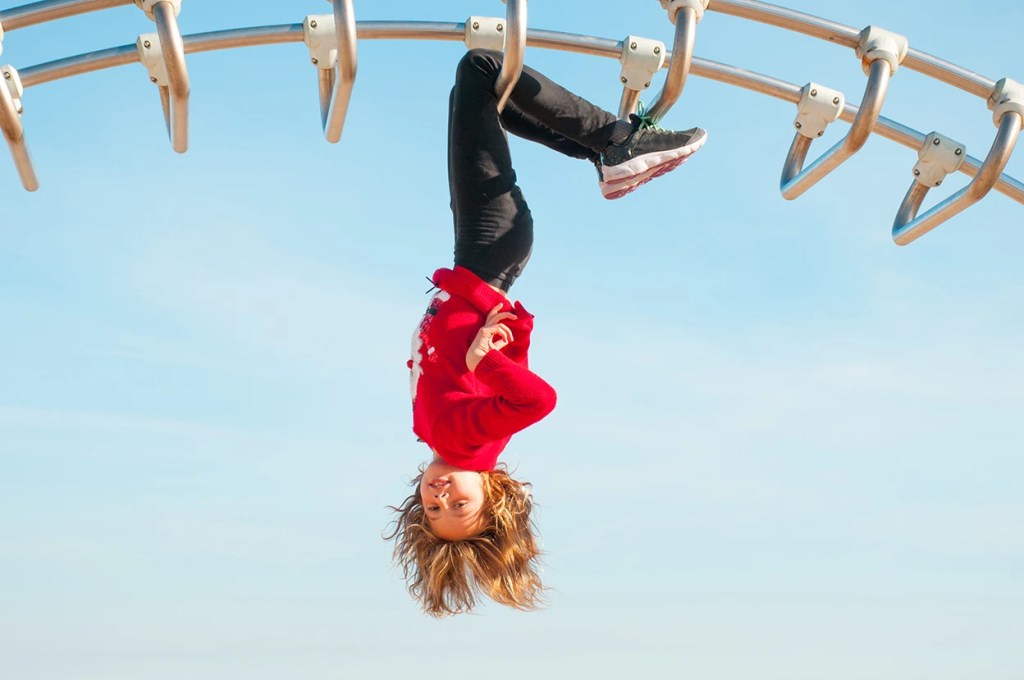
Over the past two decades, research has emerged showing that opportunities for risky play are crucial for healthy physical, mental and emotional development. Children need these opportunities to develop spatial awareness, coordination, tolerance of uncertainty and confidence.
Risky play is now more restricted than ever, thanks to misconceptions about risk and a general undervaluing of its benefits. Research shows that children know more about their own abilities than adults might think, and some environments designed for risky play point the way forwards. Many researchers think that there’s more to learn about the benefits, but because play is inherently free-form, it has been logistically difficult to study.
“… the benefits [of risky play] are so broad in terms of social, physical, mental development and mental health, I don’t think we can underestimate the value.”
Pamela Fuselli,
president of Parachute,
an injury-prevention non-profit organization
The goal of promoting risky play isn’t to turn cautious children into thrill-seekers, it’s simply to allow them to take incremental risks at whatever pace they choose, say proponents. “What risky play looks like for one child will be totally different to what it looks like for another.”
“All children need to be able to stretch their own limits, and all children want that.”
Ellen Sandseter
Queen Maud University College of Early Childhood Education
Trondheim, Norway
Risky play is associated with greater resilience, self-confidence, problem-solving and social skills such as cooperation, negotiation and empathy.
When a study in Leuven, Belgium, gave four- and six-year-olds just two hours a week of opportunities for risky play over the course of three months, their risk-assessment skills improved compared with those of children in a control group. In this study, the risky play took place at school, in a gym class and in the classroom.
“Children should be as safe as necessary, not as safe as possible.”
Mariana Brussoni (the University of British Columbia in Vancouver, Canada) thinks a lot about how to practically apply her research as well, and remove barriers to risky play. She has developed online training tools to help parents and educators to understand the benefits.
 Surtil :