
“Intuitive insight: Fast associative processes drive sound creative thinking”
- We tested intuitive vs. deliberate responding using a two-response paradigm.
- Correct creative answers often emerged intuitively under load and time pressure.
- Intuitive solutions rely on fast associative processes in semantic memory.
- Intuition may play a greater role in creativity than previously assumed.
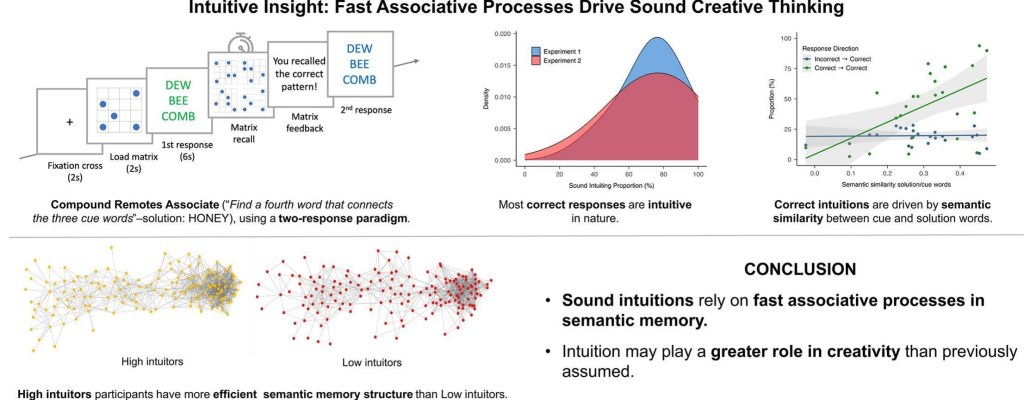
Convergent thinking, the ability to find a single optimal solution to a well-defined problem, is considered a core component of creativity, and is often assumed to rely on controlled, deliberative processes.
We tested this assumption using the Compound Remote Associates (CRA) test, where participants have to find a word that connects three seemingly unrelated words (e.g., “river, note, account”; solution: “bank”).
We implemented a two-response paradigm wherein participants provided an initial, intuitive response (under cognitive load and time constraints to minimize deliberation), followed by a final, deliberate response.
Our findings reveal that, in most cases, extended deliberation was not necessary for sound thinking—correct final responses were typically preceded by accurate intuitive responses produced under time pressure and cognitive load.
By using large language models and semantic network modeling, we found that items with a smaller semantic search space are better solved intuitively, and that participants with a more efficient and flexible semantic memory structure display higher intuitive performance on the CRA.
These results suggest that effective problem-solving in creative tasks may often rely on fast, automatic associative processes within semantic memory, without necessarily requiring extended deliberation.
To conclude, the present paper shows that convergent thinking does not necessarily require extended deliberation: under strong time and resource constraints, correct solutions can emerge through associative processes supported by semantic memory.
 Surtil :