
“Active information sampling in health and disease”
Active information gathering is a fundamental cognitive process that enables organisms to navigate uncertainty and make adaptive decisions. This review has synthesised current knowledge on the behavioural, neural, and computational mechanisms underlying information sampling across health and disease. Several key themes have emerged from this analysis.
Firstly, information gathering behaviour varies across clinical conditions, with some disorders associated with under-sampling (e.g. schizophrenia, addiction) and others with over-sampling (e.g. obsessive-compulsive disorder). This highlights the potential of information sampling paradigms as transdiagnostic markers of psychopathology.
Secondly, multiple neurotransmitter systems modulate information gathering, including norepinephrine, dopamine, and serotonin. These systems appear to influence different aspects of the sampling process, such as urgency, reward valuation, and cost perception.
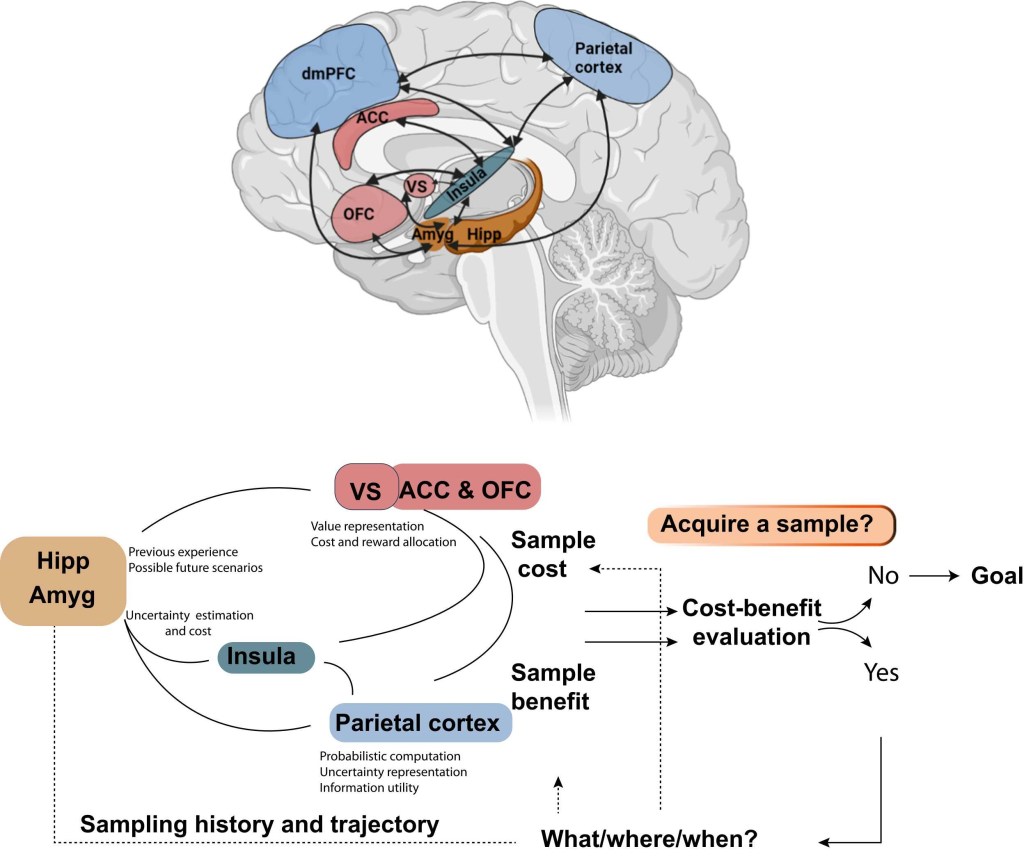
Active information gathering engages a distributed network of brain regions involved in valuation, decision-making, learning, and uncertainty monitoring. The process requires neuroeconomic computations that weigh the potential benefits of acquiring additional information against the costs of continued sampling, in order to determine an optimal stopping point and maximise expected value. Estimating the benefit of further sampling entails evaluating environmental uncertainty and simulating possible information trajectories. These computations have been linked to limbic regions such as the amygdala and hippocampus, and to the insula, which is thought to encode interoceptive signals and uncertainty-related salience. These areas interact with the parietal cortex, implicated in tracking the instrumental value of information and guiding attention toward informative cues. The dorsomedial prefrontal cortex (dmPFC) plays a central integrative role, supporting prospective inference and cognitive control over exploratory decisions. It is implicated in estimating control demand, predicting future decision difficulty, and balancing competing goals under uncertainty. Reward-related regions,including the ventral striatum (VS), orbitofrontal cortex (OFC), and anterior cingulate cortex (ACC), contribute to estimating sampling costs (e.g., effort, time, opportunity cost) and integrating these with expected informational value to guide action selection. Together, these interconnected regions form a circuit that supports adaptive information sampling under uncertainty.
Abbreviations: Hipp, Hippocampus; Amyg, Amygdala; VS, Ventral Striatum; ACC, Anterior Cingulate Cortex; OFC, Orbitofrontal Cortex; dmPFC, Dorsomedial Prefrontal Cortex.
A distributed network of brain regions supports information gathering, including limbic areas (hippocampus, amygdala), insula, fronto-striatal circuits, and parietal cortex. These regions contribute to uncertainty estimation, value computation, and decision-making under uncertainty.
Computational approaches have provided valuable insights into the cognitive processes underlying information gathering, framing it as a cost-benefit optimisation problem.
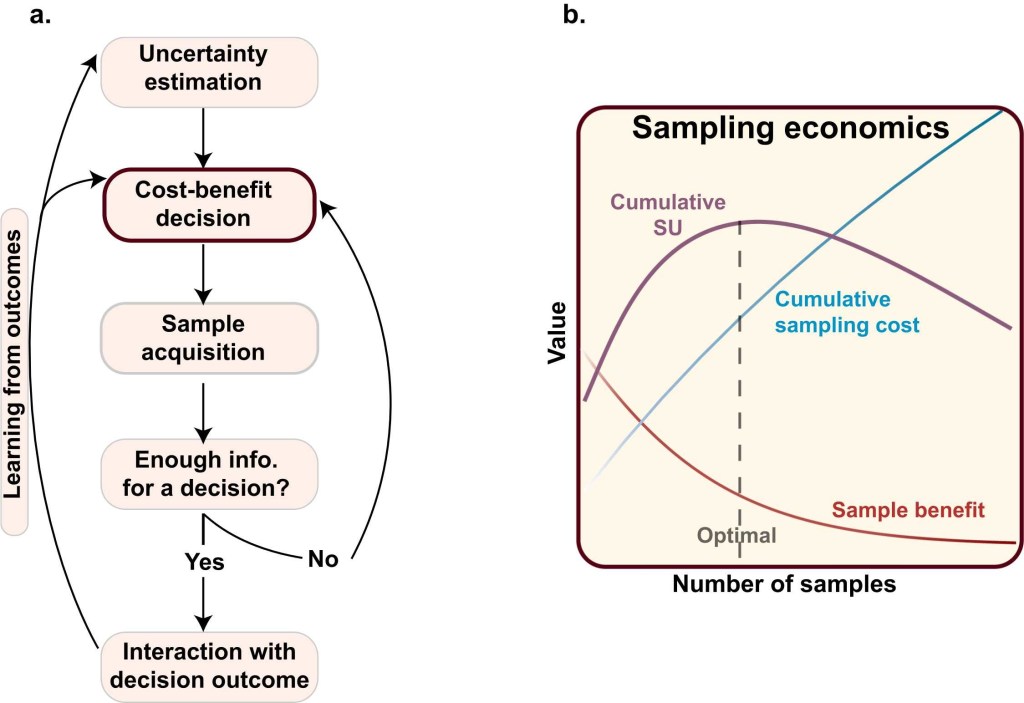
a Behavioural components of active information gathering. At each step, as agents acquire information, they estimate the uncertainty within their environment while making a goal-directed decision. To determine whether obtaining an additional sample is worthwhile, agents conduct a cost-benefit analysis, weighing the cost of acquiring new information against its expected benefit—specifically, how much the new information is likely to improve their decision and lead to a better outcome. If the benefit of sampling outweighs its cost, the agent proceeds to acquire the sample. This process continues iteratively until the cost of obtaining further samples exceeds their expected benefit. At this point, the agent stops sampling and makes a final decision, leading to an outcome. The agent then interacts with this outcome, consuming the expected reward, comparing it with prior expectations, and using this feedback to refine future decision-making.
b This trade-off between information gain and sampling cost dictates an optimal stopping point, where the subjective utility (SU) of the decision is maximised. The inset illustrates the evolution of SU across successive samples, highlighting the diminishing benefit of additional information alongside increasing cumulative costs. The optimal number of samples is marked at the peak of cumulative SU, where uncertainty reduction is maximally balanced against the cost of further sampling.
This framework allows for more precise quantification of the mechanisms that may be disrupted in clinical populations. The hippocampus has emerged as a key region of interest, with recent evidence suggesting it plays a crucial role in decision-making under uncertainty and information sampling behaviour. This expands our understanding of hippocampal function beyond its traditional roles in memory and spatial cognition.
Building on the findings synthesised in this review, several promising avenues for future research emerge. Longitudinal studies are needed to determine whether aberrant information gathering behaviours precede the onset of clinical symptoms, potentially serving as early markers of vulnerability to psychiatric disorders. Such studies could help elucidate the causal relationships between information sampling deficits and the development of various psychopathologies. Further development and application of computational models to clinical populations may help elucidate the specific cognitive processes disrupted in different disorders, potentially informing more targeted interventions. These models could be refined to incorporate additional factors such as metacognitive processes and the influence of prior beliefs, providing a more nuanced understanding of information gathering deficits across various conditions.
A comprehensive examination of how information gathering behaviour evolves across the lifespan, from early childhood to older adulthood, could provide valuable insights into both typical and atypical cognitive development.
This developmental perspective may shed light on critical periods for the emergence of adaptive information sampling strategies and potential windows for intervention in clinical populations. Future studies should aim to combine behavioural, computational, neuroimaging, and pharmacological approaches to develop a more comprehensive understanding of the mechanisms underlying information gathering. This multi-modal approach could help clarify the specific contributions of different neurotransmitter systems and brain regions to various aspects of the sampling process, such as uncertainty estimation, cost-benefit evaluation, and decision threshold setting.
Development of more naturalistic information sampling paradigms that better reflect real-world decision-making scenarios could enhance the clinical relevance and applicability of findings. This could involve the use of virtual reality environments or ecological momentary assessment techniques to capture information gathering processes in daily life. Finally, further exploration of how personality traits, cognitive abilities, and environmental factors influence information gathering strategies could provide insights into why some individuals are more vulnerable to maladaptive decision-making patterns. This line of research could inform personalised approaches to both assessment and intervention in clinical populations.
By pursuing these research directions, we can deepen our understanding of how humans and other animals navigate uncertainty through active sampling of their environment. This knowledge has broad implications for cognitive science, neuroscience, and clinical practice, potentially informing the development of novel diagnostic tools and therapeutic approaches for a range of psychiatric and neurological conditions.
 Surtil :