
“Narcissism Is Associated With Blunted Error-Related Brain Activity”
Narcissism is associated with self-enhancement and social antagonism, yet its neural underpinnings, particularly in error processing, remain underexplored. Competing theoretical models, such as the mask model and the metacognitive model, offer conflicting hypotheses regarding how narcissism influences early neural responses to errors. We examine whether grandiose agentic narcissism relates to an elevated or blunted error-related negativity, a neural marker of cognitive control and performance monitoring.
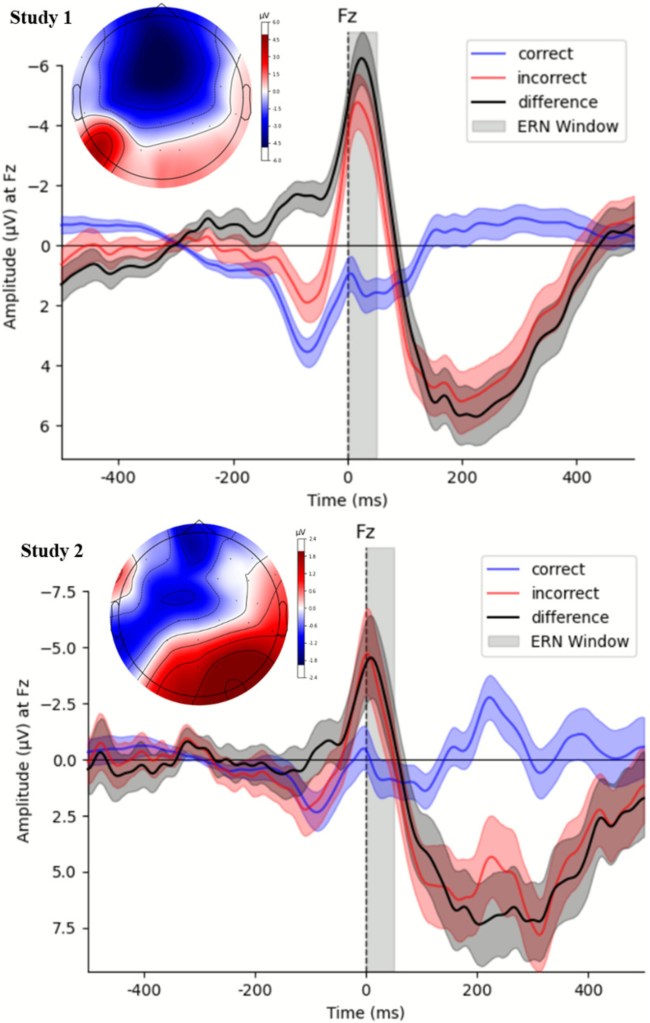
Higher admiration and rivalry narcissism were associated with a blunted (less negative) error-related negativity. These associations held when controlling for the number of errors and were confirmed by an internal meta-analysis, which showed moderate effect sizes across analytic approaches.
The results are consistent with the metacognitive model of narcissism, showing that grandiose narcissists exhibit reduced neural sensitivity to errors. These findings highlight a potential mechanism through which narcissists resist self-corrective learning, bolstering their positive self-views. Blunted error processing may influence decision-making
and behavior across contexts.
This research lays the groundwork for a more precise neuroscientific account of narcissism and raises promising questions. Is narcissism conducive to changes in neural processes? Do neural processes scaffold the development and maintenance of narcissism? Do attenuated error or feedback processing underlie the intra-and interpersonal consequences of narcissists’ self-regulation strategies? Addressing these questions may deepen understanding and inform efforts to reduce the interpersonal
and societal costs of narcissism.
 Surtil :