
“From Noise to Music: Reframing the Role of Context in Clinical Reasoning”
Traditional perspectives on clinical reasoning (CR) have framed it as a content-specific process in which differences in the information stored in a clinician’s mind account for differences in CR performance.
The finding that individual clinicians perform differently on cases with the same clinical content but varying situational features or contextual factors suggested that context plays an important role in CR.
These studies advanced the idea of CR as not only “content-specific,” but also “context-specific.”
Studies on diagnostic errors have identified how contextual factors can disrupt clinicians’ reasoning, and subsequent work has primarily focused on contextual factors that may compromise accurate CR.
Context-specificity argues that effective CR relies on both how information is stored in a clinician’s mind and their ability to perceive (e.g., recognize the problem at hand), retrieve, and apply that information in practice. Individuals experience problems with applying what they learned in one setting (e.g., an inpatient ward) to another context (e.g., primary care clinic).
This so-called transfer problem may, in part, be due to the fact knowledge use in a specific situation relies on retrieval cues, many of which are likely to be connected to the context. Because of context’s integral role in CR, attending to clinicians’ familiarity and dexterity with the contexts in which they reason offers the potential to advance their abilities beyond what is possible by developing content knowledge alone.
Despite their potential to improve CR, to date, empiric research and application of theory has viewed contextual factors (e.g., emotion, cognitive load, and biases), as noise that interferes with perception, retrieval, and application of knowledge.
Rooted in the information-processing (IP) paradigm, this perspective centers an individual’s stored knowledge (i.e., “the world in the mind”) and places less emphasis on the dynamic interactions between individuals and the environment (i.e., “the mind in the world”). Positioning contextual factors solely as detractors from cognition makes it difficult to move beyond viewing context as a burden to be mitigated in CR.
In this paper, we aim to reframe contextual factors as not solely challenges to be mitigated but also opportunities to be leveraged in CR.
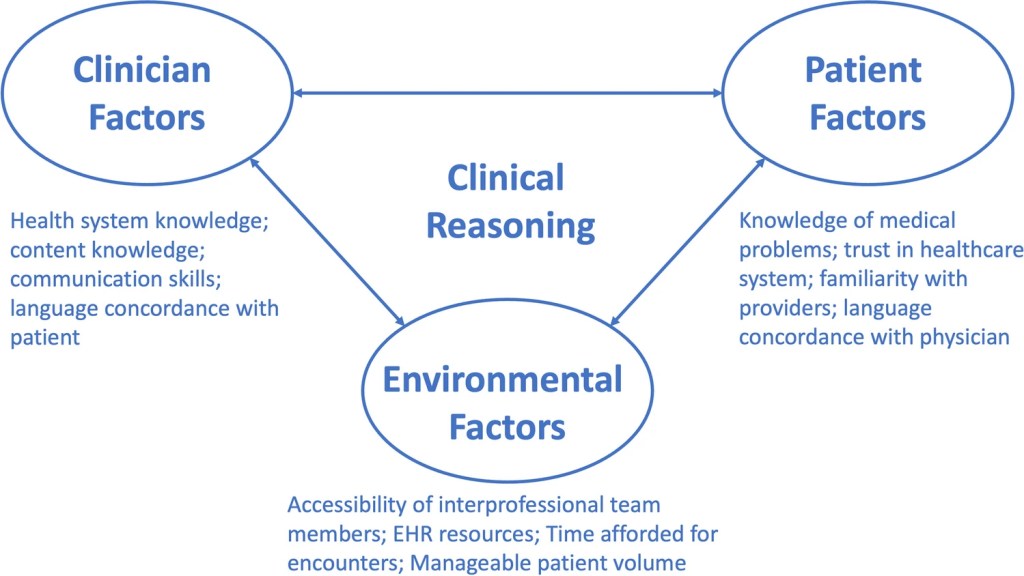
SitCog argues that cognitive processes, such as CR, emerge from the dynamic interplay between individuals, the environment, and the interactions that unfold between them. This interdependence between cognition and context creates a bidirectional relationship: context shapes the content of a case and cognition, which goes on to further shape the context, which then influences the subsequent content and cognition.
Ecological Psychology
EcoPsych offers another perspective for examining how an individual can identify and engage with contextual factors that enable wise action. These contextual elements, which EcoPsych calls affordances, include anything that may support an individual’s ability to act. One way to conceptualize an affordance is the “-able” quality of an item; a chest x-ray is “interpretable,” and a pocket of ascites may be “tappable.” However, not all chest x-rays will be accurately read and not all pockets of ascites will be successfully tapped. For this to happen, an individual must also possess the ability to act on the affordance (e.g., interpret the chest x-ray or perform a paracentesis), which EcoPsych terms an effectivity. Effectivities represent one’s ability to perform a certain action in a certain context. Thus, there is an interdependence between affordances and effectivities—certain affordances are only available to individuals with specific effectivities, and certain effectivities are only relevant in environments with the necessary affordances. From the perspective of EcoPsych, successful CR emerges not only from the information stored in a clinician’s mind, but also from the alignment between their effectivities and the environment’s affordances.
We have used two theories of cognition—SitCog and EcoPsych—to demonstrate contextual factors’ potential to elevate CR education and practice.
Together, these two perspectives help us see how CR is directly intertwined with the context in which it occurs.
Interactions between patients, providers, and the health system; the presence or absence of certain opportunities and resources in the clinical environment (i.e., affordances); and the ways an individual can act on those opportunities (i.e., effectivities) all influence CR.
When applied to CR practice and education, optimizing the context in which reasoning occurs and cultivating new ways for trainees and practitioners to engage with that context hold the potential to help clinicians transform noise into music.
 Surtil :