
“Embodied decision making in athletes and other animals”
Humans and other animals continuously make embodied decisions about ongoing or pending courses of action. Examples of embodied decisions include a hunting lioness’s decision of which gazelle to chase and a soccer player’s decision of which teammate to pass the ball to.
The study of embodied decisions has recently gained tractions across several fields, including cognitive psychology, neuroscience, and sports science. Here, we summarize key insights from these studies and highlight that they imply a shift of perspective from viewing decision-making as a central cognitive process largely separated from perception and action dynamics to a more integrative perspective that recognizes its embodied and situated nature. We discuss how embodied decisions can be effectively conceptualized in terms of the parallel specification and selection between available (and future) affordances, i.e., as an “affordance competition” process.
We discuss studies addressing various aspects of embodied decisions, which include the selection between courses of action, the involvement of motor processes in perceptual and cognitive tasks, motivational factors and the decision of how vigorously and urgently to act.
Furthermore, we highlight current controversies in the field and open directions for future work – and their implications for the advancement of our understanding of the mind and the behavior of athletes.
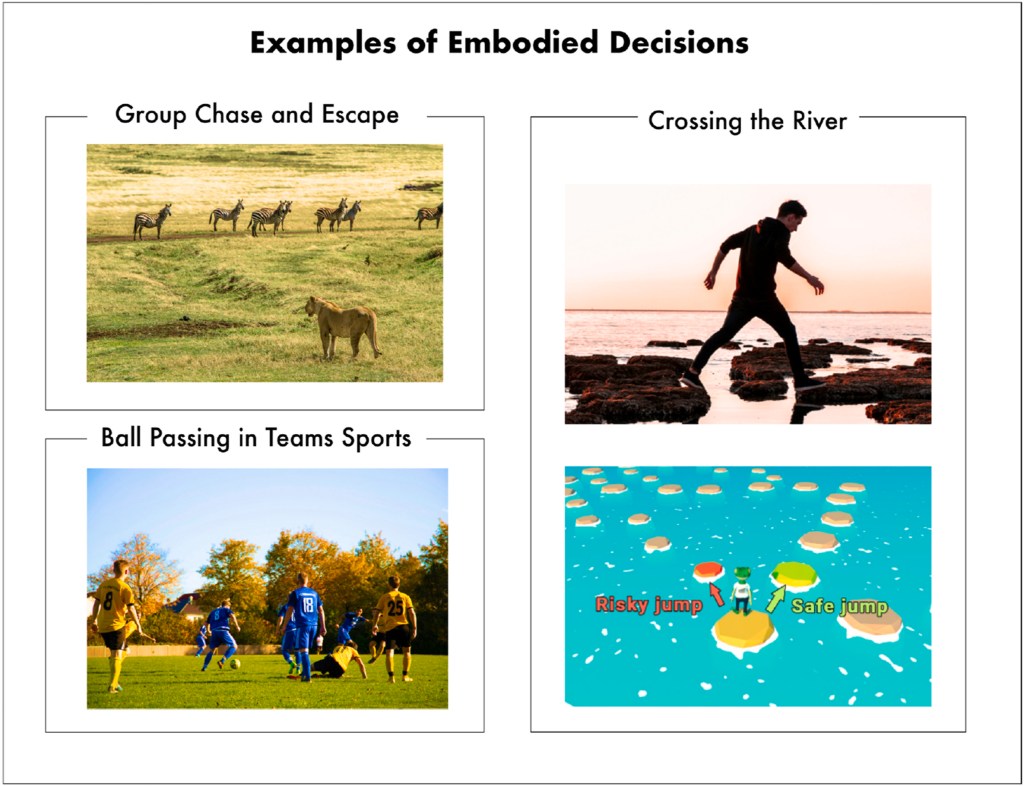
Four examples of embodied decisions, in ecologically valid contexts and virtual reality setups.
(1) A lioness chasing prey. Here, the choice is amongst which zebra to chase, in a dynamical environment in which the relative distances between lioness and the escaping zebras and the reachability of each zebra – change continuously and other factors are at play (e.g., small preys are weaker and easier to attack). Studies in the field of statistical physics provide models of the dynamics of this form of multiagent interactions and may inspire concomitant decisions models.
(2) A soccer player deciding to which teammate to pass the ball. Here, the choice is between multiple types of actions (e.g., passing or shooting on goal from distance) and between multiple alternatives within each type of action (e.g., the type of passage and the player to pass the ball to). Furthermore, the decision includes a mixture of cooperative and competitive elements. One study addressing this type of decision is.
(3) A man having to cross a river by jumping on the available stones. Here, the choice is about which of the reachable stones to approach in order to optimize the longer-term plan of reaching the other side of the river (upper panel). A recent study addressed this embodied planning task with a videogame-like experiment
Embodied decisions are at the forefront of multidisciplinary investigations across psychology, neuroscience, sports science and other fields. In this article, we summarized our current understanding of embodied decisions from both theoretical and empirical perspectives.
Many aspects of embodied decisions remain incompletely known. We conclude by highlighting five open research directions which we believe are particularly important to advance our understanding of embodied decisions.
The first open research direction regards addressing sequential embodied decisions and planning. Most current work in psychology and neuroscience focuses on the choice between currently available affordances, but cognition regards also the choice between actions and affordances that are not yet present – to achieve distal goals. There are at the moment only few studies addressing these settings in rodents, monkeys, and humans. Studying sequential embodied decisions requires considering that living organisms can act with the purpose to create novel affordances (or destroy existing affordances), as in the example of a boxer who moves towards the opponent, in order to create the opportunity to hit her with a jab. The ‘hierarchical affordance competition’ hypothesis suggests that at the neural level, predictive mechanisms might allow extending the neural architecture for affordance competition to also consider how to create and exploit future affordances. This would suggest that during sequential embodied choices, the brain might be able to specify and select amongst future affordances and their values. However, this hypothesis remains to be tested empirically.
The second research direction regards studying embodied decisions in a larger set of ecologically valid scenarios. Embodied decisions are relevant for a very large number of scenarios that remain unaddressed. Sports are the ideal setup where to advance our understanding of embodied decisions. In sports, perceptual, cognitive, and motor processes must perforce unfold in the highly integrated manner that real-world behavior demands, very much unlike the artificial situations used in laboratory studies. Confronting that integration in data from sports thus keeps theorists from proposing mechanisms that simply would not be able to handle the natural world and could not have evolved within it. Other useful setups might include large scale navigation in real world settings such as cities, dealing with architectural affordances, or shopping in supermarkets. Facing the significant methodological challenges required to addressing these and other real-world scenarios is a key direction for future research in embodied decision-making.
The third research direction consists in studying embodied decisions in small and large teams. Team sports provide an excellent platform to address this challenge. As summarized in this article, the number of studies addressing cognitive and decision aspects of team sports is growing, but in many cases the focus is on the decision processes of single individuals within a group, not on group decisions. In psychology and neuroscience, there is a long tradition of studying joint action and dyadic interaction in situated settings, both in humans and monkeys. However, few studies focus on sensorimotor aspects of joint decision dynamics. Future studies will need to address whether and how the computational and neural mechanisms that support individualistic embodied decisions also support joint embodied decisions.
The fourth research direction consists in further consolidating and advancing computational models of embodied choices. Most computational models of decision-making in psychology and neuroscience have been designed to address static settings used in (neuro)economics and the importance of (inter)action dynamics is typically ignored or minimized in these models. A few embodied choice models have been advanced that highlight parallel decision and action processes, active sensing, and the feedback from action to decision dynamics. However, these models cannot yet cover the full complexity of embodied decisions as discussed in this article; for example, they tend to ignore motivational aspects. More advanced models need to be realized and validated empirically. Research in this field might benefit from a cross-fertilization with recent advancements in embodied AI and robotics, which address embodied choices for technological reasons.
The final research direction regards using embodied decisions to assess individual cognitive strategies. The capability to make adaptive embodied decisions is important for every person, but might be even more crucial for athletes. It is increasingly recognized that cognitive skills are as important as physical skills in elite athletes and developing robust methodologies that assess their cognitive skills by analyzing the ways they address embodied decisions as opposed to only using standard psychological experiments is an important objective for both theoretical and practical perspectives.
 Surtil :