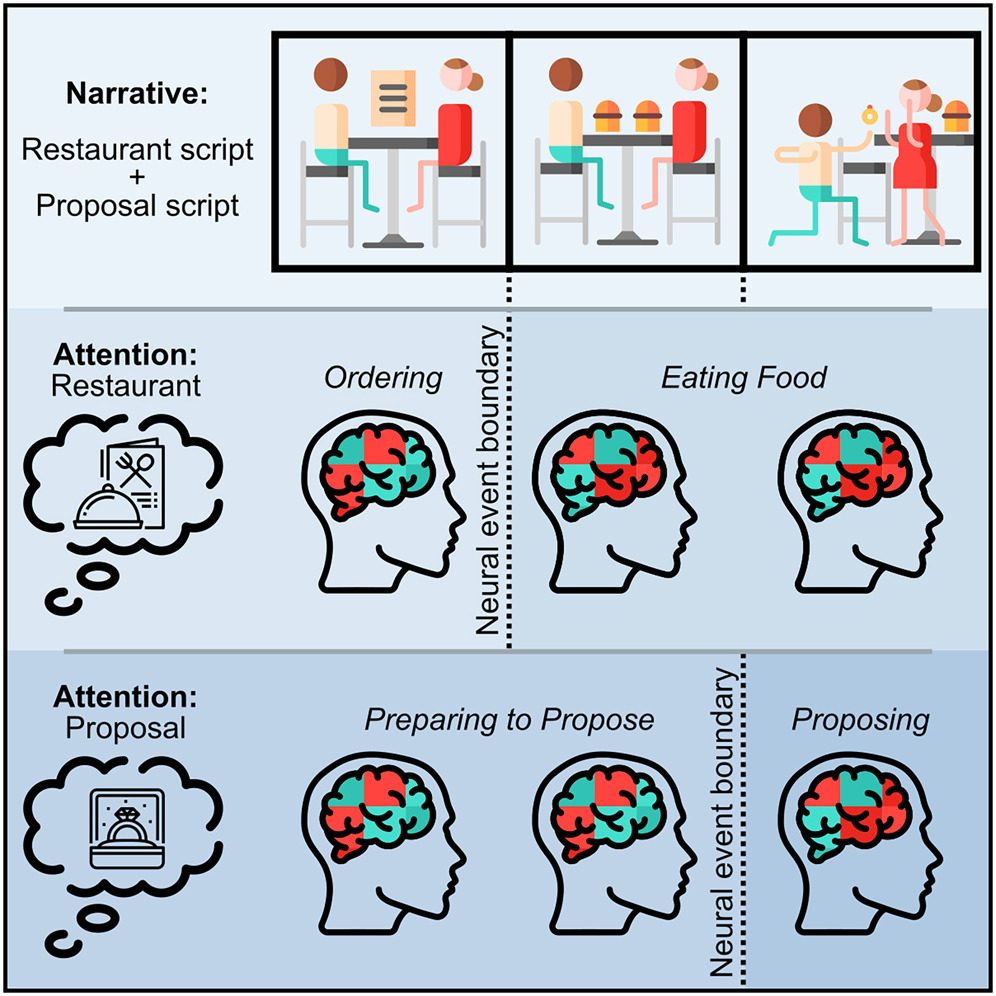
• Default mode regions represent schematic event scripts during narrative perception
• Attending to an event script impacts behavioral event segmentation and memory
• Neural dynamics in the mPFC reflect the event structure of an attended script
Understanding and remembering the complex experiences of everyday life relies critically on prior schematic knowledge about how events in our world unfold over time.
How does the brain construct event representations from a library of schematic scripts, and how does activating a specific script impact the way that events are segmented in time? We developed a novel set of 16 audio narratives, each of which combines one of four location-relevant event scripts (restaurant, airport, grocery store, and lecture hall) with one of four socially relevant event scripts (breakup, proposal, business deal, and meet cute), and presented them to participants in an fMRI study and a separate online study.
Responses in the angular gyrus, parahippocampal gyrus, and subregions of the medial prefrontal cortex (mPFC) were driven by scripts related to both location and social information, showing that these regions can track schematic sequences from multiple domains. For some stories, participants were primed to attend to one of the two scripts by training them to listen for and remember specific script-relevant episodic details.
Activating a location-related event script shifted the timing of subjective event boundaries to align with script-relevant changes in the narratives, and this behavioral shift was mirrored in the timing of neural responses, with mPFC event boundaries (identified using a hidden Markov model) aligning to location-relevant rather than socially relevant boundaries when participants were location primed.
Our findings demonstrate that neural event dynamics are actively modulated by top-down goals and provide new insight into how narrative event representations are constructed through the activation of temporally structured prior knowledge.
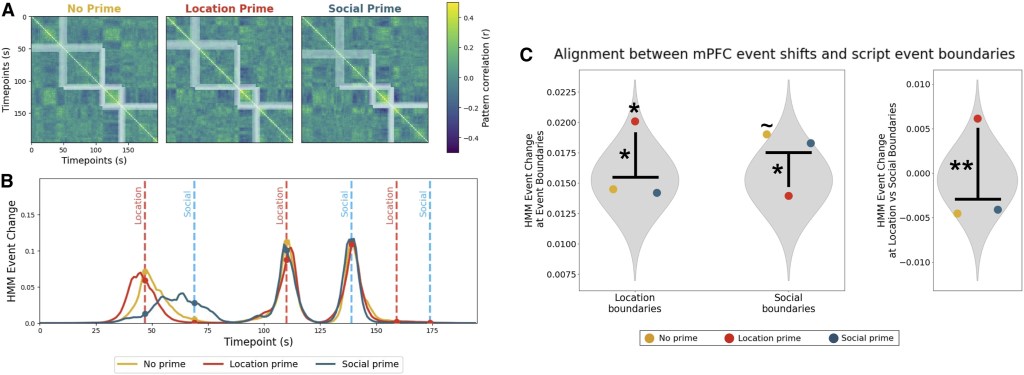
(A) The matrix for each priming group shows the correlation between mPFC voxel patterns for all pairs of time points in an example story. Blocks of high values along the diagonal indicate periods when activity patterns are remaining relatively stable over time. The HMM (hidden Markov model) event segmentation model identifies moments of rapid event change (shown in white) between these stable events.
(B) We can measure the alignment between event change in the brain and the location-script and social-script boundaries by computing the HMM event change at each boundary (dots). In this example story, we see that all groups have neural shifts that are well-aligned with boundaries in the story, but that social priming shifts the first neural boundary from a location-script boundary to a social-script boundary.
(C) Across all stories, we find that location-primed participants are significantly aligned to location boundaries, and that location priming causes a significant increase in alignment to location boundaries and a significant decrease in alignment to social boundaries. Combining data from both kinds of boundaries, we find that location priming drives a significant overall effect in shifting alignment from social boundaries to location boundaries. Null distributions for each analysis are shown in gray.
Event boundaries are often thought of as inherent features of a stimulus and therefore predictable from the stimulus content alone. For example, events are described as arising from “contextual stability in perceptual features,” “the spatiotemporal characteristics of the environment,” or “how fast various aspects of information from the environment tend to evolve.” Although the dynamics of the external environment are certainly a primary input to the event segmentation process, our findings instead favor a view of event boundaries as actively constructed in the mind and dependent on the prior knowledge and current goals of an individual. Rather than simply inheriting the temporal dynamics of the environment, event segmentation is a cognitive process that optimizes the organization of continuous experience into the most relevant units. Individual differences in the segmentation process can have impacts on how much we remember, the order of our memories, and the contents of our memories.
Our findings shed new light on how event representations are constructed in the DMN from a broad set of prior knowledge and how the activation of a schema for an event sequence can impact neural responses, perceived event boundaries, and subsequent memory for details. Our unique stimulus set allowed us to investigate how overlapping scripts can interact to support narrative perception and how attention can restructure the temporal dynamics of mental representations. These results identify mechanisms by which past experiences, distilled into schematic event scripts, change the way that we construct our present perceptions for realistic experiences.

