
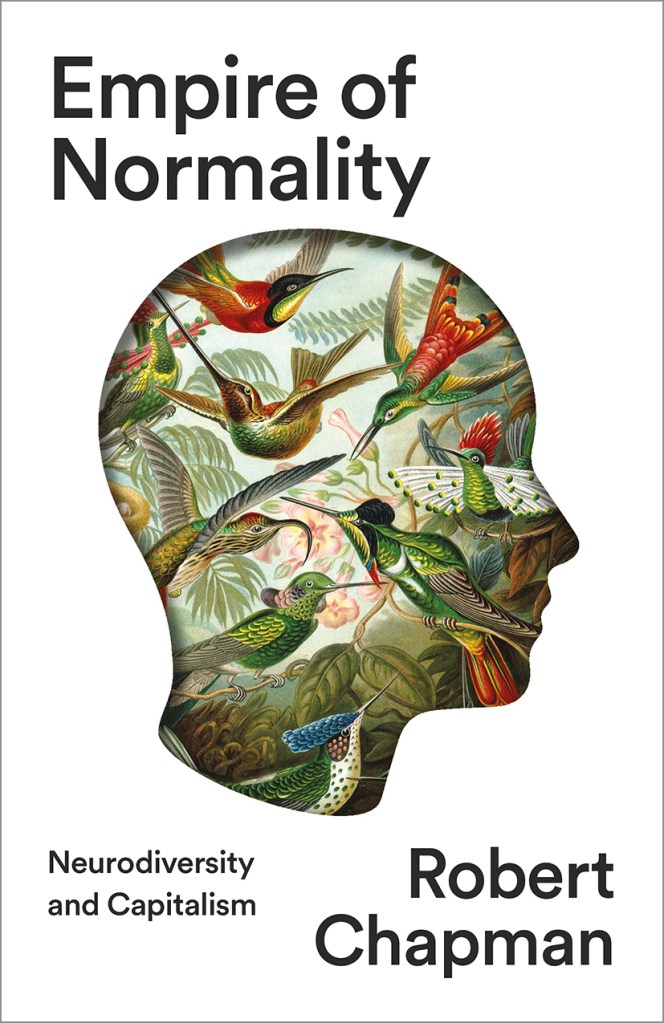
“Empire of Normality Neurodiversity and Capitalism” by Robert Chapman
(Following is an extract from Purkis, J. (2024, augustus 1). Empire of Normality: Neurodiversity and Capitalism by Robert Chapman. The Sociological Review Magazine.)
Chapman has penned an important contribution to understanding the genealogy of the ideas that sustain these western capitalist constructs of who is mentally worthy to participate in society.
They present a chilling reminder of how academic research has been complicit in some of the most shameful episodes in political and intellectual history over the past century.
Neurodiversity is the broadly recognised idea that there are many types of minds. The concept has received a huge increase in awareness over the past decade. Funding and resources for educational support are extensive; pharmaceutical shares are soaring; everyone has an opinion, a blog or a comedy show about being neurodivergent. Yet, for all this public visibility, the direction of social policy travel is far less certain, reflecting how we value wellbeing in a wider sense.
Chapman presents a chilling reminder of how academic research has been complicit in some of the most shameful episodes in political and intellectual history over the past century.
Chapman reminds us that governments of all political shades have scapegoated, persecuted and even annihilated swathes of their population for not adhering to what they regarded as “normal”. Those “on the spectrum” require more than piecemeal rights, they argue. We need a paradigm shift in thinking and a revolution of social provision.
The author offers an accessible Marxist analysis of how each stage of capitalist development since the Industrial Revolution has used definitions of “normality” to suit its economic and political purposes […].
It is also an activist’s documentation of the neurodiversity movement and its key individuals, such as Judy Singer, the sociologist who coined the term in 1997.
Growing up under “neuro-Thatcherism”, the individualising and monetarising of developmental differences to suit short-term political agendas, Chapman is well positioned to comment on the material factors that impact mental health. They themselves experienced homelessness, depression and a struggle to be accepted as neurodivergent. This openness helps the reader connect with Chapman’s primary aim: to challenge the dominant “pathology paradigm”, which seeks to measure individual experiences against some presumed quantifiable natural norm, regardless of social circumstances.
Anyone trying to secure an autism diagnosis will recognise this framework: one that denies diversity of experience and resorts to the language of cures, blame and medicating school children. Chapman traces these discourses back to Francis Galton, a relative of Charles Darwin and now known as the father of eugenics. Galton was one of many late 19th century scientists dedicated to establishing new categories of physical and mental normality. One troubling development was the so-called science of phrenology, which made links between the skull size and perceived intellectual capacities of each class, sex and, especially, race. Such thinking underpinned the conquering rationality of colonialism and Empire.
[….]
The most revelatory aspect of Empire of Normality: Neurodiversity and Capitalism is that, in using neurodiversity as a sociological lens, Robert Chapman helps facilitate a more intersectional and hopeful attitude towards how we practise mental health in the future.
The closing chapters suggest a need for further work on modelling neurological diversity as an ecosystem. When both planetary health and neurological differences seem vulnerable to the same economic and political forces, the need for a new paradigm could not be more urgent.
Empire of Normality: Neurodiversity and Capitalism by Robert Chapman is a work of critical history, disability studies, and political theory. Its central argument is not simply that neurodivergent people (autistic people, people with ADHD, and others) are misunderstood; rather, Chapman argues that the very idea of a “normal” mind is historically constructed and deeply connected to the development of capitalism.
Chapman’s core claim is that what modern societies call normality is neither natural nor timeless. The concept emerged alongside capitalist economic systems that increasingly evaluated people according to their productivity, efficiency, self-discipline, and capacity for wage labor. As capitalism developed, people whose minds or behaviors diverged from these norms came to be classified as abnormal, deficient, or pathological.
The “Empire of Normality” is Chapman’s name for the vast network of institutions—medicine, psychiatry, education, statistics, workplaces, and government bureaucracies—that continually produce and enforce these standards of normality.
In this view, neurodivergence is not primarily a medical problem. The problem is that society is organized around narrow definitions of acceptable cognition and behavior.
Major Themes
1. The Invention of the “Normal” Person
One of the book’s most fascinating themes is that people did not always think in terms of “normal” and “abnormal.”
Chapman traces how earlier societies often understood illness as imbalance or disharmony. The modern obsession with measuring, categorizing, and comparing people emerged alongside statistical thinking in the nineteenth century. Figures such as the Belgian statistician Adolphe Quetelet popularized the notion of the “average man,” turning averages into ideals rather than mere descriptions.
The result was a profound shift: deviation from the average increasingly came to be viewed as defect.
2. The Body and Mind as Machines
Chapman explores how modernity replaced older organic understandings of human beings with mechanistic ones. Influenced by thinkers such as René Descartes, bodies and minds came to be understood as machines whose parts should function efficiently. Once the machine metaphor dominates, dysfunction becomes a technical problem to be corrected.
This way of thinking laid foundations for modern psychiatry and the pathology model.
3. Eugenics and Scientific Hierarchies
A major historical section examines the rise of eugenics.
Chapman argues that the measurement of intelligence and cognitive ability became intertwined with projects of social control. The book shows how supposedly objective science often justified existing social hierarchies by presenting them as natural facts. Neurodivergent people, disabled people, racialized groups, and the poor were frequently classified as biologically inferior.
The discussion of eugenics is one of the darker but most illuminating parts of the book.
4. Capitalism as a Producer of Disability
Perhaps the most original theme is Chapman’s claim that capitalism does not merely disadvantage neurodivergent people—it actively produces forms of disability.
The book argues that whether a trait becomes disabling depends heavily on social organization. Under different economic arrangements, many neurodivergent traits might not be disabling at all. Disability therefore emerges partly from the mismatch between human diversity and social expectations.
5. Neoliberalism and “Mass Disablement”
Chapman pays particular attention to the shift toward neoliberal economies since the 1980s.
He argues that contemporary workplaces increasingly demand:
- Constant adaptability
- Emotional self-management
- Social performance
- Continuous attention switching
- Cognitive multitasking
These demands disproportionately disadvantage many neurodivergent people. Chapman even describes neoliberalism as a kind of “mass disabling event,” because traits that were once manageable become disabling under these intensified conditions.
6. Neurodiversity as a Political Movement
The book is not only critical; it is also constructive.
Chapman treats the neurodiversity movement as an important intellectual and political development. Instead of viewing autism, ADHD, and other neurodivergent conditions solely through a medical lens, neurodiversity understands them as forms of human variation.
However, Chapman goes further than many liberal versions of neurodiversity. He argues that recognition and inclusion alone are insufficient. Genuine liberation requires changing the economic and social structures that create exclusion in the first place.
Several episodes stand out:
The Rise of the “Average Man”
Chapman tells the story of how nineteenth-century statisticians (Gauss, Quetelet, Galois, ..) began measuring populations and calculating averages. What started as a mathematical description gradually became a moral and medical standard. Average became normal; normal became desirable.
The Eugenics Movement
The book traces how cognitive testing and classifications of mental difference became connected to eugenic programs across the Western world. This history reveals how scientific language was often used to legitimize exclusion and discrimination.
Fordist Factories and Standardization
Chapman discusses how industrial capitalism favored workers who could conform to rigid routines and standardized processes. The factory became a model for what counted as normal behavior and productivity.
The Transformation of Work Under Neoliberalism
One of the most compelling contemporary stories is how the economy shifted from factory labor to service and knowledge work. Traits that may have fit comfortably in more routine environments became liabilities in workplaces demanding endless social interaction, flexibility, and emotional labor.
The book’s deepest contribution is that it reframes neurodivergence from a purely medical issue into a historical and political question.
Whether one agrees with Chapman’s anti-capitalist conclusions or not, the book offers a powerful challenge to assumptions that categories like “normal,” “healthy,” or “functional” are self-evident. It asks readers to consider who defines those categories, whose interests they serve, and how different social arrangements might produce very different understandings of human minds.
In that sense, Empire of Normality is as much a history of modern society as it is a book about neurodiversity. It explores how ideas about minds, work, value, and human worth became intertwined—and how they might be disentangled.

